{ "@context": "https://schema.org", "@type": "Article", "headline": "AI Stylist: Your Guide to E-commerce Fashion Styling", "description": "Discover what an AI stylist is and how it helps fashion brands cut costs, boost sales, and create on-brand visuals. A practical guide for e-commerce.", "image": "https://cdn.prod.website-files.com/64f1790de36d896066aafd37/69d4b2606a4a1a5dd2354a92_ai-stylist-fashion-illustration.jpeg", "datePublished": "2026-04-07T07:29:38.486Z", "dateModified": "2026-04-07T07:29:37.102Z", "author": { "@type": "Person", "name": "Michael Pirone", "jobTitle": "Founder, PicJam & Vidico", "url": "https://www.picjam.ai/about" }, "publisher": { "@type": "Organization", "name": "PicJam", "url": "https://www.picjam.ai", "logo": { "@type": "ImageObject", "url": "https://www.picjam.ai/images/picjam-logo.png" } } }
Tutorial
Apr 7, 2026

AI Stylist: Your Guide to E-commerce Fashion Styling

Discover what an AI stylist is and how it helps fashion brands cut costs, boost sales, and create on-brand visuals. A practical guide for e-commerce.

How to start saving money

Lorem ipsum dolor sit amet, consectetur adipiscing elit lobortis arcu enim urna adipiscing praesent velit viverra sit semper lorem eu cursus vel hendrerit elementum morbi curabitur etiam nibh justo, lorem aliquet donec sed sit mi dignissim at ante massa mattis.

  1. Neque sodales ut etiam sit amet nisl purus non tellus orci ac auctor
  2. Adipiscing elit ut aliquam purus sit amet viverra suspendisse potent i
  3. Mauris commodo quis imperdiet massa tincidunt nunc pulvinar
  4. Adipiscing elit ut aliquam purus sit amet viverra suspendisse potenti

Why it is important to start saving

Vitae congue eu consequat ac felis placerat vestibulum lectus mauris ultrices cursus sit amet dictum sit amet justo donec enim diam porttitor lacus luctus accumsan tortor posuere praesent tristique magna sit amet purus gravida quis blandit turpis.

Mauris commodo quis imperdiet massa tincidunt nunc pulvinar

How much money should I save?

At risus viverra adipiscing at in tellus integer feugiat nisl pretium fusce id velit ut tortor sagittis orci a scelerisque purus semper eget at lectus urna duis convallis. porta nibh venenatis cras sed felis eget neque laoreet suspendisse interdum consectetur libero id faucibus nisl donec pretium vulputate sapien nec sagittis aliquam nunc lobortis mattis aliquam faucibus purus in.

  • Neque sodales ut etiam sit amet nisl purus non tellus orci ac auctor dolor sit amet
  • Adipiscing elit ut aliquam purus sit amet viverra suspendisse potenti
  • Mauris commodo quis imperdiet massa tincidunt nunc pulvinar
  • Adipiscing elit ut aliquam purus sit amet viverra suspendisse potenti
What percentage of my income should go to savings?

Nisi quis eleifend quam adipiscing vitae aliquet bibendum enim facilisis gravida neque. Velit euismod in pellentesque massa placerat volutpat lacus laoreet non curabitur gravida odio aenean sed adipiscing diam donec adipiscing tristique risus. amet est placerat imperdiet sed euismod nisi.

“Nisi quis eleifend quam adipiscing vitae aliquet bibendum enim facilisis gravida neque velit euismod in pellentesque massa placerat”
Do you have any comments? Share them with us on social media

Urna ut fermentum imperdiet lacus, elementum etiam maecenas libero nunc, suspendisse massa, nisl, elit curabitur feugiat in quis ut nibh enim in tristique aliquam sed vitae dui, dis adipiscing pharetra aliquam turpis turpis nibh rhoncus enim, pellentesque leo laoreet neque in sed bibendum fermentum suspendisse tempus non purus adipiscing suscipit fringilla adipiscing convallis dolor nulla fermentum facilisis ullamcorper ut vehicula tortor libero metus donec velit, tristique fermentum, dictum euismod diam scelerisque enim non pharetra tristique lectus habitant pharetra est id

By Michael Pirone, Founder of Picjam & Vidico

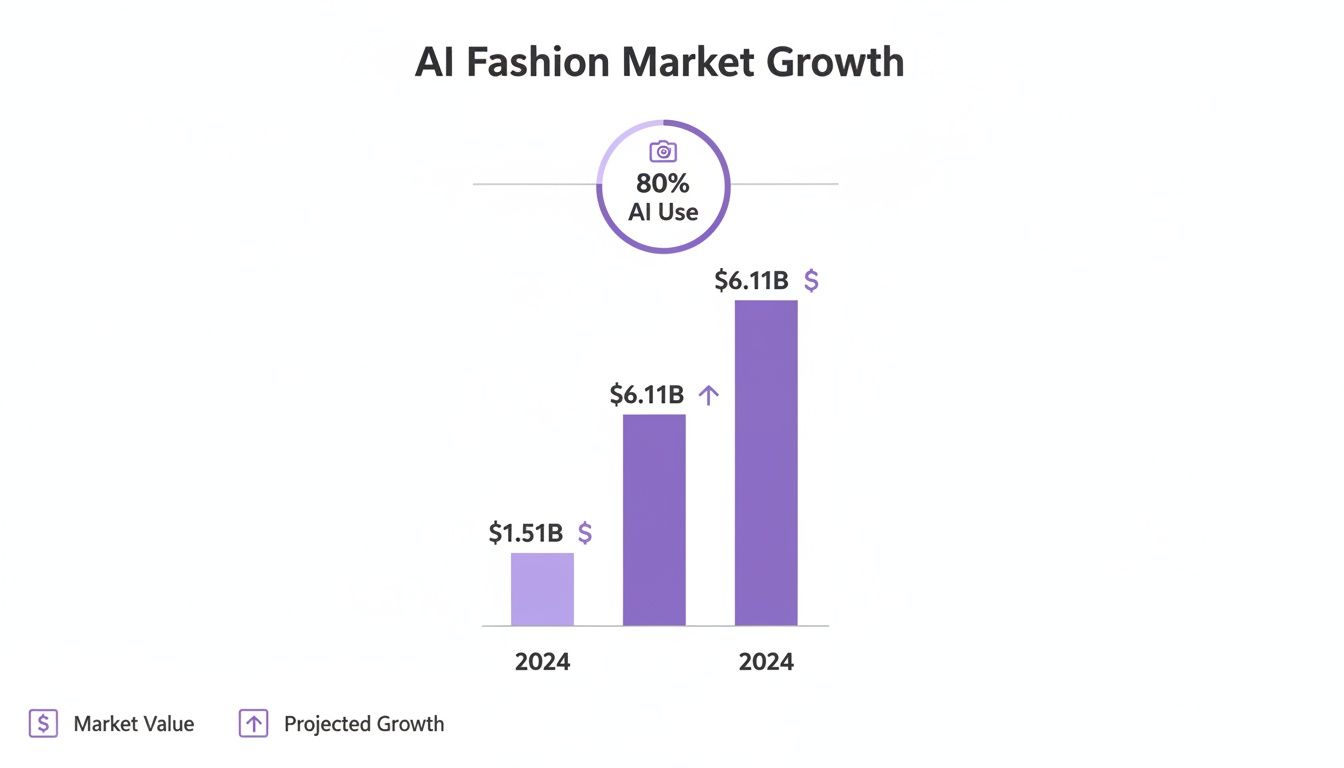
The strongest signal around the ai stylist category is not consumer hype. It is market direction. The global AI fashion market is projected to grow from $250 billion in 2024 to $1.7 trillion by 2034, with a 21% CAGR, driven heavily by AI stylists in e-commerce and personalization, according to Glance’s industry analysis.

That matters because most brands still frame an ai stylist as a shopper-facing novelty. In practice, the more valuable use case is operational. For fashion brands, an ai stylist helps teams create better merchandising, tighter visual consistency, faster campaign variants, and more useful product storytelling without building every look manually from scratch.

The brands getting value from this are not using AI to replace taste. They are using it to scale taste. That is a different brief.

What Is an AI Stylist and Why Is It Taking Over Fashion?

An ai stylist is understood as a decision engine for fashion presentation.

At the consumer level, that can mean outfit suggestions. At the brand level, it means something more commercial. It analyzes garments, context, and styling logic, then helps teams produce visuals and recommendations that feel consistent with a brand’s point of view.

For e-commerce, that changes the role of styling from a bottleneck into a system.

A traditional stylist works through references, samples, availability, deadlines, model bookings, and edit rounds. An ai stylist works from product attributes, visual patterns, category logic, trend signals, and merchandising rules. The output is not just “what goes with this jacket.” It is also “how should this jacket be presented across PDPs, campaigns, seasonal edits, audience segments, and regional storefronts.”

Why brands care

Its true appeal is not novelty. It is control.

Teams use ai stylists to help with:

  • On-brand look building for product pages and launch collections
  • Creative variation across paid social, email, marketplaces, and site banners
  • Merchandising consistency when catalog volume starts to outgrow manual review
  • Faster visual decision-making when trend windows are short

An ai stylist also helps solve a common scaling problem. Many brands can define their aesthetic clearly when they have 20 hero SKUs. That gets harder when they have hundreds of SKUs, multiple drops, regional differences, and pressure to refresh creative every week.

Practical view: The best ai stylist systems do not act like an “auto mode” for fashion. They act like a structured assistant that keeps your styling choices coherent at scale.

Why it is taking over now

Three forces are converging.

First, e-commerce teams need more assets than ever. Second, shoppers respond better to merchandising that reduces decision friction. Third, AI systems can now interpret garments in a way that is useful enough for production workflows, not just experimentation.

That is why the ai stylist conversation has moved out of the app-demo phase and into the operating model of fashion commerce.

The Core Capabilities of a B2B AI Stylist

A good B2B ai stylist behaves like a digital style bible with infinite pages.

It does not just “see” a blouse or a trouser. It maps style relationships, understands fit cues, interprets color harmony, and applies those signals across a wide volume of products. That is what makes it useful to brands, not just interesting to consumers.

A fashion designer uses a virtual holographic interface to organize digital clothing models for a collection.

It reads garments as data, not just images

One of the most credible examples comes from the way AI fashion stylists use 128-dimensional garment embeddings to capture characteristics such as fabric, cut, style, and color. In Intelistyle’s explanation of AI fashion styling, that structure helps the system represent each item with a high-dimensional signature that can support precise outfit matching.

That matters in production because a brand team is rarely asking for one answer. It is asking for many usable answers that still feel on-brand.

Here, AI also stops being a blunt automation tool. It starts to function like a ranking layer for creative choices.

It can model taste with regional and brand context

A capable ai stylist is not only matching colors. It is learning the rules behind presentation.

That includes signals like:

  • Silhouette balance across tops, bottoms, outerwear, and shoes
  • Regional styling preferences that change how looks should be assembled
  • Category context so a tailoring story does not get merchandised like athleisure
  • Brand DNA such as minimalist, romantic, technical, street-led, or occasion-led styling

In practice, this gives brands a way to create more consistent outputs across teams. A junior merchandiser, freelance creative, and marketplace coordinator can all work from the same visual logic instead of improvising from separate references.

For a broader consumer-facing angle on this space, Picjam has also written about virtual try-on workflows, though the stronger B2B value usually sits upstream in content and merchandising operations.

It supports creative precision, not just speed

The strongest systems are persuasive because they can produce combinations that feel intentional.

In the same Intelistyle source, 70% of respondents preferred AI-generated looks in a blind test at London Fashion Week against human stylists. That does not mean human stylists are obsolete. It means AI can now operate at a level where brand teams should take its output seriously.

What works: Use AI to generate a range of credible styling directions, then let a human team select and refine the final set.

What does not: Letting the tool run without guardrails and expecting it to understand your brand’s taste automatically.

It gives merchandising teams a repeatable system

For most fashion brands, the useful capability is repeatability.

A B2B ai stylist can help teams:

NeedHow the ai stylist helps
New collection launchGenerates coherent styling directions across the range
PDP enhancementSuggests pairings that help shoppers understand complete looks
Regional merchandisingAdapts outfit logic to different markets
Campaign expansionCreates multiple visual directions from the same core product story

That is where the commercial value starts. Not in a one-off AI image. In a repeatable styling layer that makes the whole catalog easier to sell.

How AI Stylists Transform Content Production Workflows

The old workflow is familiar to every apparel team. Pull the range. Brief the stylist. Book talent. Align on references. Confirm studio timing. Shoot. Review. Retouch. Resize. Distribute. Then repeat the process because one category underperformed or a launch date moved.

The problem is not that this workflow is bad. The problem is that it does not scale cleanly when creative demand multiplies.

Infographic

The traditional workflow breaks at volume

Manual styling still has a place, especially for flagship campaigns and high-concept editorial work.

But in day-to-day e-commerce, it creates pressure in four areas:

  • Scheduling friction because products, talent, and creative approvals rarely move at the same pace
  • Asset scarcity when each SKU needs more variations than the original brief allowed for
  • Inconsistent interpretation across stylists, freelancers, and channel teams
  • Slow feedback loops because every change request can trigger another round of production

This is why so many teams end up with uneven catalogs. The hero products look polished. The long tail looks rushed.

The AI-assisted workflow is more modular

An ai stylist changes the sequence.

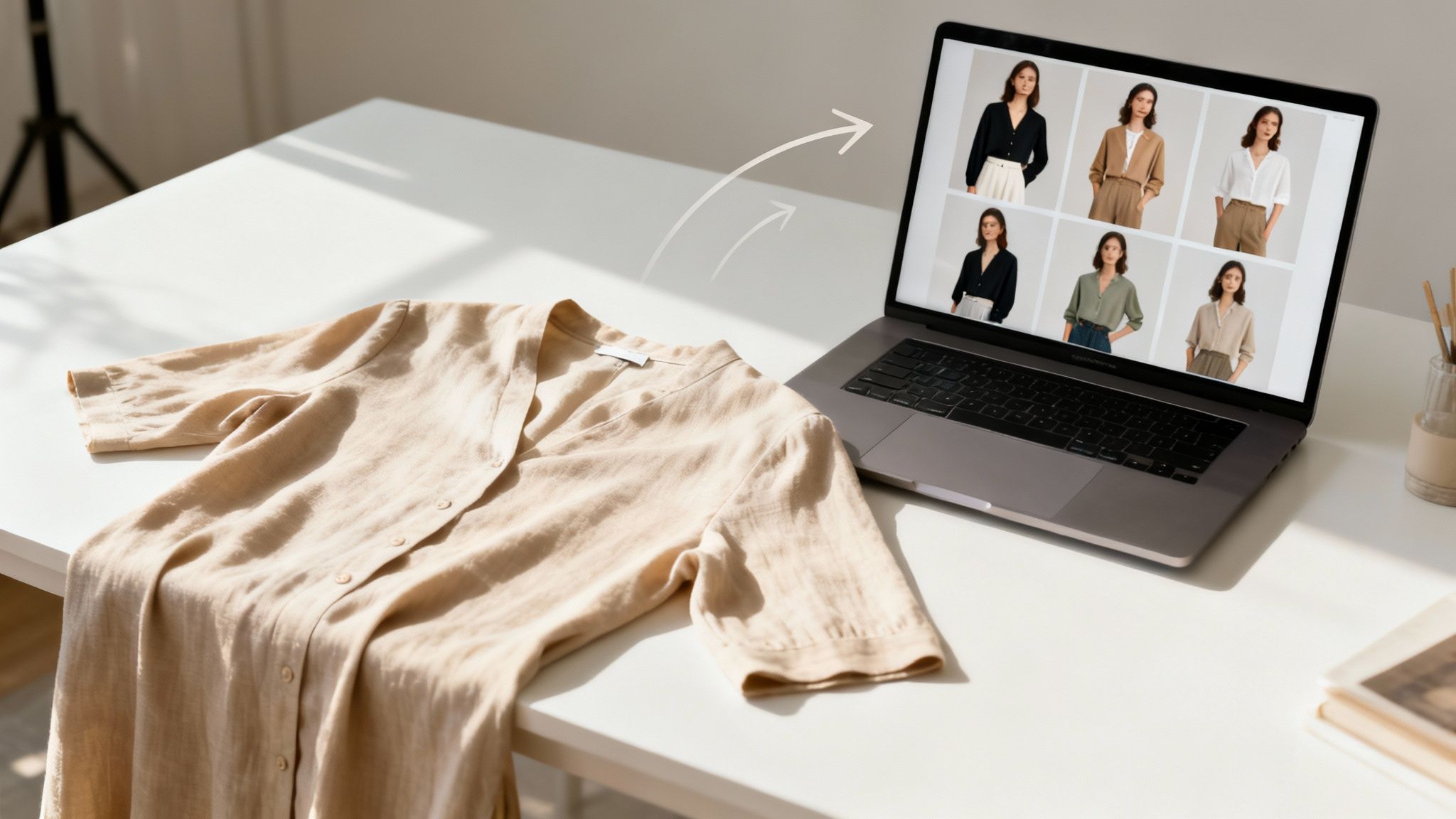
Instead of building every visual through a fully manual production chain, teams can start with existing product imagery and structured product information, then generate styled outputs that match different contexts. That could mean a cleaner cross-sell story on a PDP, a sharper social creative direction, or market-specific styling for a marketplace listing.

The important shift is operational. Styling becomes something you can test, revise, and deploy much faster.

A practical workflow often looks like this:

  1. Start with the product set
    Select the SKUs that need stronger styling support. Usually this begins with new arrivals, bestsellers, or products with weak engagement.

  2. Define visual rules
    Set the brand guardrails. Color logic, silhouette pairings, level of minimalism, category boundaries, and exclusions matter more than many teams realize.

  3. Generate controlled variations
    Build a small but useful spread of looks. Avoid flooding the team with endless options. Better curation beats option overload.

  4. Push into channels
    Use the outputs where styling has the clearest commercial job, such as PDP enhancement, campaign support, merchandising edits, and paid creative testing.

  5. Review performance and tighten
    Keep what converts, remove what confuses, and refine the ruleset.

Tip: The fastest path is not “AI everywhere.” It is one category, one campaign, or one merchandising problem with a clear success metric.

What works better than brands expect

The biggest surprise for many teams is not just speed. It is how much easier internal alignment becomes when styling rules are documented and operationalized.

An ai stylist can reduce the usual back-and-forth around questions like:

  • Does this look feel premium enough?
  • Is this outerwear story too heavy for the season?
  • Are we over-styling basics?
  • Does this visual fit the local market?

When the system is set up well, those questions move earlier in the workflow, before expensive production decisions stack up.

What still needs human control

AI is strong at structured variation. It is weaker when the brief depends on cultural nuance, emerging fashion tension, or intentionally imperfect styling.

That means human teams should still own:

  • Seasonal creative direction
  • Campaign concepting
  • Final brand approvals
  • Sensitive categories such as occasionwear, identity-led styling, or trend moments with cultural nuance

A good ai stylist setup supports those decisions. It should not flatten them.

The operational upside

For content teams, this model changes planning.

You can build a visual system where a single item is merchandised in multiple valid ways instead of waiting for one final image set to do all the work. That is especially useful when a product needs to serve different placements, from homepage tiles to product detail pages to social edits.

The result is a faster content cycle, fewer production dependencies, and a cleaner way to keep styling logic consistent across channels.

Real Brands Using AI Styling to Drive Engagement

The most useful examples are not always the loudest ones.

In practice, brands use ai stylist workflows in quiet, commercially sensible ways. They improve product storytelling, expand creative options, and test visual directions without rebuilding the whole content machine.

A diverse group of people using smartphones and a tablet to interact with an AI stylist app.

Stitch Fix shows the hybrid model

Stitch Fix is one of the clearest real-world examples of AI-assisted styling with human oversight. Its product direction has centered on combining algorithms, client data, and stylist expertise rather than pretending one replaces the other.

That model is worth watching because it reflects what works for brands. AI handles scale and pattern recognition. Humans handle judgment, reassurance, and edge cases.

Luxury and premium brands use AI differently

Premium fashion teams usually do not want AI to make them look more automated. They want it to help them look more intentional.

That often means using ai stylist logic to support:

  • cleaner visual merchandising across collections
  • more coherent outfit pairing on-site
  • stronger seasonal edits built from existing product imagery
  • controlled experimentation with audience-specific creative

A plain white tee is a good example. One team might merchandise it into a minimal, monochrome story. Another might place it inside a layered streetwear edit. Another might frame it around travel, utility, or off-duty tailoring. The garment is the same. The styling context changes the commercial meaning.

For brands exploring adjacent creative workflows, Picjam has also published a useful primer on AI fashion models.

Smaller brands often move faster

DTC labels and boutique sellers usually have fewer approval layers, so they can test ai stylist outputs more aggressively.

They tend to use the technology in 3 ways:

  • Ad testing for multiple creative directions from one hero product
  • Catalog enrichment when some SKUs lack enough supporting imagery
  • Merchandising refreshes for product pages that feel flat or repetitive

One practical example is a capsule collection with limited sample inventory. A team can still explore several styling narratives around the range, then decide which one deserves the primary push in paid and on-site placements.

This kind of workflow is easier to understand when you see it in motion:

Engagement comes from clearer visual context

The reason ai stylist content can perform well is simple. It helps shoppers picture the product in a fuller context.

That does not require theatrical output. Usually, the strongest results come from visuals that answer practical questions clearly:

  • What goes with this item?
  • What mood does it belong to?
  • Is it dressed up, pared back, or everyday?
  • Does this look relevant to me?

When brands use AI to answer those questions cleanly, engagement tends to improve because the product no longer has to do all the explanatory work on its own.

Measuring the ROI of an AI Stylist

The ai stylist conversation gets easier when it moves out of “innovation” language and into operating metrics.

Many fashion teams do not need another creative toy. They need a better return on content production and merchandising effort. That is why ROI should be measured across revenue impact, operational efficiency, and quality of customer decision-making.

A fashion professional working at a desk, looking at an AI stylist dashboard on a computer monitor.

Start with the three commercial metrics that matter most

According to Style3D’s analysis of AI stylists in fashion commerce, apparel retailers integrating AI stylists report a 35% uplift in conversion rates, a 20% decrease in product returns, and a 40% increase in average time spent per session.

Those are not vanity metrics.

They map directly to the core job of fashion merchandising:

KPIWhy it matters
Conversion rateBetter visual context helps shoppers move from browsing to buying
Return rateClearer styling and fit cues can reduce mismatch and uncertainty
Session timeStronger product storytelling keeps shoppers engaged longer

If an ai stylist is not helping one of those three areas, it is probably being used in the wrong part of the workflow.

Build the ROI case in layers

The strongest business case usually has 3 layers.

Revenue lift

Styled presentation can improve how shoppers understand an item and what to pair it with. That can increase confidence at the point of purchase, especially in categories where a garment is easier to buy once the full look is visible.

Enhanced PDP content and outfit-led merchandising tend to show the clearest value in these situations.

Cost savings

The second layer is production efficiency.

Even without assigning a fixed figure in this section, many teams can identify cost pressure in manual styling, reshoots, late creative changes, underused inventory, and duplicate editing work. An ai stylist reduces that drag when it lets the team generate more usable visual directions from existing assets.

A useful adjacent reference is Picjam’s article on AI clothing product photos, which shows how brands think about scaling image outputs from a commercial lens.

Operational speed

Speed is not just a convenience metric. It affects how fast teams can launch, test, localize, and revise.

When styling becomes easier to version, the brand gets better at responding to merchandising gaps, campaign feedback, and seasonal changes before those issues become missed revenue.

Practical rule: Measure the ai stylist where it touches live commerce. If the output never reaches PDPs, collection pages, ads, or emails, you are not measuring business impact. You are measuring internal interest.

A simple scorecard works best

Many teams overcomplicate this.

A straightforward scorecard is usually enough for the first rollout:

  • Primary metric
    Choose one. Conversion, return reduction, or engagement.

  • Operational metric
    Track production speed, approval cycles, or asset output consistency.

  • Quality metric
    Review whether the styling remains aligned with brand standards.

What not to do

Do not ask the ai stylist to prove itself across every channel at once.

A cleaner approach is to test it where styling clearly influences the customer journey. That might be tops on PDPs, coordinated sets in collection pages, or launch creative for a single drop. Once the tool proves its value there, it earns a broader role.

Practical Implementation and Ethical Considerations

There is a gap between interest and adoption in this category. According to Just Style’s reporting on virtual AI stylists, 63% of shoppers have never used a virtual AI stylist. The article highlights trust concerns around AI accuracy for diverse body types, as well as weak ROI clarity for brands.

That adoption gap matters because it exposes the main mistake brands make. They assume the technology problem is solved as soon as the output looks polished.

It is not.

Trust is part of implementation

A brand can have attractive AI-styled content and still fail if the visuals feel unreliable.

That usually happens when:

  • the styling ignores how garments sit or layer
  • the outputs drift away from the product’s real proportions
  • the presentation feels detached from the brand’s customer
  • the range of bodies, identities, or cultural references feels too narrow

Shoppers do not need to understand the model architecture. They need to believe the presentation is relevant, respectful, and useful.

Tip: If your team would not approve the output for a hero launch, do not use it as “good enough” for the rest of the catalog. Customers notice quality inconsistencies quickly.

The practical setup is less glamorous than the demo

Implementation usually works best when the first phase is small and structured.

A sensible setup includes:

  1. Clean product inputs
    The ai stylist needs reliable imagery, category labeling, and product attributes.

  2. Brand rules
    Define what your styling should and should not do. Often, projects fail at this point. The tool needs exclusions as much as inspiration.

  3. Review workflow
    Decide who approves outputs, what gets rejected, and where feedback is stored.

  4. Channel priority
    Pick one commercial surface first. PDPs, collection edits, and paid social all have different styling jobs.

  5. Performance loop
    Feed real results back into the process. Teams learn quickly when they review outputs against engagement, conversion, and customer feedback.

Ethical use is a brand decision, not just a legal one

Inclusive representation is not a side note in AI styling. It is one of the hardest tests of whether the system is useful.

A narrow training reference can produce narrow outputs. A generic prompt can strip away cultural nuance. An efficiency-first rollout can create visuals that feel polished but disconnected from real customers.

That is why ethical use needs active choices around:

  • Representation across body types, identities, and style contexts
  • Accuracy so garments are shown in ways that do not mislead
  • Disclosure when needed by channel or brand policy
  • Privacy in any system using customer data or wardrobe-based inputs

What works in practice

The best implementations usually keep a human in charge of the last mile.

AI can propose. The brand should still decide.

That balance tends to preserve two things that matter commercially: trust from the customer, and coherence across the brand’s visual identity.

The Future of AI in Fashion Styling

The next phase of the ai stylist market is less about automation for its own sake and more about better fit between brand presentation and customer identity.

That is why the most interesting frontier is inclusivity.

According to Glance’s discussion of inclusive AI in fashion, 2026 trends show AI stylists moving into gender-neutral and inclusive fashion curation, creating dynamic wardrobes based on mood, culture, and non-binary identities. The same source notes that e-commerce performance data in this area is still developing.

Inclusive styling is a business opportunity

Many brands still merchandise gender-neutral and adaptive products with blunt visual logic.

The issue is rarely product intent. It is presentation. Teams often default to category structures and styling conventions that do not reflect how people want to shop or see themselves represented.

An ai stylist can help if it is trained and guided properly. It can create more flexible outfit logic, support broader identity expression, and help brands avoid forcing every product into legacy menswear or womenswear cues.

That matters because inclusive merchandising is not only cultural positioning. It is catalog usability.

Sustainability also becomes more practical

Another long-term advantage is waste reduction.

If teams can test styling directions digitally before committing to broader production, they can reduce unnecessary sample use, avoid avoidable reshoots, and make sharper decisions earlier. That does not remove the need for physical production. It makes physical production more selective.

The brands that will benefit most

The winners are unlikely to be the brands that use AI the most aggressively.

They will be the brands that use it with the clearest point of view.

That means:

  • treating the ai stylist as a decision support layer, not a substitute for taste
  • building systems that can flex across identities and markets
  • using AI to narrow uncertainty before expensive production choices are made

Key takeaway: Efficiency got the category noticed. Inclusive, context-aware styling is what will make it strategically important.

Your Takeaway and Next Steps

If you are evaluating an ai stylist for your brand, the most useful shift is conceptual.

Do not treat it as a shopper gimmick. Treat it as a content and merchandising system that can help your team make faster, more consistent visual decisions.

3 actions worth taking now

1. Start with one business problem

Pick a narrow use case.

Good starting points include a weak PDP category, a collection that needs more complete look context, or a campaign that needs more creative variants. A focused test reveals much more than a broad rollout.

2. Define the styling rules before you generate anything

Many teams rush into prompts and outputs.

The better move is to document your visual logic first. What combinations feel right, what styling moves are off-brand, what level of polish you want, and what customer the imagery should speak to. This is what keeps an ai stylist useful instead of generic.

3. Measure commercial impact, not internal excitement

Judge the rollout by what changes in the store.

Look at conversion, engagement, return patterns, asset velocity, and approval efficiency. If the tool is not helping a real commerce surface, refine the use case before expanding it.

Takeaway

  • Reframe the ai stylist as a B2B styling and merchandising engine, not just a consumer recommendation feature.
  • Run a controlled pilot on one category or launch, then compare performance and workflow quality.
  • Protect trust by keeping human review, accurate product presentation, and inclusive representation built into the process.

The brands getting ahead here are not chasing novelty. They are building a cleaner way to create, test, and scale fashion presentation.


If you want to turn that thinking into a cost comparison, explore Picjam and use the savings calculator to compare your current production approach with an AI-assisted workflow.

About

Picjam team

The Picjam team blends AI, product, and creative expertise to eliminate the cost and delay of traditional photography for modern eCommerce brands.