
Ecommerce Photographer: A Guide for Fashion Brands
Hiring an ecommerce photographer? This guide covers the role, costs, and workflow for fashion brands, plus smart alternatives like AI to save time and money.
How to start saving money
Lorem ipsum dolor sit amet, consectetur adipiscing elit lobortis arcu enim urna adipiscing praesent velit viverra sit semper lorem eu cursus vel hendrerit elementum morbi curabitur etiam nibh justo, lorem aliquet donec sed sit mi dignissim at ante massa mattis.
- Neque sodales ut etiam sit amet nisl purus non tellus orci ac auctor
- Adipiscing elit ut aliquam purus sit amet viverra suspendisse potent i
- Mauris commodo quis imperdiet massa tincidunt nunc pulvinar
- Adipiscing elit ut aliquam purus sit amet viverra suspendisse potenti
Why it is important to start saving
Vitae congue eu consequat ac felis placerat vestibulum lectus mauris ultrices cursus sit amet dictum sit amet justo donec enim diam porttitor lacus luctus accumsan tortor posuere praesent tristique magna sit amet purus gravida quis blandit turpis.

How much money should I save?
At risus viverra adipiscing at in tellus integer feugiat nisl pretium fusce id velit ut tortor sagittis orci a scelerisque purus semper eget at lectus urna duis convallis. porta nibh venenatis cras sed felis eget neque laoreet suspendisse interdum consectetur libero id faucibus nisl donec pretium vulputate sapien nec sagittis aliquam nunc lobortis mattis aliquam faucibus purus in.
- Neque sodales ut etiam sit amet nisl purus non tellus orci ac auctor dolor sit amet
- Adipiscing elit ut aliquam purus sit amet viverra suspendisse potenti
- Mauris commodo quis imperdiet massa tincidunt nunc pulvinar
- Adipiscing elit ut aliquam purus sit amet viverra suspendisse potenti
What percentage of my income should go to savings?
Nisi quis eleifend quam adipiscing vitae aliquet bibendum enim facilisis gravida neque. Velit euismod in pellentesque massa placerat volutpat lacus laoreet non curabitur gravida odio aenean sed adipiscing diam donec adipiscing tristique risus. amet est placerat imperdiet sed euismod nisi.
“Nisi quis eleifend quam adipiscing vitae aliquet bibendum enim facilisis gravida neque velit euismod in pellentesque massa placerat”
Do you have any comments? Share them with us on social media
Urna ut fermentum imperdiet lacus, elementum etiam maecenas libero nunc, suspendisse massa, nisl, elit curabitur feugiat in quis ut nibh enim in tristique aliquam sed vitae dui, dis adipiscing pharetra aliquam turpis turpis nibh rhoncus enim, pellentesque leo laoreet neque in sed bibendum fermentum suspendisse tempus non purus adipiscing suscipit fringilla adipiscing convallis dolor nulla fermentum facilisis ullamcorper ut vehicula tortor libero metus donec velit, tristique fermentum, dictum euismod diam scelerisque enim non pharetra tristique lectus habitant pharetra est id
By Michael Pirone, Founder of Picjam & Vidico
A fashion team signs off a shoot, waits for samples to arrive back, reviews selects, and then realizes the campaign has already moved on. The problem usually is not the photographer’s talent. It is that the whole content model moves slower than the brand does.
For fashion brands, the ecommerce photographer is not just the person behind the camera. It is a strategic function that has to produce assets fast enough for launch calendars, accurate enough for product pages, and flexible enough for paid social, email, marketplaces, and creative tests.
That is where the old playbook starts to strain. Fashion brands still need craft, taste, and consistency, but they also need a workflow that does not collapse every time the assortment changes or a campaign direction shifts.
The Hidden Costs of a Picture-Perfect Fashion Shoot
A common scenario plays out like this. The collection is ready, samples are steamed, the team books talent, confirms styling, and gets through the shoot day. Then the brand reviews the finals and realizes the imagery fits last month’s brief better than this month’s campaign.
Nobody necessarily failed. The process did.
An ecommerce photographer in fashion has always sat at the intersection of creative and operational pressure. The problem is that many brands still treat the role as a one-day hire, when in practice it is a chain of dependencies that starts long before the first shutter click and continues well after delivery.
Where friction shows up
The hidden drag is usually not in the obvious places. It shows up in:
- Brief drift. A moodboard evolves after booking, but the shot list does not.
- Sample dependence. One late shipment can derail an entire calendar.
- Approval lag. Creative, ecommerce, and performance teams often want different outputs.
- Reuse limits. Images approved for PDPs do not always work for ads or email.
A lot of founders underestimate how many people need to align for a traditional shoot to work cleanly. Photographer, producer, stylist, model, makeup, retoucher, merchandiser, and brand team all need the same mental picture before the day begins.
Why this matters for growth teams
Fast-moving brands do not just need beautiful images. They need optionality.
If your best-selling dress suddenly needs fresh ad creative, waiting for another full production cycle is rarely practical. If your product page needs a more commercial crop but the original brief leaned editorial, you are stuck reworking assets that were never designed for that use.
Practical rule: judge a photography workflow by how easily it handles revisions, channel changes, and new SKUs, not just by how strong the hero image looks.
That is why more teams are scrutinizing the full production chain, not just the final gallery. Even brands still committed to traditional photography are looking more closely at how much delay and rework the process introduces. If you want a sense of how quickly those decisions compound, this breakdown on how much do a photoshoot cost is useful context.
The strategic question is simple. Who, or what, is fulfilling the ecommerce photographer function for your brand, and can that system keep up?
The Core Role of an Ecommerce Photographer in Fashion
An ecommerce photographer in fashion does far more than take product pictures. The role blends visual judgment, production management, technical control, and brand interpretation.
In a strong setup, the photographer is shaping outcomes across pre-production, shoot execution, and post-production. If any one of those breaks, the final asset library starts to feel inconsistent.
Pre-production shapes the result
Before a camera comes out, the photographer is usually pressure-testing the brief.
That means reviewing references, clarifying what the brand needs for product pages versus campaign use, and translating vague language like “clean, elevated, premium” into concrete choices around framing, lighting, crop, model direction, and fabric detail.
For fashion, this stage matters more than often anticipated. A blazer, knit dress, or pair of trousers has to communicate fit, proportion, drape, texture, and color. If the shot list does not account for those realities, the team discovers the problem too late.
The best photographers also surface operational issues early. They ask whether the garments are pinned, how color approval will happen, which assets need to be delivered first, and how the naming structure should work across a catalog.

On set, the job is consistency under pressure
Shoot day looks creative from the outside, but most of the work is about control.
The photographer has to keep lighting stable across garments, direct poses that show the product clearly, and maintain continuity from one SKU to the next. In fashion, small misses become expensive quickly. A twisted strap, collapsed collar, uneven hem, or shadow falling across texture can make a product feel cheaper than it is.
Such details are where the experienced ecommerce photographer earns their keep. They know when a pose flatters a garment but hides a key fit detail. They know when a dramatic crop works for a campaign but creates confusion on a product page. They know when to stop chasing novelty and protect consistency.
Post-production is where volume becomes real
Most brands think the work ends after the shoot. It rarely does.
Post-production is where teams sort selects, match files to SKUs, flag reshoots, handle color review, and package assets for different channels. Even when retouching is handled elsewhere, the photographer’s input often shapes what gets delivered and what is considered usable.
A fashion catalog also needs discipline after capture:
- Selection logic for hero, secondary, and detail images
- Color consistency so products do not shift from page to page
- File discipline so ecommerce and creative teams can find what they need
- Cropping standards so grids feel intentional, not chaotic
What works: a photographer who treats the brief like a production system.
What does not: a photographer who delivers attractive images that break once they hit the site, paid social, or marketplace templates.
The role is part image-maker, part operator. That is why hiring an ecommerce photographer is really a decision about workflow design, not just visual taste.
Decoding Deliverables and Technical Specifications
A good shoot can still fail at handoff. That usually happens when the brand approves the imagery visually, but the delivered files are not ready for ecommerce use.
Technical specifications matter because shoppers judge product quality through screens. If details are soft, crops are inconsistent, or the file choice is wrong for the channel, the brand loses trust before the customer reads a word of copy.
The baseline specs worth insisting on
High-quality ecommerce product photography needs 2048 x 2048 pixels for zoom functionality and detail visibility, with standard web delivery at 72 DPI, according to Tom Crowl’s ecommerce product photography guidance.
That sounds straightforward, but it creates a practical trade-off. Large, sharp files support zoom and texture detail, but they also affect load speed if teams do not optimize them properly.
JPEG, PNG, and the format decision
Most fashion brands do not need every file delivered the same way.
A simple rule:
| Use case | Best fit | Why |
|---|---|---|
| Product page images | JPEG | Better quality-to-file-size balance |
| Assets that need transparency | PNG | Useful when transparency is required |
| Internal review files | Varies | Depends on workflow and approvals |
The point is not to fetishize formats. It is to match the output to the channel.
Blurry or pixelated files immediately hurt credibility. Overweight files slow pages down. Neither problem is glamorous, but both affect sales.
What brand teams should ask for before delivery
A cleaner handoff starts with a tighter brief. Ask for:
- Final pixel dimensions by channel
- Primary file type for site delivery
- Naming convention tied to SKU or style code
- Crop expectations for grid, PDP, and ad use
- Color review process before finals are exported
Many teams only discover these needs after launch prep starts. That is backwards.
Tip: if your ecommerce manager and creative lead are not aligned on file specs before the shoot, the photographer is guessing. Guessing is where rework begins.
One overlooked issue is that performance and visual quality need to be decided together. That is especially true for apparel, where customers want to inspect seams, texture, and color before buying.
If your team is also working through channel-specific requirements, this guide to product image size for Shopify helps frame how asset decisions affect the storefront, not just the shoot folder.
A strong ecommerce photographer understands this handoff. A strong brand team documents it.
Your Hiring Checklist for an Ecommerce Photographer
Hiring an ecommerce photographer sounds simple until you do it properly. Most brands are not just hiring for style. They are hiring for reliability, category understanding, file discipline, and the ability to interpret a brief without forcing expensive corrections later.
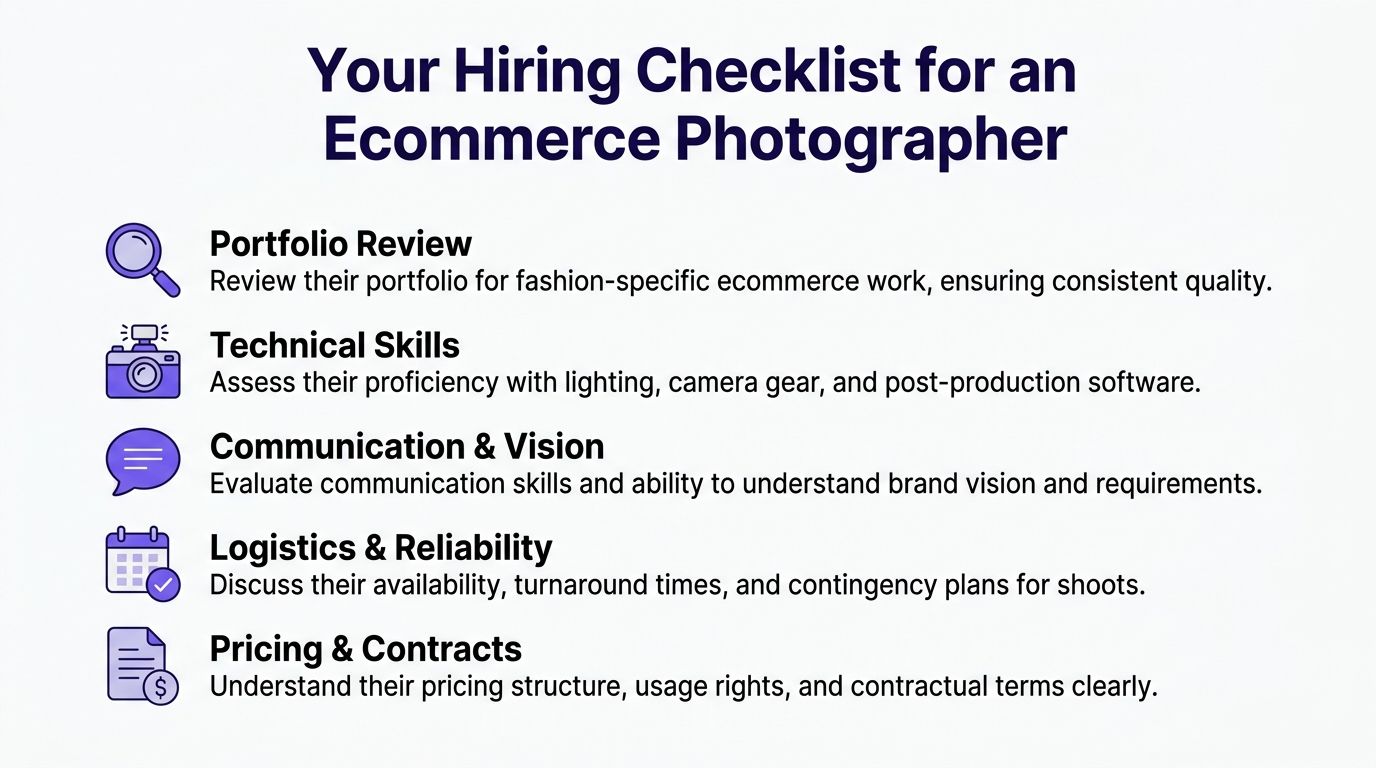
The biggest mistake is reviewing a portfolio as if you are choosing art for a wall. In fashion ecommerce, the test is whether the photographer can produce consistent assets at catalog scale.
What to evaluate before you book
Start with the portfolio, but read it operationally.
- Look for fashion relevance. Can they shoot apparel in a way that shows fit and texture clearly?
- Check consistency. One strong image means very little. You want full sets that hold together.
- Review model direction. Awkward posing can undermine a garment even when the lighting is good.
- Inspect finish quality. Wrinkles, uneven hems, odd shadows, and color shifts tell you a lot.
- Ask about workflow. A strong photographer should be able to explain pre-pro, on-set process, and delivery clearly.
A lot of early-stage brands also find talent through referrals or social platforms. If you are sourcing that way, resources like Instagram growth services designed specifically for photographers can help you understand how serious photographers build visibility and present their work professionally online.
The brief matters more than most interviews
A polished portfolio does not protect you from a vague brief.
Guidance on briefing photographers is often overlooked, and Retouching Zone notes that 30 - 50% of photoshoots require revisions due to misaligned expectations, while custom model angles can increase conversion by 20 - 25%. The operational lesson is clear. The quality of the brief often determines whether the first delivery is usable.
What should go in that brief?
Brand references
Show examples of your current imagery and where you want to push it.Channel priority
Clarify whether the first need is PDP, paid social, email, wholesale, or launch campaign.Garment-specific notes
Call out what must be visible, such as texture, hardware, sleeve shape, or fit through the waist.Non-negotiables
Include crops, styling rules, casting guardrails, and turnaround expectations.
Questions worth asking on the call
Not every useful question is technical.
Try these:
- How do you prevent inconsistencies across a large SKU count?
- What usually causes reshoots in fashion jobs?
- How do you handle changes if the brief evolves after booking?
- What do you need from us to make the first pass usable?
- How do you structure file delivery for ecommerce teams?
Practical rule: hire the photographer who asks sharp questions back. That is often a better signal than the fanciest portfolio.
The right hire can elevate your catalog. The wrong hire can still produce attractive images and leave your team fixing avoidable problems for weeks.
Mapping Traditional Workflow Timelines and Bottlenecks
Most fashion teams do not lose time on the shoot day alone. They lose it in the chain around the shoot.
A traditional ecommerce photography workflow has several points where momentum drops. Samples arrive late. Casting changes. Internal feedback loops widen. Retouching queues pile up. None of this is unusual. It is built into the model.
The workflow stretches before anyone shoots
The early phase is usually the most underestimated.
A brief gets drafted, then revised. Product selection changes because a key style is delayed. The team aligns on references, then revisits those references once paid social asks for a different crop logic or the merchandising team wants more commercial imagery.
That is still before the camera comes out.

Volume is a primary bottleneck
Professional ecommerce photographers often need 8 - 15+ distinct shots per product, and 74% of shoppers demand multi-angle visibility, according to The Line Studios. For fashion teams, that means each SKU creates repeated setup work. Repositioning, relighting, model adjustment, styling resets, review, and file handling all repeat across the catalog.
That repetition is manageable for a tight line edit. It becomes heavy fast when assortments grow.
Where traditional shoots slow down
A typical workflow often stalls in the same places:
| Stage | Common bottleneck | Why it hurts |
|---|---|---|
| Briefing | Conflicting stakeholder input | Teams want different outputs |
| Sample prep | Missing or imperfect garments | Styling and sequencing suffer |
| Shoot day | Repositioning and resets | Each variation adds friction |
| Review | Too many opinions too late | Approvals drag |
| Post-production | File organization and retouching backlog | Delivery slips into launch windows |
The hidden issue is not just elapsed time. It is the cost of dependence. A single delay upstream can force every downstream task to move with it.
Why this matters for fashion brands
Fashion content is rarely one-and-done anymore. A single SKU may need clean ecommerce imagery, campaign crops, ad creatives, email banners, marketplace variations, and seasonal refreshes.
Traditional photography can still produce excellent work. It just struggles when the business needs speed, testing, and repeatability at the same time.
Operational truth: the old model performs best when the brief is stable. It performs worst when the brand is actively learning, testing, or scaling.
That is why many teams now separate the idea of a photographer from the function of photography. The function is to create accurate, convincing visual assets at the pace the business needs. The question is whether a traditional workflow can still do that cleanly for your brand.
Why Image Quality Directly Impacts Fashion Conversions
Fashion shoppers cannot touch the fabric, test the fit, or inspect the finish in person. The image has to do that work.
That is why image quality is not a cosmetic issue. It is a conversion issue, a trust issue, and often a search visibility issue as well.
The business case is already clear
The ecommerce photography market is projected to reach up to $2.38 billion by 2034, and 75% of online shoppers rely primarily on product images for purchase decisions, while pages with high-quality photos can see up to 94% higher conversion rates and 95% more organic traffic, according to Retouching Cloud’s ecommerce photography market analysis.
For fashion specifically, that matters even more because brands frequently use multiple photo styles. The brand is not just managing one image type. It is managing a visual system.
What customers read in an image
Shoppers use fashion imagery to answer practical questions:
- How does the garment hang?
- Is the fabric matte, crisp, soft, sheer, or structured?
- Does the color look trustworthy?
- Is the fit relaxed, slim, cropped, oversized?
- Does the brand feel premium and considered?
A weak image creates hesitation. A strong image removes it.
That is why brands like Everlane and Reformation, despite having different aesthetics, both rely on visual consistency. The styling, framing, and product presentation feel intentional across the grid. That consistency makes browsing easier and products easier to compare.
High quality means clarity, not just polish
A lot of teams confuse “high quality” with “more produced.”
For product pages, quality usually means clarity first. The customer should be able to understand the garment quickly. If the lighting is dramatic but hides the knit texture, that is not helping. If the crop looks editorial but obscures length or proportion, the image may still hurt conversion.
The strongest fashion imagery usually balances 3 things:
Accuracy
The garment needs to look like the garment that arrives.Consistency
Product grids should feel cohesive from SKU to SKU.Desirability
The image should still create enough aspiration to support the brand.
A useful standard: if your image makes the item look beautiful but less understandable, it is probably doing half the job.
Why this matters beyond the PDP
High-quality visuals also compound across channels.
The same visual discipline that improves product pages tends to improve email, social, and paid creative because the brand can repurpose assets with less friction. The merchandising team gets cleaner grids. Performance teams get more usable crops. Creative teams spend less time fixing inconsistent source material.
That is part of why visual production is becoming less about isolated shoots and more about systems. The winning brands are not only producing better images. They are producing image libraries that stay useful after launch.
For fashion, that is the prevailing standard. Not whether one hero shot looks expensive, but whether the full asset set helps people buy.
Smarter Alternatives to a Traditional Photographer
Fashion brands still need the ecommerce photographer function. The difference now is that there are several ways to fulfill it.
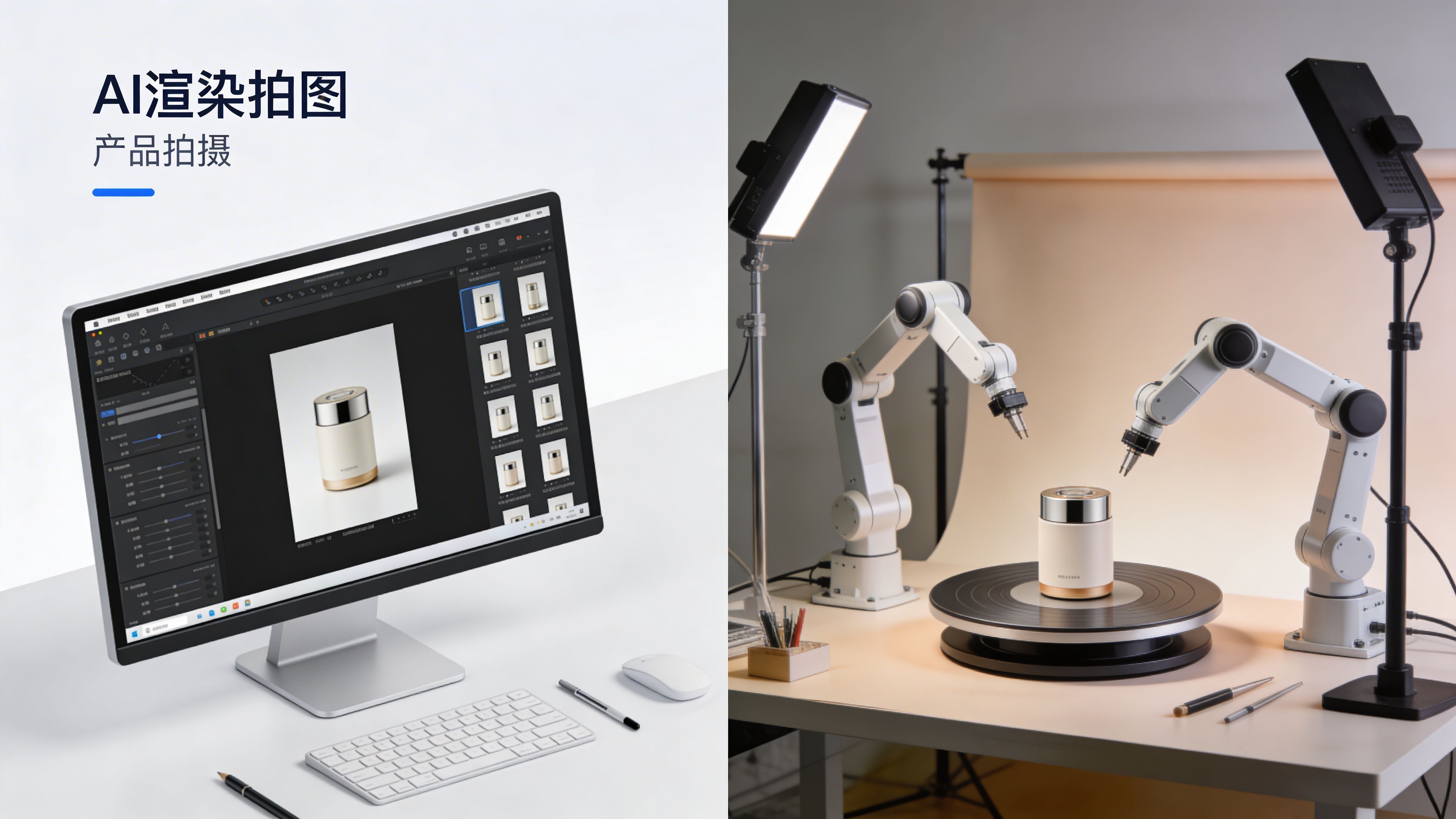
Some brands build internally. Some lean on studios. Others use software to handle the repetitive parts of production and reserve human input for brand direction, approvals, and high-level creative decisions.
Option 1 brings control with overhead
An in-house setup gives the brand close control over styling, output standards, and day-to-day priorities.
That works well when the assortment is large enough to justify constant production and when the team can maintain a repeatable visual language. The trade-off is operational weight. Internal teams still need process, equipment, management, and scheduling discipline. They can also become visually predictable if the setup never changes.
This route suits brands with steady volume and a strong internal creative lead.
Option 2 gives expertise, but flexibility can suffer
A studio partner can solve quality and production issues quickly, especially when the brand needs experienced operators and clean delivery standards.
The limits show up when the business needs rapid iteration. External partners are often strongest when the brief is settled and the production calendar is clear. They are less efficient when the team wants to test fresh concepts constantly, create extra variations after launch, or adapt assets for new channels at short notice.
For brands building out performance creative, there is also a wider ecosystem to think about. If your visual workflow feeds creator campaigns and paid social, this E-commerce Influencer Marketing Guide is a useful complement because it shows how content demand expands beyond the PDP.
Option 3 uses software to compress the slow parts
The third model is to treat content generation as a system, not a shoot.
That is where tools like Picjam fit. Rather than replacing every creative decision, the platform lets apparel brands start with simple product shots and generate additional fashion imagery and video outputs much faster than a traditional reshoot cycle. In practice, that helps teams create more variations for campaigns, social, and product merchandising without rebuilding the whole production stack each time.
A hybrid model tends to work best for most growing brands:
- use human creative direction for brand standards
- use traditional shoots when the campaign needs them. Use software for scale, variations, testing, and refresh cycles
That mix is often more useful than defending one method as the answer to everything.
A quick demo helps make the workflow easier to picture:
How to choose the right model
The decision usually comes down to 4 questions:
| Model | Best when | Main limitation |
|---|---|---|
| In-house | You need daily control and steady output | Ongoing operational overhead |
| Studio partner | You need polished execution with external expertise | Slower iteration and less flexibility |
| Software-assisted workflow | You need speed, reuse, and more content variations | Requires a clear brand system and review discipline |
If your team is exploring the software-assisted route, this overview of an ai fashion photoshoot gives a useful picture of how brands are blending traditional assets with newer workflows.
The strategic shift is simple. Fashion brands no longer need to ask only, “Who is our photographer?” They need to ask, “What is the fastest, cleanest system for creating useful visual assets across every channel?”
Takeaway: Building Your 2026 Visual Content Engine
The brands that move well now are not always the ones with the biggest production budgets. They are the ones with the clearest content systems.
A traditional ecommerce photographer can still be the right fit. But fashion teams should judge that choice against speed, reuse, and operational drag, not just creative quality in isolation.
1. Audit your current workflow
Map how content gets made in your business.
List every handoff from brief to launch. Include sample prep, approvals, retouching, file naming, and channel adaptation. Many teams discover that friction often stems from rework, waiting, and duplicate effort.
2. Run one hybrid content test
Take one product line and build a lighter workflow around it.
Use your existing source imagery, create a small batch of alternate assets for paid social or email, and compare how quickly your team can go from product-ready to campaign-ready. The point is not to replace your whole process in one move. It is to find where speed and flexibility improve first.
Start small: one SKU family, one launch window, one performance channel. Small tests reveal workflow truth faster than big internal debates.
3. Set a new standard for useful assets
A strong image library should do more than fill a product page.
Ask whether each batch of content can support merchandising, ads, email, social, and seasonal refreshes without another round of production. If the answer is no, your issue may not be image quality. It may be that your system is producing single-use assets.
The role of the ecommerce photographer is evolving into a broader visual production function. Fashion brands that treat it that way tend to move faster, waste less effort, and build cleaner content pipelines for the year ahead.
If your team wants a clearer view of what a modern workflow could save, compare your current production setup against Picjam using the savings calculator at https://beta.picjam.ai/pricing-plans#pricing-calculator. It is a practical way to benchmark your existing process against a faster content model.

Picjam team
The Picjam team blends AI, product, and creative expertise to eliminate the cost and delay of traditional photography for modern eCommerce brands.

