A Modern Guide to Your E-Commerce Shoot Studio
Discover how to build a high-performing e-commerce shoot studio. Our guide covers physical setups vs. AI alternatives for ambitious fashion brands.
For a fashion brand like Reformation, creating fresh imagery for a new collection used to mean a weeks-long process of booking photographers, models, and locations. Today, that same process can be streamlined in hours. This is the new reality of the e-commerce shoot studio — a concept that has evolved from a physical space into a strategic choice between traditional production and AI-powered content generation.
The goal remains the same: create high-quality, consistent visuals that not only showcase the product but drive sales. However, the methods for achieving that goal are changing fast.
The Modern Blueprint for Content Creation
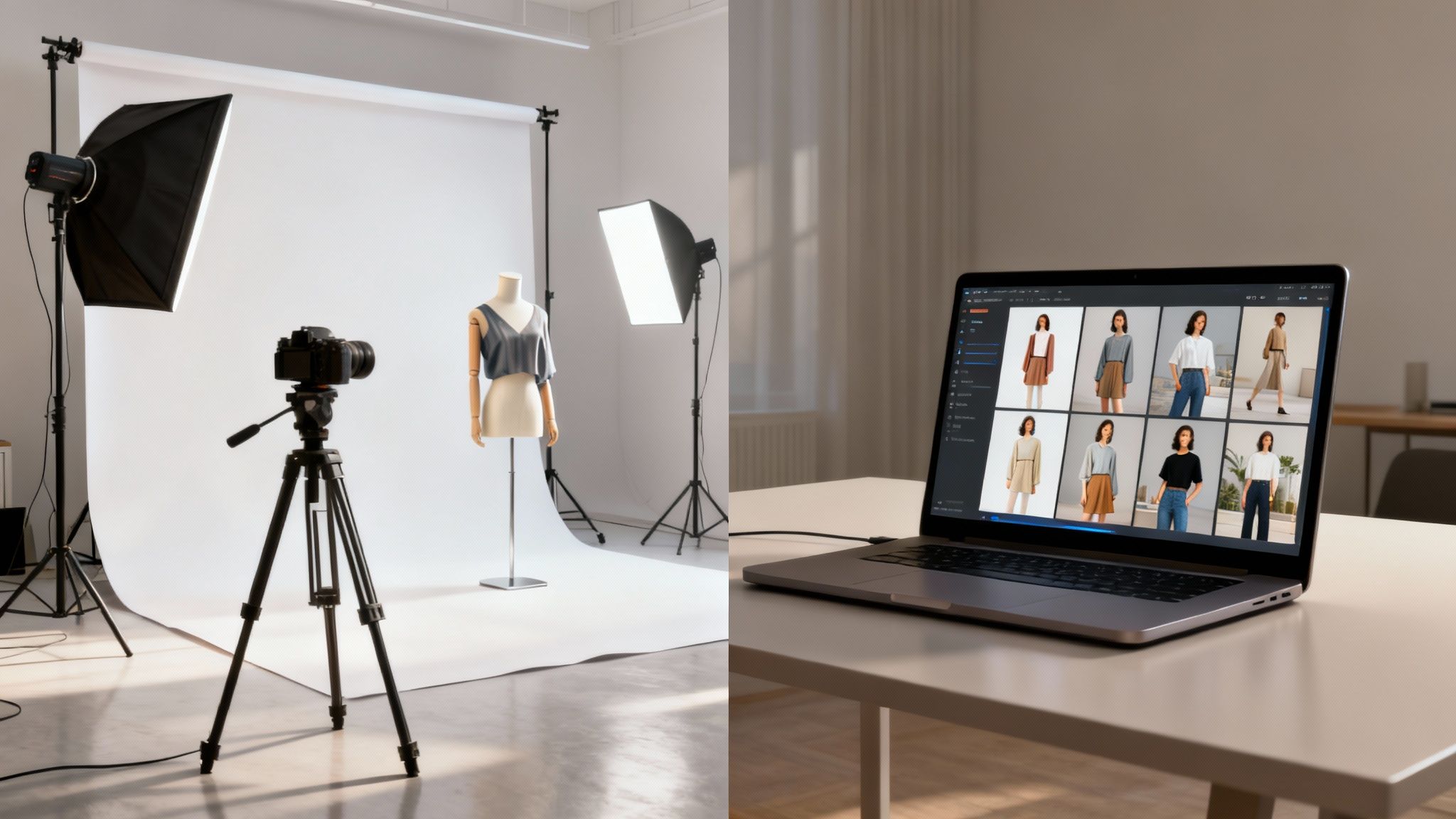
The classic idea of an e-commerce studio — a physical space buzzing with cameras and stylists — is no longer the only option. While it’s still the gold standard for capturing tactile details, the high overhead is pushing brands to look for smarter, more flexible solutions.
This shift is driven by a simple reality: the demand for visual content is relentless. The global digital photography market is on track to hit USD 70.95 billion by 2029, fueled by the constant need for fresh e-commerce and social media assets. This pressure strains old-school production models. You can read the full research about digital photography's market growth to see the data.
Two Paths: How Brands Like Zara and Ganni Choose
Today, fashion brands face a choice between two studio models. Each offers a unique balance of control, cost, and speed.
The Physical Studio: This is the traditional route with a dedicated space, professional photographers, and models. It offers total control over hero shots and detailed close-ups but comes with major overheads like rent and salaries.
The Virtual Studio: This is the new frontier, powered by AI platforms like Picjam. Brands upload a basic product photo, and AI generates an endless stream of on-brand, on-model, and lifestyle shots in minutes. This approach slashes costs and production time.
How a Physical Studio Compares to an AI Studio
The choice is a strategic decision about speed, scale, and creative agility.
Why the Virtual Studio Is Gaining Ground
For a fast-fashion giant like Zara, speed is non-negotiable. An AI-first approach allows them to create images for hundreds of new arrivals almost instantly, bypassing complex photoshoot logistics. It empowers them to test new styles and localize campaigns without the financial risk of a full-scale production.
This guide will provide the blueprint for both options — from building a physical studio to leveraging an AI-powered alternative for a faster, more scalable content engine.
Takeaway
- Acknowledge the two paths: Your brand can use a traditional physical studio, an AI-powered virtual one, or a hybrid model that leverages the best of both.
- Audit your current costs: Before making a move, calculate your current cost-per-image. It’s the only way to know where your budget is really going.
- Pilot a virtual test: Try an AI platform with a single product. It’s a low-risk way to directly compare the speed, cost, and quality against your current process.
How to Build an In-House Physical Studio
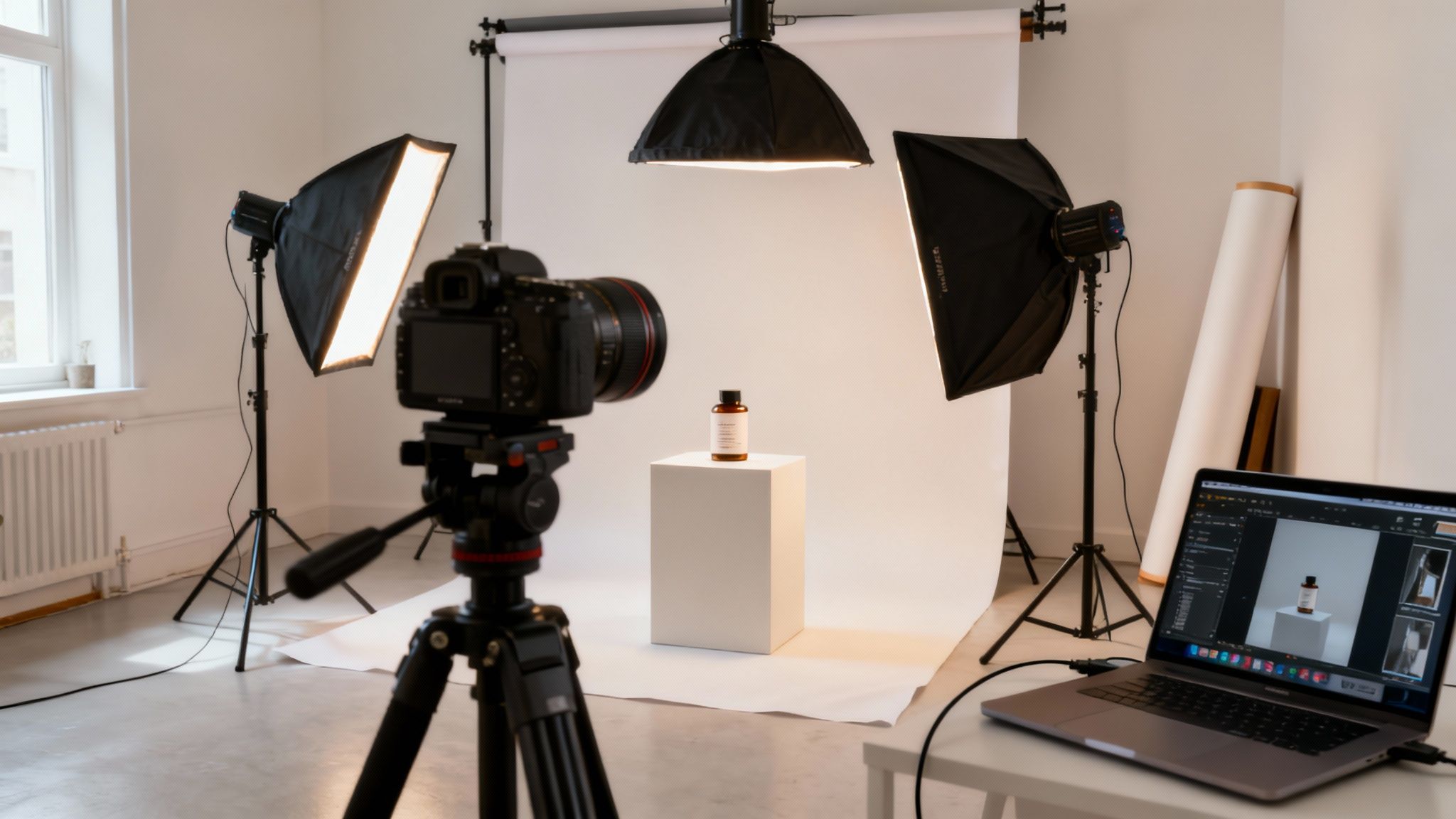
For brands that require total creative control, building an in-house e-commerce shoot studio is a powerful move. It’s a serious investment, but the rewards are consistency, speed, and a signature visual identity.
First, you need the right space. Look for a room with high ceilings — at least 10 feet is a good starting point — for lighting and camera angle flexibility.
Absolute control over light is even more critical. A windowless room is ideal, but good blackout curtains are non-negotiable. Eliminating unwanted shadows and color casts is the first step to professional results.
Assembling Your Core Photography Gear
The heart of your operation is the necessary studio equipment. Your camera and lens choices will define your image quality.
- Camera Body: A workhorse like the Sony A7IV is known for its incredible autofocus and color science. For massive resolution, the Canon R5 delivers stunning detail.
- Primary Lens: The 50mm prime lens is the champion for most e-commerce shots, capturing products with a natural look that mimics the human eye.
- Secondary Lens: For capturing crucial details like fabric texture or stitching, a 100mm macro lens is invaluable. These shots build customer confidence.
You also need a solid computer for tethered shooting, which connects your camera to a large screen for real-time review. Industry-standard software for this includes Capture One or Adobe Lightroom.
Mastering Your Lighting for Consistent Results
Great lighting separates amateur shots from professional, conversion-driving images. The goal is soft, even light that flatters your product without creating harsh shadows.
The most reliable method is a classic three-point lighting system, used by brands like Allbirds for their clean, airy style.
Here’s the setup:
- Key Light: Your main light source, positioned at a 45-degree angle to the product.
- Fill Light: Placed opposite the key light, this softer source fills in shadows.
- Back Light: Positioned behind the product, it creates separation and depth.
For a deeper dive, see our full guide on creating an effective product photography set up.
A common rookie mistake is using hard, direct light. Always use softboxes or diffusion panels. They soften and spread light, creating the flattering illumination that defines high-quality e-commerce visuals.
The Hidden Costs and Ongoing Needs of a Studio
Initial equipment is just the start. A physical studio has recurring costs and logistical needs that can add up quickly.
Be prepared for these ongoing expenses:
- Consumables: Seamless paper backdrops need constant replacement at $60 to $100 per roll.
- Props and Styling Tools: Mannequins, hangers, a good steamer, clips, and tape are all essential.
- Software Subscriptions: Monthly fees for Adobe Creative Cloud and Capture One are a fixed cost.
- Data Storage: High-resolution images require a robust system of external hard drives or cloud storage.
A physical studio demands a significant, ongoing investment of time, space, and money to run efficiently.
Takeaway
- Prioritize space and light control: Before buying gear, secure a space with high ceilings and complete control over ambient light. This is foundational.
- Invest in a core kit first: Start with a reliable mirrorless camera, a 50mm prime lens, and a three-point lighting system with softboxes. This handles 90% of e-commerce needs.
- Account for recurring costs: Budget for seamless paper, software subscriptions, and data storage. These "hidden" expenses are the true cost of ownership.
The Financial Reality: How Much Does a Physical Studio Cost?
Building an in-house studio promises creative control, but the long-term financial commitment can be steep. The numbers reveal a story of high initial investments and relentless operational costs.
The global photography studio industry is projected to hit between $37 billion and $46 billion by 2025, a significant jump from $33 billion in 2020. This growth is fueled by e-commerce and highlights the expense of traditional studio operations. You can discover more insights about the photo studio industry to explore these market forces.
The Upfront Investment to Get Started
Setting up a physical studio is a serious one-time capital expense that often catches brands off guard.
A typical breakdown of initial costs:
- Professional Camera & Lenses: $5,000 – $10,000
- Lighting Equipment: $4,000 – $8,000
- Computer & Software: $3,000 – $6,000
- Studio Build-Out & Props: $2,000 – $7,000
A mid-sized fashion brand can expect an initial investment between $14,000 and $31,000 before taking a single picture.
The Hidden Drain: Monthly Recurring Costs
The initial setup is a hurdle, but the monthly operational expenses are the real financial test. These costs are constant and directly impact your cost-per-image.
As the founder of a popular DTC brand noted in an interview, "The studio isn't a one-time purchase; it's a new department with its own payroll and rent that can seriously strain cash flow."
Brands known for clean, consistent imagery, like Everlane, fuel a non-stop production machine with these recurring expenses.
Calculating Your True Operational Burn Rate
Your monthly burn rate is what you’ll pay just to keep the studio running.
A realistic model of recurring costs:
- Commercial Space Rental: $3,000 – $7,000/month
- Full-Time Photographer Salary: $4,500 – $7,000/month
- Part-Time Stylist/Assistant: $2,000 – $4,000/month
- Utilities & Insurance: $500 – $1,000/month
- Consumables & Maintenance: $300 – $600/month
A brand can easily spend between $10,300 and $19,600 every single month.
If you shoot 200 products a month, your cost-per-image can land between $50 and $150. For a deeper analysis, see our guide on the cost for product photography.
Estimated Cost Breakdown for a Physical Studio
The first-year commitment can easily run into six figures when combining the initial investment with a full year of operational expenses.
Takeaway
- Calculate both investment & operational costs: Focus on the recurring monthly costs for rent and salaries, as they are the true financial test.
- Determine your true cost-per-image: Divide total monthly studio expenses by the number of final images produced to reveal the actual cost of your content.
- Model a realistic scenario: Use these estimates to build a financial model for your brand. This data-driven approach will determine if an in-house studio is a smart investment.
How AI Slashes Content Costs by up to 90%
The financial and logistical burden of a physical studio is pushing brands toward a smarter alternative: the virtual e-commerce shoot studio. This strategic shift trades physical sets and photographers for powerful AI that generates on-brand imagery in minutes.
The process is simple. A brand uploads a clean product photo on a plain background. AI platforms like Picjam then generate an endless variety of scenes.
Imagine a single shot of a handbag. In moments, that photo becomes a lifestyle image — held by a model in Paris, placed on a café table in Milan, or featured in a minimalist studio. This is achieved without booking a single plane ticket or model.
This chart highlights the exact expenses AI eliminates.
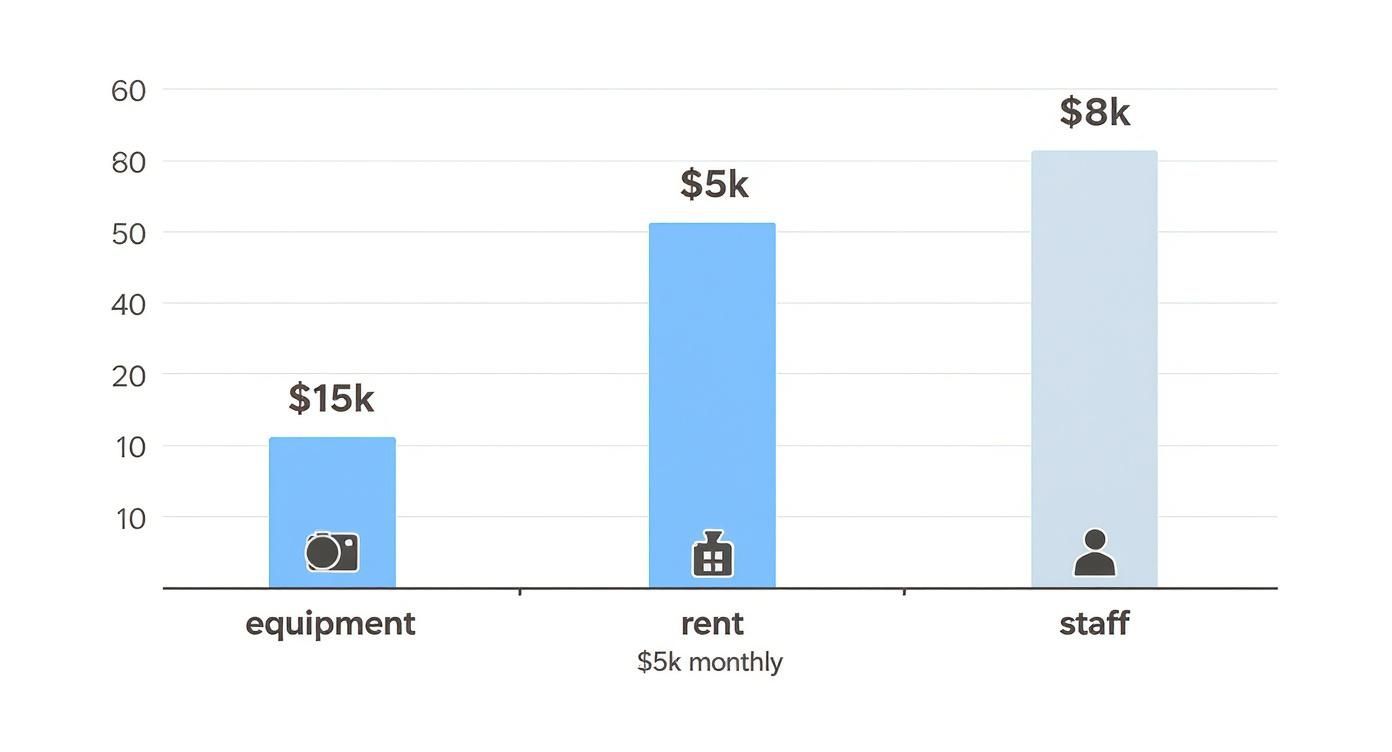
The recurring costs of rent and staff — often over $13,000 per month — are the primary budget-killers AI makes obsolete.
Unlocking Savings and Creative Freedom with AI
The financial upside of a virtual studio is immediate. McKinsey estimates that AI will generate up to $275 billion in value for the apparel, fashion, and luxury sectors, much of it from operational efficiencies like content creation. By removing the need for photographers, models, and locations, brands can cut their image creation costs by as much as 90%.
Consider a brand like Ganni. A traditional campaign to shoot 10 new dresses in 5 different cities would be a logistical and financial nightmare. With an AI workflow, they could generate hundreds of variations for each dress in every imagined location for a fraction of the cost and time. This is the real power of AI savings.
This shift moves brands from a mindset of scarcity (how many shots can we afford?) to one of abundance (what endless creative possibilities can we explore?).
Scaling Aesthetics and Localizing Content Instantly
Beyond cost savings, the virtual studio provides incredible creative agility. Brands can test new aesthetics and localize campaigns without the risk of a full-scale shoot.
- A/B Testing Visuals: Generate 10 different background styles for one product and run them in social media ads to see which converts best.
- Hyper-Localization: A global brand like Uniqlo can create imagery with models and backdrops that feel local to customers in São Paulo or Seoul from one set of product flats.
- Expanding Product Catalogs: An AI product photo generator can quickly create diverse images to make marketplace listings stand out.
Advancements in AI rendering technologies are improving realism at a rapid pace, making AI content nearly indistinguishable from traditional photography.
Actionable Takeaways for Your Brand
So, what is the right move for your brand? The path forward is about building a smarter, more scalable content engine.
The global e-commerce product photography market is expected to hit USD 1 billion in 2024 and double by 2033. This explosion highlights the critical role of high-quality visuals. You can dig into the e-commerce photography market findings to see the industry's trajectory.
1. Audit Your Current Cost-Per-Image
Before you can improve your process, you must understand it. Start with one metric: your cost-per-image.
- Factor in everything: Include rent, staff salaries, equipment depreciation, software subscriptions, and sample shipping costs.
- Calculate the real number: Divide your total monthly content creation costs by the number of final, usable images you produce. This metric reveals your workflow's true efficiency.
This number provides a powerful baseline for comparing alternatives.
2. Pilot an AI Tool with a Single Product
The fastest way to understand AI's potential is to see it in action. Pilot a tool like Picjam with one product to compare the results, speed, and cost against your current process. This low-risk experiment provides hard data.
As one creative director for a DTC startup told Vogue Business, "We ran one jacket through an AI generator and got 50 lifestyle shots in an hour for less than the cost of our intern's lunch. It completely reframed our budget conversation for the next quarter."
3. Adopt a Hybrid Content Model
The smartest brands aren’t choosing between a physical and a virtual e-commerce shoot studio — they are using both. The future is a hybrid model.
Use a physical studio for what it does best: capturing high-detail hero shots that must be perfect. At the same time, unleash an AI platform to generate the volume of lifestyle, on-model, and social assets needed to compete today. This approach balances quality with scale and savings.
Got Questions? We've Got Answers
Stepping into the world of content creation always brings up questions, especially when weighing a traditional studio against a virtual one. Let's break down some of the most common things we hear from fashion brands.
What Are the Biggest Hidden Costs of a Physical Studio?
It's not the cameras or the lights that'll get you. It’s the slow, relentless burn of operational expenses that really catches brands off guard. The initial investment is one thing, but keeping the lights on (literally) is a whole other beast.
Most of the time, the biggest surprises come from:
- Commercial Rent and Insurance: This is usually the biggest line item, month after month, especially if you're in a major city.
- Talent Salaries: A full-time photographer and a stylist can easily run you over $10,000 a month in payroll before you’ve even shot a single product.
- Consumables: Things like seamless paper backdrops get scuffed and torn way faster than you'd think. At $60-$100 a roll, those replacements add up.
- Software Subscriptions: Adobe Creative Cloud, Capture One, asset management tools... they all come with a monthly price tag.
- Data Storage: High-res RAW files are massive. You’ll be constantly buying new hard drives or upgrading cloud plans just to keep everything organized and safe.
How Much Space Do I Really Need for a Basic Studio?
You can get started with a small space, maybe around 200 square feet, if all you're doing is styled flat lays or simple product shots on a table. But for fashion, that’s going to feel cramped real fast.
The minute you bring a model in, everything changes. To comfortably shoot on-model, which is non-negotiable for apparel, you need to think bigger. A realistic starting point is at least 500-700 square feet. That gives you enough room for a standard 9-foot backdrop, a 3-point lighting setup, and—this is key—enough distance between the camera and the model so you don't get weird lens distortion.
And don't forget about height. Ceiling height is just as important as floor space. You'll want at least 10-12 feet to give your lighting stands room to breathe and to allow for flattering, top-down lighting setups.
How Do AI Platforms Ensure Product Accuracy?
This is the big one, right? The good news is the technology has gotten incredibly good. AI platforms like Picjam use highly specialized models trained on millions of fashion items to make sure your products look like your products.
It's not just a simple cut-and-paste job. The AI intelligently separates the product from its original photo and then seamlessly integrates it into a new scene, preserving all the critical details:
- Texture and Fabric: The AI keeps the original fabric's texture, sheen, and drape intact.
- Color Fidelity: Sophisticated color-matching algorithms make sure your product's color stays true to life.
- Shape and Fit: When placing a garment on an AI model, the system understands how fabric should realistically hang and fold. You avoid that flat, "pasted-on" look that screams fake.
As one founder told us, "The biggest surprise was how the AI respected the product's details. The stitching on our denim jacket looked just as sharp in the AI-generated lifestyle shot as it did in our original flat lay."
Can AI-Generated Content Help Reduce Return Rates?
It sounds counterintuitive, but yes, it absolutely can. The reason is simple: better visuals set better customer expectations. A Shopify study actually found that 40% of online returns happen because of poor product descriptions or not enough quality images.
AI studios tackle this problem head-on. Imagine a brand like Reformation being able to instantly show a new dress on models with different body types, heights, and skin tones. A customer can see how the item might actually fit them, not just a professional sample-size model.
By providing more representative and varied visuals, you close the gap between what a customer sees online and what arrives at their door. This builds confidence and significantly reduces the "it didn't look like I expected" reason for returns.
Can AI Replace My Photographer Entirely?
Not entirely, and it shouldn't. The smartest brands are adopting a hybrid model. Think of AI not as a replacement for your creative team, but as a massive force multiplier.
Here’s how it usually works in practice:
- Use Your Photographer for Hero Shots: Your best photographers are artists. Let them focus on what they do best: shooting your main campaign imagery, telling nuanced brand stories, and capturing those stunning hero shots where every detail has to be perfect.
- Use AI for Volume and Variety: This is where you unleash the scale. Use an AI e-commerce shoot studio to generate the hundreds of other assets you need—every product on every model for your PDPs, endless social media content, and localized ad creatives.
This hybrid approach gives you the best of both worlds. You get the irreplaceable artistic touch for your biggest campaigns and the speed, scale, and cost-savings of AI for everything else.
Ready to see how a virtual studio can transform your content workflow? Use our savings calculator to get a precise comparison between your current photography costs and an AI-powered workflow.

Picjam team
The Picjam team blends AI, product, and creative expertise to eliminate the cost and delay of traditional photography for modern eCommerce brands.