
Flat Lay Clothing Photography: Setup, Steps & AI Option
Flat lay photography for clothing: setup, lighting, camera settings, folding and styling for ecommerce, plus when to generate flat lays with AI instead.
Short answer: flat lay photography means laying a product on a flat surface and shooting it from directly above. For clothing brands it is the fastest way to get clean, consistent catalogue images without a model. Get four things right: a white or neutral surface, a camera locked overhead, large soft light, and the same exposure and white balance for every SKU.
This guide covers which garments work flat, the setup, a step-by-step shoot, settings, folding, styling, common mistakes, and when it is faster to generate flat lays with AI instead.
What is flat lay photography?
A flat lay is a top-down photo of products arranged on a flat surface. The camera points straight down, so the whole item is visible at once: shape, colour, print, trims and details. Because there is no perspective distortion and nothing in the frame you do not control, flat lays are easy to keep consistent across a full range.
Brands use flat lays for product pages, marketplaces, social, email, lookbooks and line sheets, and as the input for AI on-model images. Flat lay differs from ghost mannequin photography, where the garment is shaped to imply a body, and from lifestyle photography, where a model wears the product in context.
Which clothes work as flat lays (and which need on-model support)
Some garments photograph well flat; others lose the shape that sells them. Use this three-tier framework.
- Works very well flat: t-shirts and tees, hoodies and sweatshirts, denim jeans and jackets, chunky knitwear, kidswear, and accessories such as scarves, belts and hats.
- Works with effort: blazers and structured jackets (shape the shoulders and lapels with tissue or foam), collared shirts and polos (use collar stays or tissue to keep the collar open), button-ups (button and press everything), and activewear sets.
- Needs on-model or ghost mannequin as the main image: dresses and skirts that collapse when laid flat, wrap styles, bodycon pieces and bias-cut garments. The fit only reads on a body, so use the flat lay as a secondary image.
If much of your range sits in the third tier, plan on-model images alongside your flat lays.
Flat lay photography setup
Surface and background
For product pages, shoot on white seamless paper, a white foam board or a matte white tabletop. It retouches easily to pure white, which suits most marketplaces. Keep textured backdrops for social and lookbooks. Make sure the surface is bigger than your largest garment so you never crop into a sleeve.
Camera position
Mount the camera directly overhead with the sensor parallel to the surface, using a tripod with a horizontal arm, a C-stand with a boom or a copy stand. For weekly volume, a fixed rig is worth it: handheld shots add tilt, so garments look wider at one end and crops will not line up.
Lighting
Use a large, soft light source. A softbox placed high at about 45 degrees is the workhorse setup; the bigger the light, the softer the shadows. A 90cm octabox about 80cm from a 60 x 90cm layout is a good start. Add a white reflector or a low-power fill light on the opposite side to open shadows without removing them: soft shadows show fabric texture.
Natural light works for small batches. Shoot beside a large north-facing window on an overcast day, bounce light back with white foam board, and turn off indoor lights so warm bulbs do not mix with daylight. Whatever you choose, keep the same setup and distances for the whole drop.
Kit list
- Garment steamer and lint roller
- Pins, clips and gaffer or double-sided tape, hidden under the garment
- Tissue paper or foam for shaping sleeves, collars and shoulders
- A grey card or colour checker for accurate colour
- A tape measure or marked guides so every garment sits in the same place

How to take flat lay photos of clothes, step by step
This is the workflow we recommend for ecommerce flat lays. For a broader overview of shooting apparel, see our guide on how to take pictures of clothes to sell.
- Steam and lint-roll. Wrinkles and fluff are far harder to fix in retouching than before the shoot. Steam every garment, give it a couple of minutes to cool and settle, then lint-roll it once it is on the surface. A low-angle light makes pills and loose threads easy to spot.
- Fold or shape the garment. Decide on one fold style per category and stick to it. Shape sleeves, collars and hems with tissue so the garment looks full rather than deflated.
- Square it to the frame and centre it. Line the garment up with your guides so it sits in the same position and takes up the same share of the frame as the rest of the range. Start from symmetry: both sleeves at the same angle, collar centred, hem straight.
- Lock exposure and white balance. Shoot in manual mode and set a custom white balance from your grey card. Keep the same settings for the whole set so colours do not drift between SKUs.
- Shoot the hero, then the details. Take the full-garment hero shot first, then close-ups of fabric texture, prints, labels, buttons and trims. Check that no pins, tape or supports are visible.
- Retouch consistently. Clean the background to white, colour-match against the real garment, remove stray threads and apply the same crop and margins to every image.
Camera settings for sharp, true-colour flat lays
You need consistent settings more than an expensive camera. A good starting point:
- Aperture: f/8 to f/11 so the whole garment is sharp edge to edge. Go to f/11-f/16 for thick knits and padded jackets.
- ISO: 100-200. Higher ISO adds noise to solid-colour fabric that is slow to retouch.
- Shutter speed: whatever gives a correct exposure at those settings. On a tripod, use a cable release or a 2-second timer to avoid shake.
- White balance: custom, set from a grey card at the start of the session. Do not change it until you change the light.
- Lens: a standard 35mm to 50mm (full-frame equivalent) lens, or longer. Avoid wide angles, which bend garment lines at the edges.
- Focus and file format: single-point autofocus on the centre of the garment, or manual focus locked in, and RAW files so you can correct colour later.
Shooting flat lays on a phone
Use the standard 1x lens rather than ultrawide, mount the phone overhead in exactly the same spot for every shot, lock focus and exposure on the garment, turn off beauty and HDR modes, and use a timer or remote. The limit is not image quality but colour consistency across hundreds of shots, so for large ranges a camera with RAW and tethering saves retouching time.
How to fold clothes for flat lay photos
How you flat lay clothes depends on the category. Pick one style per category and use it across the whole range.
- T-shirts and tops: lay the garment face up, smooth the body, and angle the sleeves slightly down and out. Put tissue inside to stop the back showing through thin fabric.
- Shirts: button the shirt, square the collar with tissue underneath, and either lay the sleeves straight or fold one across the body to show the cuff.
- Knitwear: handle gently to avoid stretching. Shape the shoulders, keep the ribbed hem straight, then shoot a close-up of the knit.
- Jeans and trousers: lay them straight with legs parallel, or fold one leg across to show the side seam. Show the waistband and pockets clearly.
- Dresses and skirts: fan the skirt out slightly so the shape reads, and tuck in straps that distract from the silhouette.
A simple shot list for each SKU
Agree a shot list before the shoot so every SKU gets the same coverage:
- Front hero flat lay
- Back view
- Fabric or print close-up
- Detail shots: label, buttons, zips, trims or embroidery
- Optional styled flat lay for social and email
Styling flat lays for ecommerce vs social
Flat lay photography covers two different jobs. Know which one you are shooting before you start styling.
Ecommerce and PDP flat lays
- One SKU per image, so shoppers know exactly what they are buying
- Minimal or no props, nothing that hides the product
- True colour, checked against the physical garment
- The same fold, position and crop across the range, so category grids look tidy
Social and lookbook flat lays
Start with a mood board for palette, texture and feel. Build outfits around a hero piece and choose props that relate to how the product is used: a ceramic mug with a chunky knit, a water bottle with an activewear set. Then use simple composition rules:
- Odd-number groupings: groups of 3 or 5 items feel more natural than even groups.
- An S-curve: gently shaping a sweater or trousers into a soft S gives the eye a path through the frame.
- Negative space: empty surface around the product keeps it the hero.
- Texture contrast: a knit on smooth marble reads better than a knit on linen.
- A slight diagonal: rotating the layout 15-30 degrees looks editorial rather than catalogue.
- A partial reveal: a second item cropped at the frame edge implies a bigger story.
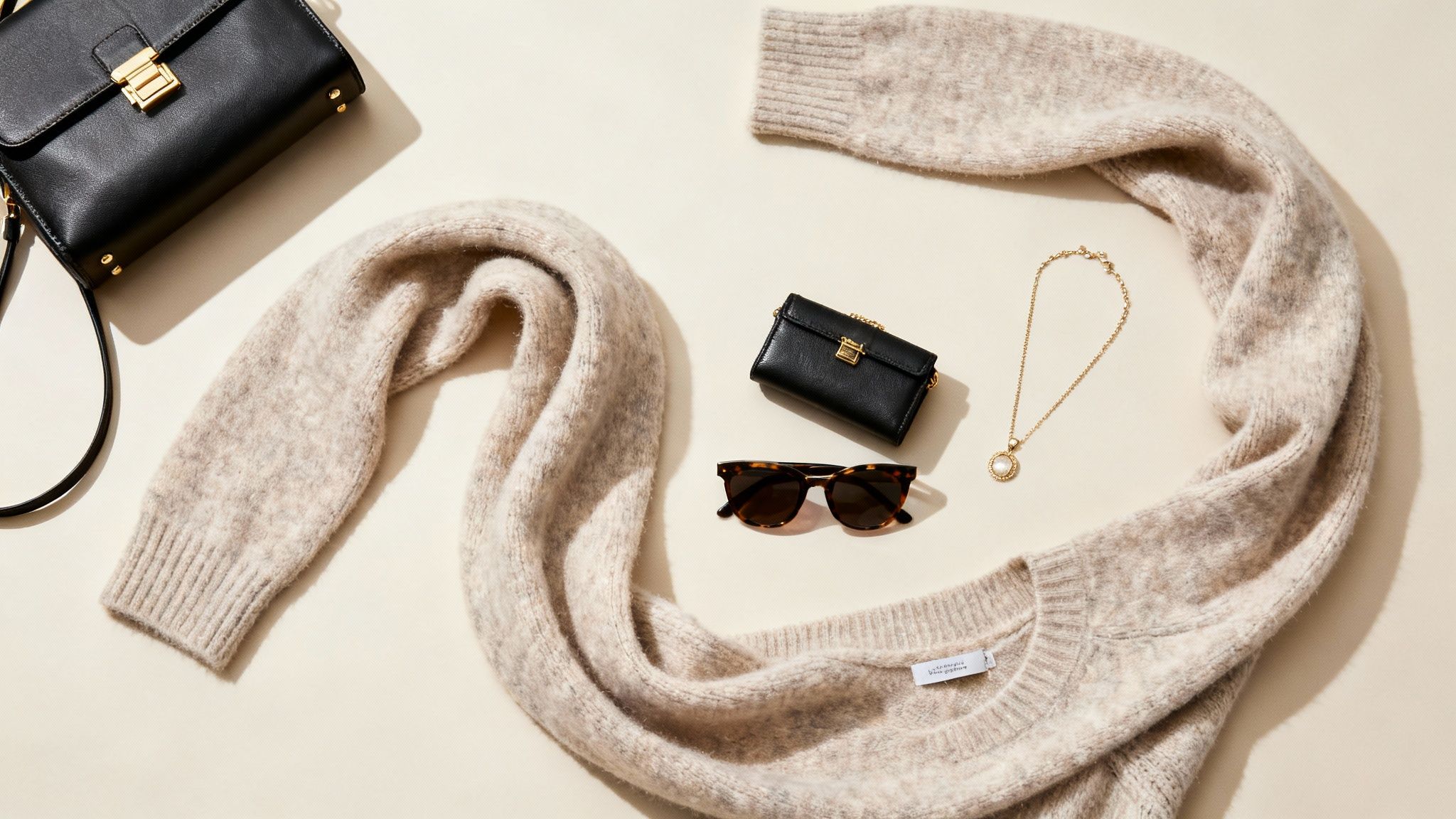
Many brands shoot both from the same session: a clean PDP flat lay first, then a styled version for social and email.
Common flat lay mistakes that hurt conversion
- Wrinkles and creases. They make garments look cheap and worn. Steam everything.
- Colour drift between SKUs. Mixed light or auto white balance makes the same colourway look different across images, which drives returns.
- Hot spots on synthetic fabrics. Nylon, polyester and satin catch hard highlights. Diffuse the light more.
- Flat, textureless images. If the fill light is too strong, fabric looks lifeless. Reduce it or move it back.
- Inconsistent crops. Garments at different sizes and positions make category pages look messy.
- Props hiding product detail. On a PDP, the product is the hero. Save props for social.
Flat lay vs ghost mannequin vs on-model: which does your listing need?
Each shot type does a different job, and most apparel listings convert best with a mix.
- Flat lay: shows the whole garment and its details cleanly. Fast and cheap to keep consistent. Does not show fit.
- Ghost mannequin: shows the garment's 3D shape without a visible model, the standard for many marketplaces and wholesale catalogues. See ghost mannequin removal.
- On-model: shows fit, drape and scale on a body. See AI virtual model and our guide to flat lay to model AI.
Flat lays as AI input: shoot once, use twice
A well-shot flat lay is also the source file for AI on-model and packshot images. AI tools read colour, pattern, texture, construction and silhouette from it, so the cleaner the flat lay, the more accurate the result. What matters most:
- Clean background: white or light grey makes the garment easy to separate; busy backgrounds create edge artefacts.
- Sharp fabric detail: a deep depth of field gives the AI texture to work with.
- True colour: a warm cast in the flat lay means the wrong colour on the model.
- Full garment visible: do not fold hems, cuffs or key details out of frame.
In practice: shoot each new-season garment as a flat lay, use it as the main image for first-tier garments, lead with AI on-model for third-tier garments such as dresses, and regenerate on-model images from the same files at each seasonal refresh, with no reshoot.
When AI flat lays beat a reshoot
Shooting flat lays works for a handful of hero SKUs. It breaks down when a drop has hundreds of SKUs, supplier photos do not match, or new colourways need to go live this week.
Picjam is an AI flat lay generator for ecommerce. It creates consistent flat lays from the product photos you already have, with the same lighting, background and crop across the whole drop. There are no prompts to learn: Picjam suggests the shots to make from your product images and sales data. The same assets can then become on-model, ghost mannequin, packshot, lifestyle or video content with AI product photography.
Want to know which listings are missing a flat lay, back view or on-model shot first? Scoring is optional: score your listing images, or book a demo to see it on your own catalogue.
Flat lay photography FAQ
What is flat lay photography?
Flat lay photography is a top-down photo of products laid on a flat surface, shot from directly above. Ecommerce brands use it for clean, consistent images that show the whole item, its colour and its details, without a model.
How do you take flat lay photos of clothes?
Steam and lint-roll the garment, lay it on a white or neutral surface, shape it with tissue, mount the camera directly overhead, use large soft light, lock exposure and white balance, then shoot the full garment followed by close-ups of fabric, labels and trims.
What is the best lighting for flat lay photography?
A large softbox at about 45 degrees above the surface, with a white reflector or a low-power fill light opposite. Without studio lights, use a big north-facing window on an overcast day and turn off indoor lights so colours do not mix.
What camera settings are best for flat lay photography?
ISO 100-200, f/8 to f/11 (f/11 to f/16 for thick knits and padded jackets), a shutter speed that gives correct exposure on a tripod, custom white balance from a grey card, and RAW files. Lock the settings for the whole shoot.
Can you shoot flat lays on a phone?
Yes. Use the standard 1x lens rather than ultrawide, mount the phone overhead, lock focus and exposure, and use a timer. A phone workflow is fine for small ranges; at catalogue scale, colour consistency is easier with a camera, RAW files and tethering.
Which clothes should not be shot as flat lays?
Dresses, wrap styles, bodycon and bias-cut garments lose their shape when laid flat, because the fit only reads on a body. Use flat lays as a secondary image for these and lead with ghost mannequin or on-model shots.
Is flat lay or on-model better for selling clothes?
Flat lays show the whole garment and its details cleanly. On-model shows fit, drape and scale. Most apparel listings convert best with both, plus a ghost mannequin or packshot as the main image.
How do I make flat lays look interesting?
Get the basics right first: steaming, symmetry and even light. Then add one styling choice, such as a relevant prop, a 15-30 degree diagonal, texture contrast, negative space, or a second item cropped at the frame edge.
What is a good tool for fashion flat lays?
Picjam generates consistent flat lays from the product photos you already have, with no prompts to learn: it suggests the shots to make from your product images and sales data. The same assets can become on-model, ghost mannequin, packshot, lifestyle and video content.

Michael Pirone
Co-Founder

