
How AI Fashion Models Are Reshaping Ecommerce
Discover how top brands use AI fashion models to reduce costs, accelerate campaign launches, and enhance diversity. Get actionable insights for your brand.
How to start saving money
Lorem ipsum dolor sit amet, consectetur adipiscing elit lobortis arcu enim urna adipiscing praesent velit viverra sit semper lorem eu cursus vel hendrerit elementum morbi curabitur etiam nibh justo, lorem aliquet donec sed sit mi dignissim at ante massa mattis.
- Neque sodales ut etiam sit amet nisl purus non tellus orci ac auctor
- Adipiscing elit ut aliquam purus sit amet viverra suspendisse potent i
- Mauris commodo quis imperdiet massa tincidunt nunc pulvinar
- Adipiscing elit ut aliquam purus sit amet viverra suspendisse potenti
Why it is important to start saving
Vitae congue eu consequat ac felis placerat vestibulum lectus mauris ultrices cursus sit amet dictum sit amet justo donec enim diam porttitor lacus luctus accumsan tortor posuere praesent tristique magna sit amet purus gravida quis blandit turpis.

How much money should I save?
At risus viverra adipiscing at in tellus integer feugiat nisl pretium fusce id velit ut tortor sagittis orci a scelerisque purus semper eget at lectus urna duis convallis. porta nibh venenatis cras sed felis eget neque laoreet suspendisse interdum consectetur libero id faucibus nisl donec pretium vulputate sapien nec sagittis aliquam nunc lobortis mattis aliquam faucibus purus in.
- Neque sodales ut etiam sit amet nisl purus non tellus orci ac auctor dolor sit amet
- Adipiscing elit ut aliquam purus sit amet viverra suspendisse potenti
- Mauris commodo quis imperdiet massa tincidunt nunc pulvinar
- Adipiscing elit ut aliquam purus sit amet viverra suspendisse potenti
What percentage of my income should go to savings?
Nisi quis eleifend quam adipiscing vitae aliquet bibendum enim facilisis gravida neque. Velit euismod in pellentesque massa placerat volutpat lacus laoreet non curabitur gravida odio aenean sed adipiscing diam donec adipiscing tristique risus. amet est placerat imperdiet sed euismod nisi.
“Nisi quis eleifend quam adipiscing vitae aliquet bibendum enim facilisis gravida neque velit euismod in pellentesque massa placerat”
Do you have any comments? Share them with us on social media
Urna ut fermentum imperdiet lacus, elementum etiam maecenas libero nunc, suspendisse massa, nisl, elit curabitur feugiat in quis ut nibh enim in tristique aliquam sed vitae dui, dis adipiscing pharetra aliquam turpis turpis nibh rhoncus enim, pellentesque leo laoreet neque in sed bibendum fermentum suspendisse tempus non purus adipiscing suscipit fringilla adipiscing convallis dolor nulla fermentum facilisis ullamcorper ut vehicula tortor libero metus donec velit, tristique fermentum, dictum euismod diam scelerisque enim non pharetra tristique lectus habitant pharetra est id
When Levi’s announced it was testing AI fashion models to supplement its human model shoots, it signaled a major shift in ecommerce. The goal was to boost diversity and representation on its product pages — all without the logistical headaches of a traditional photoshoot.
This move highlights a powerful new reality for fashion brands. AI isn't just an experiment anymore; it's a core strategy for brands that plan to win the future.
How AI Models Cut Photoshoot Costs by up to 90%
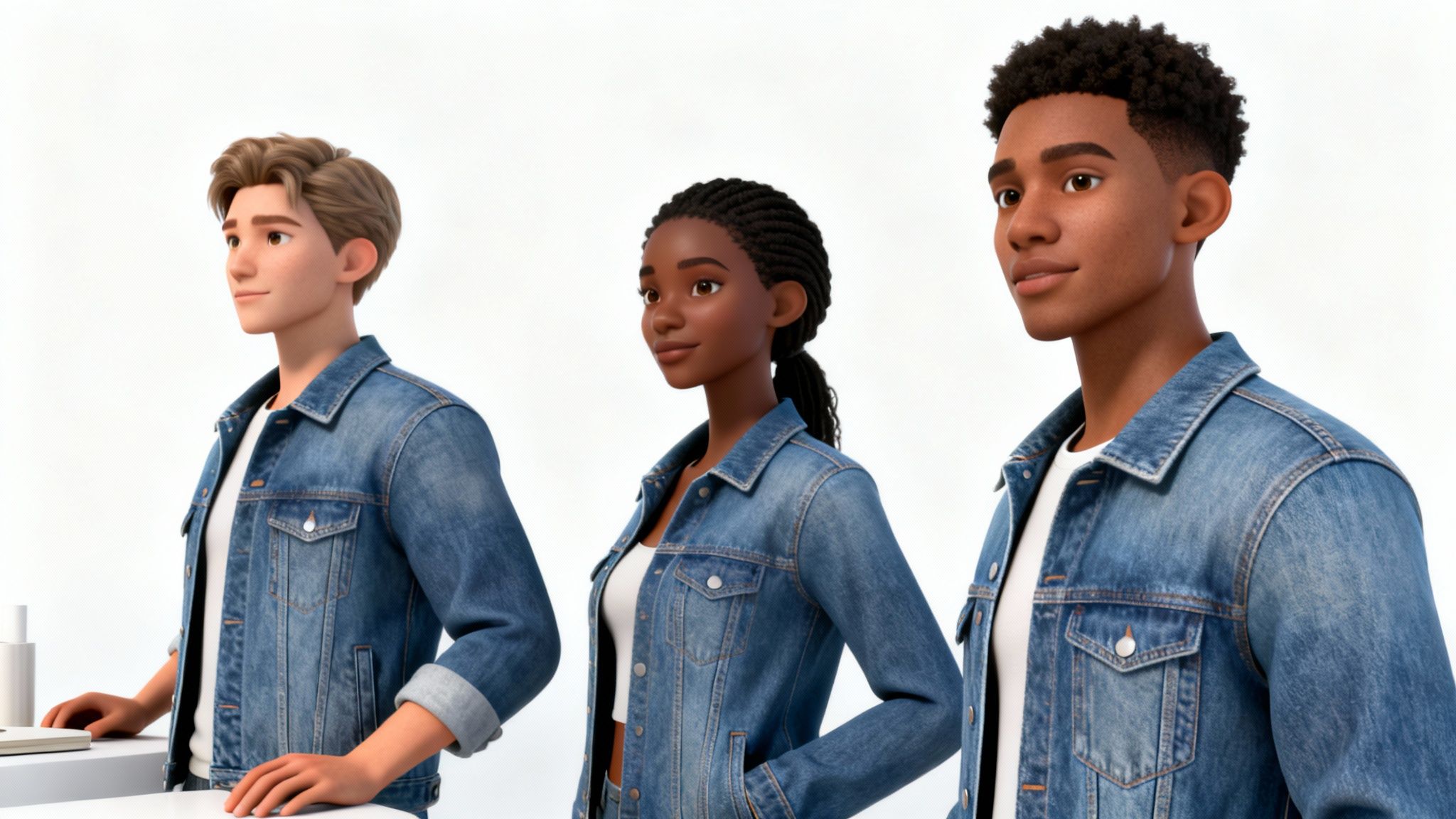
Brands can now create lifelike, on-brand model imagery in minutes, not months. These aren't just digital mannequins; they're dynamic, fully customizable assets that deliver an incredible level of creative control.
This movement is driven by tangible benefits that impact a brand's bottom line and operational speed. For a solid foundation on the tech behind this, see this guide on general information about AI technology.
Speed, Savings, and Creative Freedom
Platforms like Picjam generate realistic AI fashion models that are becoming essential for scaling content production. Imagine creating an entire on-model photoshoot for a new collection in a single afternoon, right from your laptop.
This technology directly tackles the biggest pain points of traditional content creation:
- Massive Cost Savings: A single traditional shoot can easily run upwards of $20,000, while AI-generated shoots cost a fraction of that. You eliminate expenses for model casting, studio rentals, photographers, and travel.
- Unmatched Speed: Go from a basic product-on-mannequin photo to a full set of high-quality, on-model images in minutes. This drastically cuts time-to-market, letting you sell new inventory almost as soon as it arrives.
- Total Creative Control: Specify the exact ethnicity, age, body type, and pose to create imagery that genuinely reflects your diverse customer base. This level of personalization was nearly impossible to achieve at scale before now.
The ability to generate an endless variety of on-brand models means you can finally test which visuals resonate best with specific audiences, directly impacting engagement and conversion rates.
This efficiency is fueling significant market growth. A report from Precedence Research projects the global AI in fashion market to grow from $1.1 billion in 2022 to $17.1 billion by 2032.
Takeaway
- Audit Your Last Shoot: Calculate the total cost of your most recent photoshoot — models, studio, crew, and retouching. The savings potential with AI will become immediately clear.
- Accelerate Go-to-Market: Map your current process from inventory arrival to product launch. Identify how AI can shrink a multi-week timeline into a single day.
How Brands Streamline Workflows with AI Models
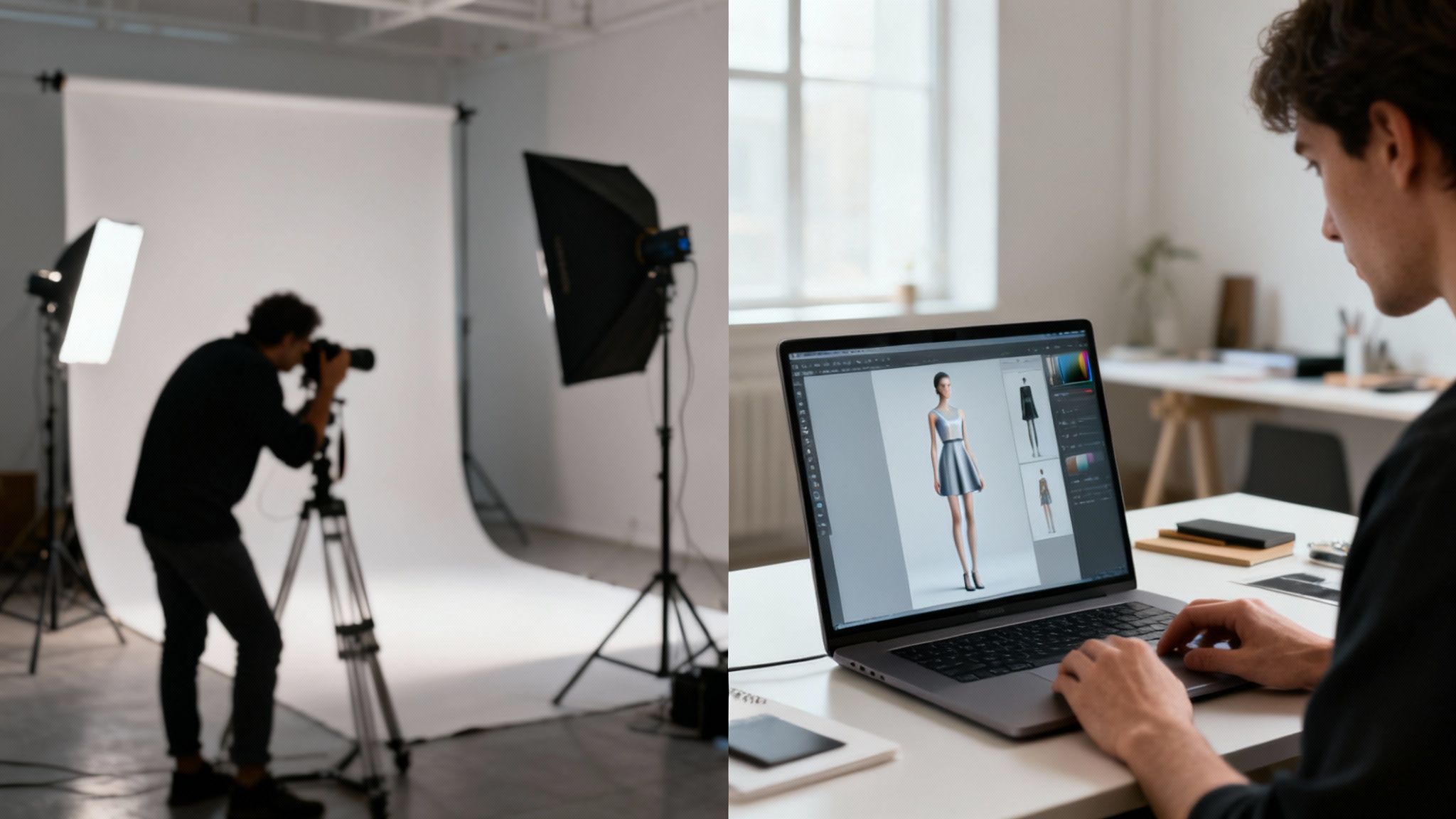
Anyone who has run a fashion brand knows the traditional photoshoot is a logistical and financial beast. Juggling models, photographers, studios, and post-production can push a single campaign past $20,000 and leave you waiting weeks for final assets.
It's a slow, expensive cycle that can't keep pace with modern e-commerce.
Now, you can generate a complete set of on-model product images in hours for a fraction of that cost. The goal isn't just to save money; it's about fundamentally changing how quickly you can get products live and selling.
By eliminating the logistical nightmares of coordinating crews and locations, brands can finally produce fresh, professional imagery on demand.
The Old Way vs. The New Way: A Workflow Comparison
Let's break down the difference between the old, cumbersome process and the new, streamlined approach.
Traditional Photoshoot vs AI Model Generation
The contrast is stark. The traditional path is a linear, resource-heavy marathon. The AI workflow is a nimble, iterative sprint that gives you complete creative control without the punishing timeline or budget.
A study by Stylitics highlights that generative AI directly addresses this production bottleneck, allowing teams to move faster and experiment more often without the high costs of physical shoots.
Quantifying the Impact on Your Bottom Line
The savings are real and have a massive impact. We see similar cost-cutting patterns in adjacent creative fields, like the rise of AI TV Commercials for Small Businesses making high-quality video accessible to everyone.
For fashion brands, this shift means you can reallocate your budget from content production into areas that grow the business, like marketing and product development.
By cutting weeks of waiting time, you can get new collections online the moment they're ready, capitalizing on trends while they're still hot. The same principles apply when using an AI product photo generator for all sorts of items.
Takeaway
- Audit Your Costs: Pull the numbers from your last few photoshoots. Add up everything — model fees, studio rental, photographer, retouching — and compare it to an AI-powered plan. The difference is usually eye-opening.
- Accelerate Timelines: Map your current product launch process. AI can shrink a multi-week marathon into a single afternoon, getting your products in front of customers almost instantly.
How AI Models Elevate Personalization at Scale
Trying to represent a global customer base is one of the toughest, most expensive puzzles in fashion. How do you find the right models for every collection and every market without your budget spiraling out of control?
This is where AI fashion models flip the script. Instead of being a limitation, diversity becomes a scalable asset.
A swimwear brand can show the same bikini on 10 different body types with a few clicks. A global retailer can swap models to create region-specific campaigns for its websites in Asia, Europe, and North America — no flights, no new photoshoots needed.
Tailoring the Shopping Experience, One Customer at a Time
We can finally move past the one-size-fits-all approach to product imagery. Using a platform like Picjam, you can get incredibly granular, A/B testing which model connects best with different audience segments.
Imagine running a TikTok ad featuring a younger, edgier model for your Gen Z audience, while your email subscribers see the same product on a more classic, mature model. That level of targeted visual merchandising was practically impossible to scale before now.
Shoppers expect to see themselves reflected in the brands they buy from. For a deeper look at the tech making this possible, our guide on what is a virtual model breaks it all down.
When a shopper sees a garment on a model who looks like them, their confidence in the fit skyrockets. AI makes this possible across your entire catalog, which means fewer returns and happier customers.
The Numbers Don't Lie: Personalization is Driving the Market
This isn't just a trend; it's a fundamental shift. The AI in fashion market is booming, and apparel claimed 45.20% of the market in 2024, according to a Precedence Research report. A massive demand for virtual try-ons and personalized content is fueling that growth.
Fashion designers are the biggest adopters, making up a 60.20% share as they integrate AI into everything from creative design to prototyping. You can see more on how AI is influencing market trends in fashion, and it’s clear that personalization is front and center.
The data points to one thing: the industry is betting big on tools that create more relevant, individualized shopping experiences.
Takeaway
- Map Your Demographics: Identify your top 3 customer segments. Use AI to generate model personas that reflect their specific age, ethnicity, and style. Test these new images on key product pages.
- Run a Regional Test: If you sell internationally, pick one key region and create custom model imagery for your 10 best-selling products. Track the impact on engagement and add-to-cart rates.
How to Integrate AI Models into Your Ecommerce Workflow
Bringing new technology into your creative process can sound daunting, but getting started with AI fashion models is surprisingly straightforward. For most brands, the journey begins with an asset you already have: the simple product-on-mannequin photo.
Platforms like Picjam are designed to feel less like a heavy technical lift and more like a creative superpower. The goal isn't to overhaul your entire operation. It's about giving your team tools to produce amazing content without a painful learning curve.
From Mannequin to Model in 3 Steps
The core workflow is beautifully simple. You take a static product photo and turn it into a dynamic, ready-to-publish image. The only prerequisite is a clean, well-lit picture of your garment.
Upload Your Product Image: Start by uploading a high-resolution photo of your product, preferably on a ghost mannequin or even a hanger. The AI uses this as its blueprint.
Select Your AI Model: Next, pick a model who fits your brand's vibe and speaks to your target customer. You can browse a diverse library or generate new ones to match a specific brief.
Generate and Refine: With a single click, the platform drapes the garment onto your chosen model. From there, you can select different poses, tweak expressions, and add on-brand backgrounds.
This infographic breaks down how you can take this workflow a step further to drive personalization by testing different models and body types with your audience.
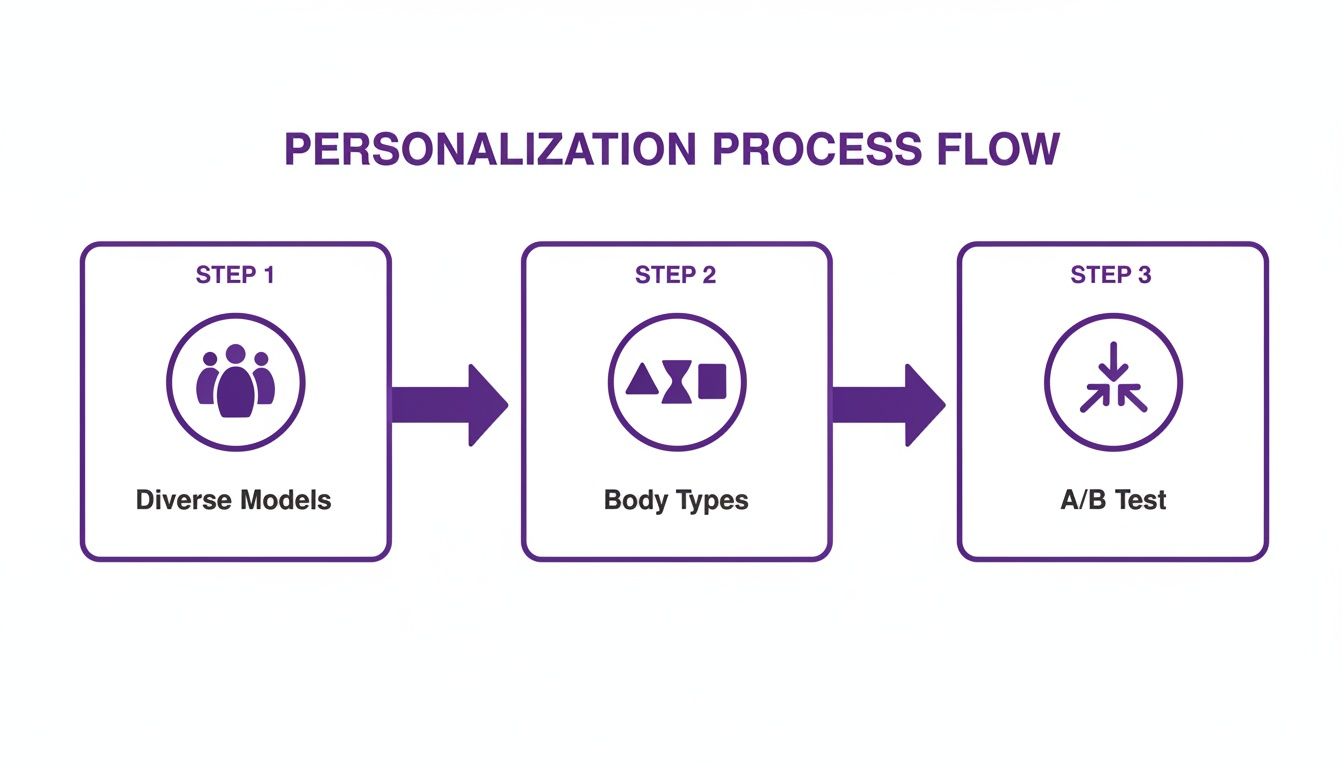
This simple flow allows a brand to go from a generic "one-size-fits-all" product photo to visuals that connect with specific customer segments on a much deeper level.
Best Practices for a Seamless Integration
To get the most value from your AI-generated images, consistency is everything. Think of it as an extension of your existing brand guidelines, not a replacement.
According to Stylitics, a "crawl-walk-run" approach works best. Start by using AI to fill gaps on your product pages. Once comfortable, expand into creating full styled looks, and finally, push those visuals to other marketing channels.
Adopting AI gradually helps your team get comfortable and prove the quality. Here are a few best practices to ensure your AI-generated images always feel on-brand.
- Maintain Consistent Lighting: Ensure the lighting in your original product photo is even and clean. This is the single biggest factor in helping the AI render the garment realistically.
- Create an AI Style Guide: You have a brand book for traditional photoshoots; do the same for AI content. Define your go-to model types, poses, and background styles to keep everything cohesive.
- Focus on High-Quality Inputs: The old saying "garbage in, garbage out" absolutely applies here. The better your input photo, the more realistic your output will be. Always start with high-resolution, professionally shot mannequin photos.
Takeaway
- Pilot a Single Category: Pick one of your top-selling product categories and use AI to generate a fresh batch of on-model images. Compare key metrics against your old photos to see the impact.
- Document Your Workflow: Put together a simple, one-page guide for your team that outlines the three-step process. This clears up any confusion and makes it easy for anyone to create content.
How to Navigate Quality and Ethical Considerations
While the numbers on cost and speed are compelling, jumping into AI fashion models requires forethought. For any brand, a key worry is the "uncanny valley" — that off-putting feeling when a digital human looks almost real, but not quite.
Thankfully, technology has evolved. Today's leading platforms are trained on massive, high-quality fashion datasets. They have learned the nuances of skin texture, natural lighting, and how a silk shirt actually falls.
The result is photorealistic imagery that is often indistinguishable from a traditional photoshoot, giving shoppers confidence.
AI as a Partner, Not a Replacement
The conversation around AI often lands on job losses, but it's more accurate to see this as a collaboration. AI isn't here to replace human models or photographers; it’s here to act as a powerful assistant.
It takes over the high-volume, repetitive work that eats up creative energy and budgets.
AI is the perfect tool for creating the hundreds of standard, on-white-background product shots you need. This frees up your human models and photographers for high-impact editorial campaigns and brand storytelling.
The creative vision stays in human hands; AI just handles the most tedious parts of the job. You can dig deeper into how brands are striking this balance by looking into different types of models for photo shoots.
According to Stylitics, the sweet spot is a hybrid approach. You pair the raw efficiency of AI with human oversight to keep brand fidelity front and center. This ensures quality and consistency never slip.
Framing AI as Innovation
Transparency is everything. Frame your use of AI as an innovative leap toward better efficiency and inclusivity.
When you can openly talk about how this tech allows you to showcase a wider range of body types and ethnicities, you turn potential skepticism into a story about progress.
The future isn't about replacing people — it's about giving them better tools to create more representative experiences for everyone.
Takeaway
- Focus on the Workflow: Let AI handle the heavy lifting of high-volume product page imagery. This frees your creative team for signature campaign shoots where their talent truly makes a difference.
- Communicate the Benefit: Don't just say you're using AI. Explain why. Frame it as a way to improve the customer experience by offering more diversity and personalization at a scale that was out of reach before.
Your Action Plan for Getting Started with AI Models
Moving from the idea of AI models to actually using them is simpler than you might think. You don't need to tear down your entire creative process. All it takes is a focused, step-by-step approach.
Here’s a clear plan to get started.
Step 1: Audit Your Current Costs
Before you can see the savings, you need to know what you're spending now. Tally the total cost of your last three photoshoots: model fees, studio rentals, photographer's day rate, and post-production.
That final number is your baseline. Pinpointing these expenses turns the abstract idea of "saving money" into a tangible, measurable goal.
Step 2: Launch a Pilot Project
You don’t have to switch everything over at once. A small, focused test is the smartest way to begin. Pick a single product category — maybe your best-selling t-shirts — and run a pilot project.
Use a platform like Picjam to generate on-model images for just that category. This lets you measure the impact on key metrics like add-to-cart rates and conversion without a big risk.
Step 3: Create a Simple AI Style Guide
Brand identity is all about consistency. You need every image to feel like it came from you. Put together a simple, one-page document outlining your standards for AI fashion models.
Define your preferred model aesthetics, common poses, and the background styles that fit your brand. This guide ensures every image feels cohesive and intentional. To dig deeper, check out how AI is transforming fashion production models.
Frequently Asked Questions About AI Fashion Models
As more apparel brands explore AI fashion models, a few key topics come up time and again. Let's clear the air so you can make a smart, confident decision.
Can AI Models Wear Any Kind of Clothing?
For the most part, yes. The best platforms have been trained on a massive library of clothing, from basic tees to structured jackets. The tech can take a product photo from a mannequin or a flat lay and drape it realistically onto the AI model's body.
The trick is to start with a great product photo — clean, well-lit, and high-resolution. For tricky textures like fine lace or sheer fabrics, you'll want an AI engine built to handle those details.
Is It Legal to Use AI-Generated Models Commercially?
Yes — if you use the right platform. Reputable providers like Picjam generate completely new, synthetic people from scratch. They aren’t based on any real person.
This means you get 100% legally safe images for commercial use. No model releases, no ongoing royalties, no headaches. The critical piece is ensuring your provider guarantees their models are ethically created and not trained on copyrighted images.
How Realistic Do AI Fashion Models Look?
The leap in realism has been incredible. We're past the "uncanny valley" phase. Leading platforms now produce images that are hard to tell apart from traditional photoshoots.
The magic is in the details: nailing subtle skin textures, creating natural lighting and shadows, and perfectly mimicking the way different fabrics hang and fold. Today's systems deliver professional, lifelike visuals ready for any product page.
This isn't just an experiment. It's a reliable tool for creating high-quality, thumb-stopping content that builds customer trust and moves the needle on sales.
Takeaway
Ready to see how much you could save by switching to AI fashion models? The first step is turning insights into a concrete plan.
- Audit current photoshoot expenses to find clear opportunities for savings.
- Run a small-scale pilot on one product category to prove the ROI.
- Establish a style guide to keep your brand looking sharp from day one.
Ready to see what you could save? Use our savings calculator to compare your current photography costs with Picjam's solution and build your business case today.

Picjam team
The Picjam team blends AI, product, and creative expertise to eliminate the cost and delay of traditional photography for modern eCommerce brands.

