
12 Essential Product Photography Accessories to Elevate Your Apparel Shots
Discover essential product photography accessories to elevate apparel imagery with lighting, backdrops, and AI tools for stunning fashion visuals.
How to start saving money
Lorem ipsum dolor sit amet, consectetur adipiscing elit lobortis arcu enim urna adipiscing praesent velit viverra sit semper lorem eu cursus vel hendrerit elementum morbi curabitur etiam nibh justo, lorem aliquet donec sed sit mi dignissim at ante massa mattis.
- Neque sodales ut etiam sit amet nisl purus non tellus orci ac auctor
- Adipiscing elit ut aliquam purus sit amet viverra suspendisse potent i
- Mauris commodo quis imperdiet massa tincidunt nunc pulvinar
- Adipiscing elit ut aliquam purus sit amet viverra suspendisse potenti
Why it is important to start saving
Vitae congue eu consequat ac felis placerat vestibulum lectus mauris ultrices cursus sit amet dictum sit amet justo donec enim diam porttitor lacus luctus accumsan tortor posuere praesent tristique magna sit amet purus gravida quis blandit turpis.

How much money should I save?
At risus viverra adipiscing at in tellus integer feugiat nisl pretium fusce id velit ut tortor sagittis orci a scelerisque purus semper eget at lectus urna duis convallis. porta nibh venenatis cras sed felis eget neque laoreet suspendisse interdum consectetur libero id faucibus nisl donec pretium vulputate sapien nec sagittis aliquam nunc lobortis mattis aliquam faucibus purus in.
- Neque sodales ut etiam sit amet nisl purus non tellus orci ac auctor dolor sit amet
- Adipiscing elit ut aliquam purus sit amet viverra suspendisse potenti
- Mauris commodo quis imperdiet massa tincidunt nunc pulvinar
- Adipiscing elit ut aliquam purus sit amet viverra suspendisse potenti
What percentage of my income should go to savings?
Nisi quis eleifend quam adipiscing vitae aliquet bibendum enim facilisis gravida neque. Velit euismod in pellentesque massa placerat volutpat lacus laoreet non curabitur gravida odio aenean sed adipiscing diam donec adipiscing tristique risus. amet est placerat imperdiet sed euismod nisi.
“Nisi quis eleifend quam adipiscing vitae aliquet bibendum enim facilisis gravida neque velit euismod in pellentesque massa placerat”
Do you have any comments? Share them with us on social media
Urna ut fermentum imperdiet lacus, elementum etiam maecenas libero nunc, suspendisse massa, nisl, elit curabitur feugiat in quis ut nibh enim in tristique aliquam sed vitae dui, dis adipiscing pharetra aliquam turpis turpis nibh rhoncus enim, pellentesque leo laoreet neque in sed bibendum fermentum suspendisse tempus non purus adipiscing suscipit fringilla adipiscing convallis dolor nulla fermentum facilisis ullamcorper ut vehicula tortor libero metus donec velit, tristique fermentum, dictum euismod diam scelerisque enim non pharetra tristique lectus habitant pharetra est id
When Crocs tested AI-generated photos for their spring collection, they discovered a 60% faster campaign rollout. This wasn't because they bought a better camera — it was because they modernized their workflow, rethinking the need for traditional product photography accessories.
A few key pieces of gear can make the difference between an amateur snapshot and a professional, sales-driving product photo.
But for future-focused fashion brands, the most powerful accessories aren’t always physical. Platforms like Picjam are streamlining content creation, replacing bulky equipment with AI that saves significant time and money.
How to Build a Modern Photography Kit for Your Brand
Great apparel photography doesn't happen by accident. It's built on a foundation of stability, lighting, and context. Brands like Reformation built their empire on a clean, consistent look that lets the clothing speak for itself.
That look traditionally comes from a foundational kit. But the market for photography equipment is expected to hit USD 9.74 billion by 2026, a clear signal that brands are investing heavily in visuals.
This core setup is pretty straightforward, breaking down into three key areas that support your camera.
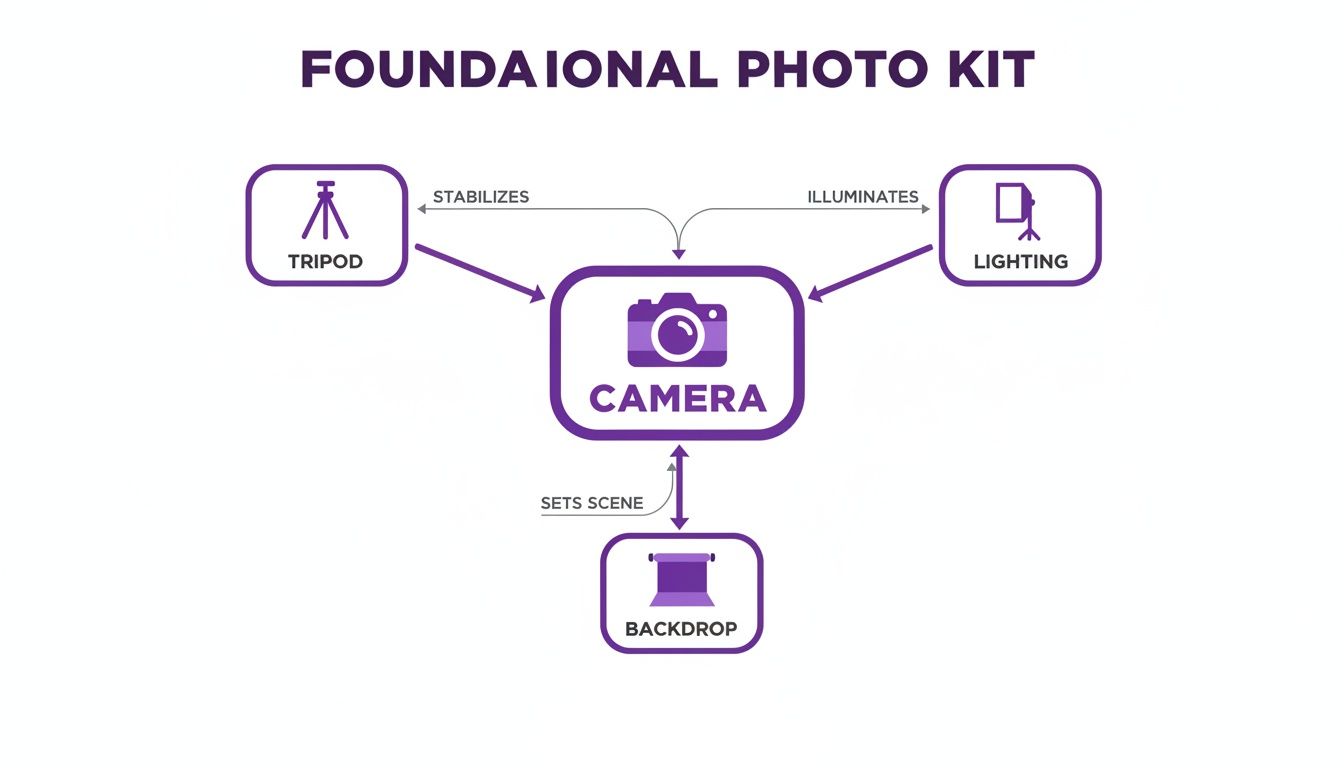
As you can see, the camera is just the beginning. The accessories you pair it with are what truly elevate your shots from good to great.
The Non-Negotiables for Every Fashion Brand
If you're just starting out, focus on the product photography accessories that deliver the most value. These are the absolute must-haves:
- A Sturdy Tripod: This is your secret weapon for sharpness and consistency. A tripod eliminates the tiny shakes that make photos blurry, letting you capture crisp details. It also locks in your angle, so every product is shot from the exact same perspective.
- A Basic Lighting Kit: Relying on window light is a recipe for inconsistency. A simple kit, usually with 2 softbox lights, gives you total control. You can kill harsh shadows and guarantee colors look the same in every photo, cutting down on returns.
- A Seamless Paper Backdrop: Your product is the hero. A simple roll of seamless paper in white, grey, or beige creates a clean, distraction-free canvas. It also makes editing in post-production a thousand times easier.
This trio is the traditional starting point. For a deeper dive, our complete guide to equipment for product photography covers all the essential gear.
The Modern Alternative: How AI Slashes Accessory Costs
Even a "basic" studio setup costs money and takes up space. That’s where AI-powered tools like Picjam are creating a new path for fashion brands.
Instead of spending thousands on lights and backdrops, you can take one good photo and let artificial intelligence handle the rest.
Picjam can digitally add studio-quality lighting, generate endless on-brand backgrounds, and even place your clothing on diverse AI models. This workflow dramatically slashes the need for physical gear.
For a brand like Zara, this approach is rumored to have cut content production costs by up to 40% by reducing the need for elaborate photoshoots. The budget that once went to equipment can now fund a marketing campaign or another production run.
This table breaks down how an AI-powered workflow stacks up against a traditional one:
Traditional Accessory Kit vs. AI-Powered Workflow
The shift is clear. By replacing the need for a closet full of gear, AI offers a more agile and cost-effective way to create stunning product content.
How to Master Light with Modifiers and Reflectors
If your camera is the eye, light is the voice that gives an image shape, mood, and a professional finish. Getting light right is the single most important skill in apparel photography.
The product photography accessories we call "modifiers" are your main tools for controlling it. This is what separates a flat, lifeless shot from a dynamic, high-converting catalog image.
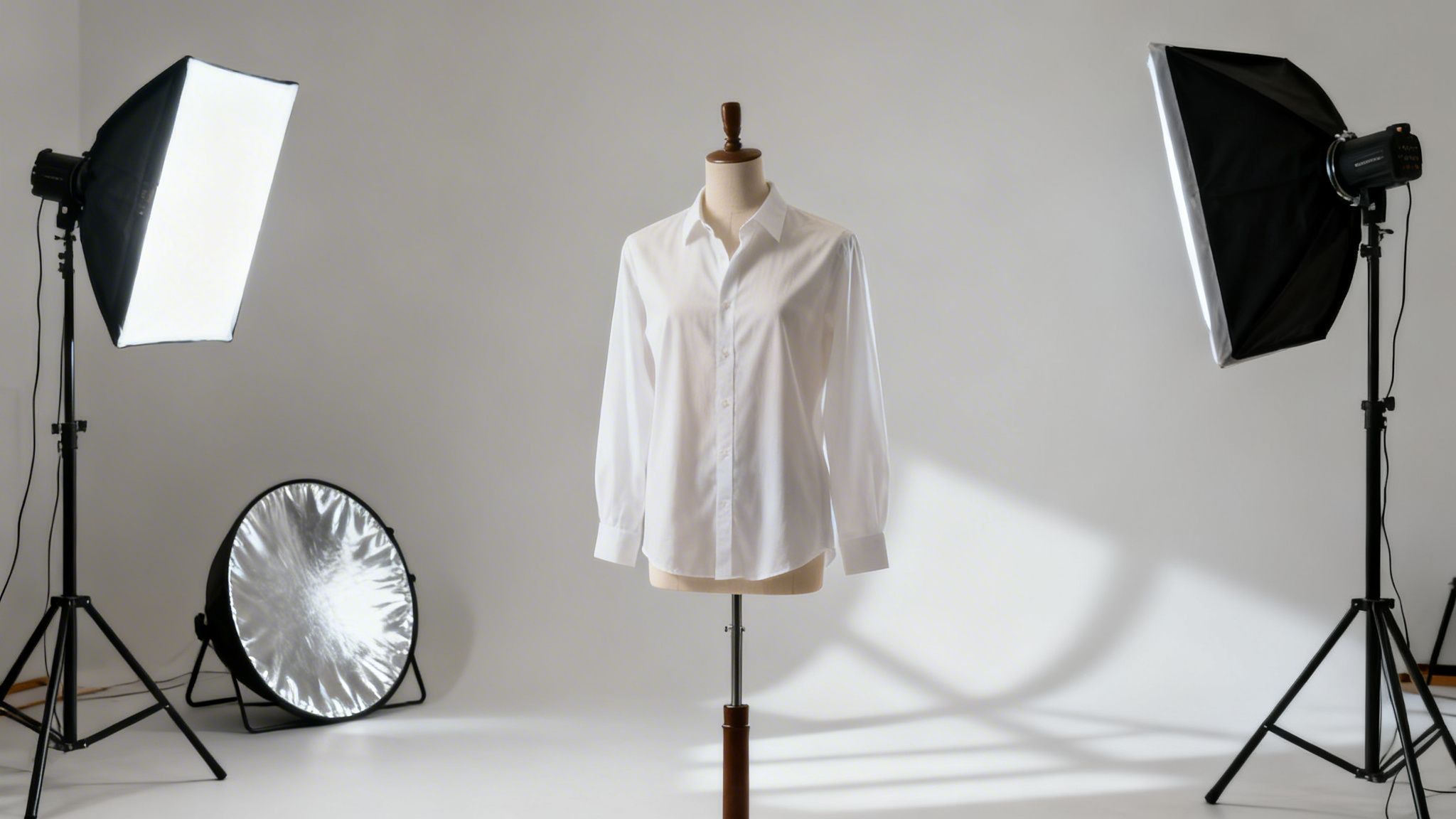
A McKinsey report notes that brands leveraging advanced analytics and AI see a 10% lift in sales. Better visuals, created efficiently, are a core part of that equation.
Hard Light vs. Soft Light: What's the Difference?
Lighting quality really comes down to one simple thing: the transition from light to shadow.
- Hard Light: This creates sharp, clearly defined shadows. Think direct sunlight. It can be dramatic, but for apparel, it's usually too harsh and hides fabric details.
- Soft Light: This creates smooth, gradual shadows with fuzzy edges. This light wraps itself around the product, beautifully revealing texture and color without distractions.
For fashion, soft light is almost always the goal. It flatters everything from delicate silk to rugged denim. This is where modifiers enter the picture.
Choosing Your Go-To Light Modifiers
A light modifier is any accessory that attaches to your light to shape or change its quality. For fashion brands, there are 3 you need to know:
Softboxes: These are the workhorses of e-commerce photography. A softbox pushes light through a white diffusion panel, creating beautiful, soft, and even light. For a deeper look, check out our guide on using a product photography light box.
Umbrellas: A simpler and often cheaper alternative. A shoot-through umbrella softens light by firing through its fabric, while a reflective umbrella bounces light off its inner surface. They give you less control than a softbox.
Beauty Dishes: This creates light that’s somewhere between hard and soft. Edgy fashion brands — think Rick Owens — can use it to create a more dramatic, high-fashion look in their model shots.
For most apparel brands, a large octagonal softbox is the most versatile investment for clean, appealing product shots.
The Simple Power of Filling Shadows with Reflectors
Even with a perfect main light, you’ll have shadows on one side of your product. A reflector is a simple tool used to bounce light back into those dark areas.
A simple white foam board from an art supply store works wonders as a reflector. Place it opposite your main light to gently fill in the shadows.
This little trick is a game-changer for showing the texture in dark fabrics like black denim or navy wool.
How AI Replicates a Pro Lighting Setup, Saving Thousands
A multi-light setup with different modifiers can easily cost thousands of dollars. More importantly, it takes time and expertise to set up correctly.
This is where Picjam’s AI lighting engine gives you a massive shortcut.
Instead of physically hauling lights, you can take one clean shot and digitally test-drive countless lighting styles. Picjam can perfectly replicate the soft light of a huge softbox or create the dramatic edge of a beauty dish with a click.
Imagine you're shooting a leather jacket for a brand like AllSaints. With Picjam, you can apply a hard lighting style digitally to show off the leather's sheen, then instantly test a softer setup for a different campaign — all without touching a single piece of physical gear.
How to Create Brand Context with Backdrops and Props
The background of your photo does more than fill space — it tells a story. While a clean white backdrop is a workhorse, contextual shots build your brand’s personality.
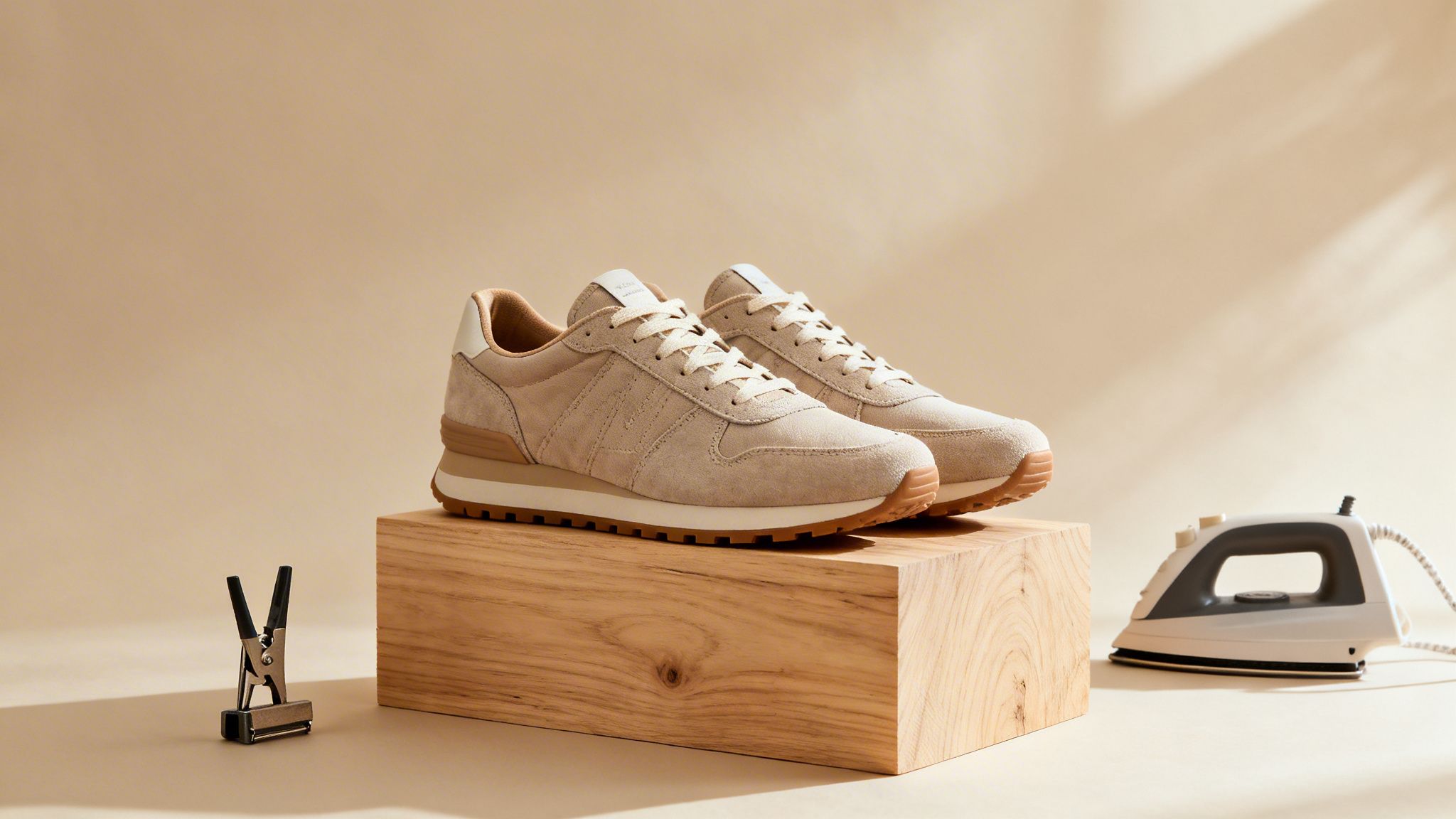
This is where backdrops and props become essential product photography accessories. They transform a simple product shot into brand marketing.
Choosing Backdrops That Build Your Narrative
Your choice of backdrop should always circle back to your brand’s core identity.
- Seamless Paper: This is the industry standard. A brand like Everlane might use neutral tones like bone or grey to maintain their minimalist, high-quality vibe.
- Textured Fabrics: Materials like linen or canvas can add depth. This works beautifully for brands with a natural feel — think of Sézane, whose photography often features soft, tactile surfaces.
- Durable Vinyl: Need to create repeatable scenes, like a faux marble surface? Vinyl backdrops are a fantastic, cost-effective option perfect for high-volume shoots.
For brands that want total creative freedom, a professional green screen background offers the ultimate flexibility, allowing you to digitally drop in any environment.
A Stylist’s Prop Kit for Flawless Presentation
Even for simple catalog images, a basic styling kit is non-negotiable for making every garment look its best.
Your basic kit should include:
- Clamps and Pins: Essential for cinching fabric on a mannequin to get that perfect, tailored fit.
- Fashion Tape: A secret weapon for holding unruly collars, lapels, and hems exactly where you want them.
- A Handheld Steamer: Wrinkles are the fastest way to make a product look cheap. A good steamer is absolutely essential.
Think about how a brand like Allbirds uses props. Their shoots often feature simple, organic elements like blocks of wood or stone that subtly reinforce the brand's sustainable ethos. For more options, see our guide on selecting the right product photography backdrop.
How AI Unlocks Infinite Backdrops and Saves Your Budget
Sourcing physical backdrops and finding shoot locations is a huge investment. A single lifestyle shoot can demand location scouting, permits, and hauling gear.
Picjam’s AI background generator lets you bypass that logistical headache. Take one clean product photo and instantly place it in hundreds of on-brand settings — from a sleek studio to a sun-drenched streetscape.
This capability completely transforms your creative workflow. Instead of committing to one expensive set, you can generate a dozen environments in minutes and A/B test them in ads. This agility saves thousands on location fees and prop rentals.
How to Capture Perfect Detail with Stabilization Tools
In fashion e-commerce, details sell the product. Nailing the intricate weave of a knit or the precise stitching on a handbag demands absolute sharpness.
This is where stabilization tools become mission-critical product photography accessories.
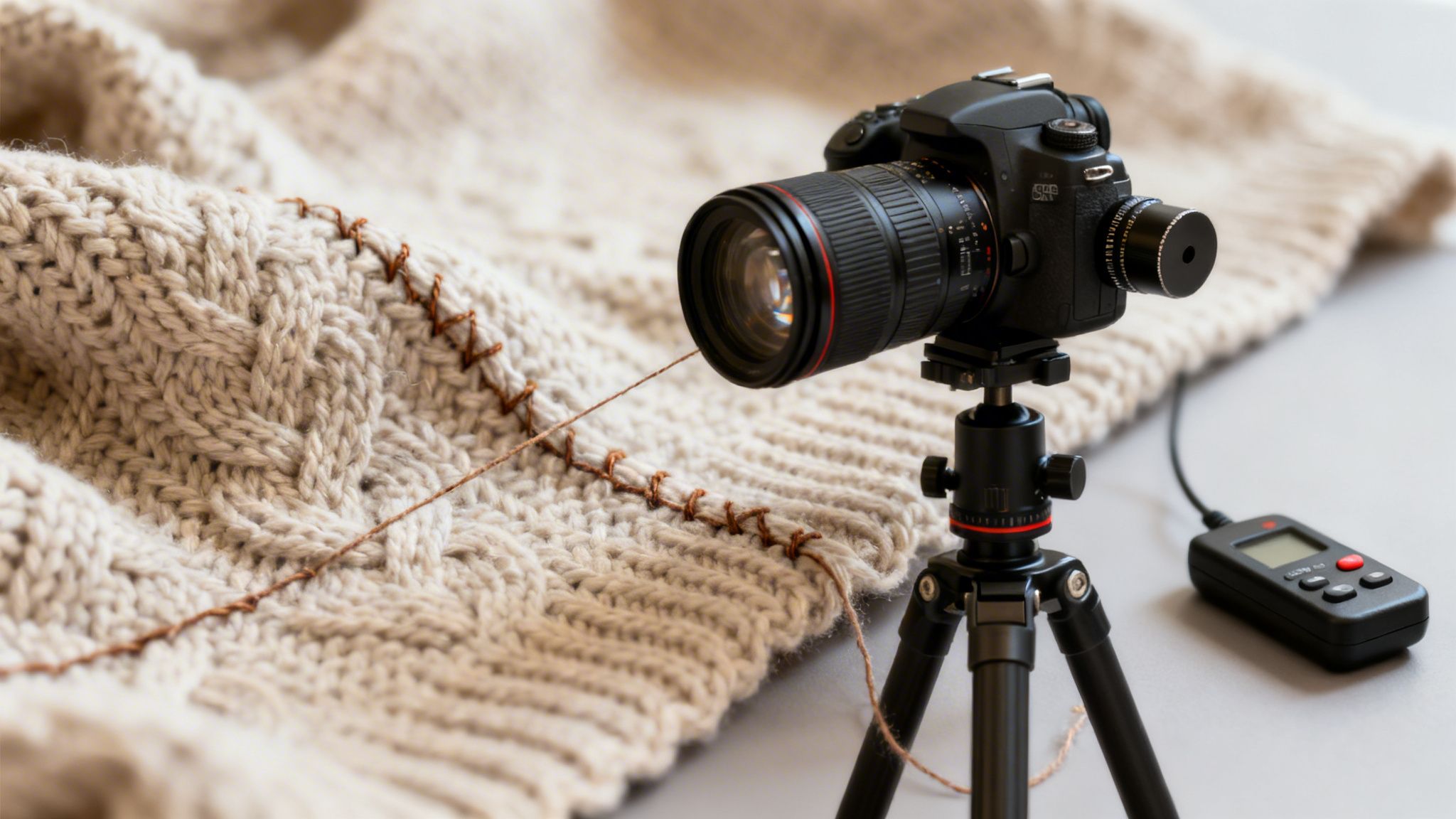
The overall photography equipment market is expected to grow significantly, according to Mordor Intelligence, because shoppers now expect high-resolution content everywhere they look.
Getting Closer with Macro Tools
To show off true craftsmanship, you have to get close — really close.
Macro Lenses: A dedicated macro lens is the gold standard. It captures subjects at a 1:1 life-size ratio. Think of Patagonia using a macro shot to highlight the water-resistant weave of a jacket. That one photo says more about quality than a paragraph of text.
Extension Tubes: For brands on a tighter budget, extension tubes are a fantastic workaround. They are hollow rings placed between your camera and lens, allowing the lens to focus much closer than it normally could.
Eliminating Every Trace of Camera Shake
When shooting extreme close-ups, the tiniest vibration can ruin the shot.
We’ve already covered why a sturdy tripod is non-negotiable. For macro work, you also need a remote shutter release. It lets you trigger the camera without touching it, eliminating vibration and ensuring your images are perfectly crisp.
In macro photography, sharpness is everything. Combining a tripod with a remote shutter release is the non-negotiable formula for achieving tack-sharp details.
The AI Shortcut to Perfect Detail
Capturing flawless macro shots and focus-stacking images is a time-consuming grind. This is another area where AI can make a real difference, saving brands time and money.
After capturing your best possible shot, Picjam’s AI can take it to the next level. Its upscaling and detail preservation features can intelligently sharpen and enlarge your images, ensuring that details stay crisp and clear, even when customers zoom in.
This hybrid approach — combining solid in-camera technique with smart AI enhancement — allows brands to produce elite-level detail shots without a steep learning curve.
How to Use Smart DIY Solutions on a Budget
When bootstrapping a fashion startup, the price of high-end product photography accessories can feel like a major roadblock. But a lean budget doesn't have to mean compromising on quality.
With a little resourcefulness, you can create stunning visuals by swapping professional gear for clever DIY solutions.
Building Your DIY Lighting Kit
Professional lighting is usually the biggest expense, but sunlight is free. The secret is learning how to shape it.
Create a Giant Softbox: Tape a sheer white curtain or vellum paper over a large window. This diffuses direct sunlight, transforming it into the same soft, flattering light you'd get from a pro setup.
Craft Your Own Reflector: You can get the exact same result as a pricey reflector from a large white foam board. Position it opposite your window to gently fill in shadows on your product.
This simple window-and-reflector combo can produce incredibly professional results.
Faking a Studio Backdrop
A clean, seamless background is non-negotiable.
A large, clean white wall is your best friend. If you don’t have one, grab a large roll of white craft paper and tape it to a wall, letting it curve gently onto the floor. This creates the seamless “infinity” look that makes products pop.
Resourcefulness is a startup’s greatest asset. A simple foam board and a window can outperform a poorly used professional lighting kit every time.
The Limits of DIY and the AI Alternative
While DIY solutions are fantastic for getting started, they have their limits. The 2 biggest challenges are consistency and scalability.
The quality of window light changes constantly, making it almost impossible to maintain a consistent look across an entire collection.
This is where an AI tool like Picjam starts to make sense from a savings perspective. Picjam gives you absolute consistency by letting you apply the exact same digital lighting and background to every photo, building a polished brand image without the headaches of a DIY approach.
Takeaway: How to Build Your Modern Workflow
Mastering your product photography gear isn't about ditching your camera for an app. It’s about building a modern, hybrid workflow to create incredible visuals faster and more efficiently.
1. Build a Solid Foundation, Then Experiment Digitally
Your first job is to nail the fundamentals. Invest in a sturdy tripod, a basic light, and a clean backdrop. Once you have that crisp base image, let AI become your creative playground to test endless digital backgrounds and lighting styles.
2. Light Control Is Everything
If you take one thing away from this guide, let it be this: light is everything. Whether you're shaping it with a physical softbox or tweaking it with a digital tool, your control over light separates an amateur snapshot from a professional image.
3. Think of AI as Your Ultimate, Cost-Saving Accessory
The biggest shift in thinking is to see AI not as a replacement, but as the ultimate accessory. It’s the one tool that can give you infinite backdrops, perfect lighting, and on-brand models without the physical clutter or expense.
Powerful product photography directly fuels your success. Mastering your visuals is a huge step, and exploring how that connects with ecommerce SEO marketing can elevate your brand's online sales.
Ready to see how much you could save by swapping physical accessories for a smarter workflow? Use the Picjam savings calculator to compare your current photography costs with a modern, AI-powered approach.

Picjam team
The Picjam team blends AI, product, and creative expertise to eliminate the cost and delay of traditional photography for modern eCommerce brands.

