AI for Fashion: Your Guide to Smarter E-Commerce
Discover how AI for fashion is transforming e-commerce. Learn practical applications for design, marketing, and sales that cut costs and boost brand growth.
How to start saving money
Lorem ipsum dolor sit amet, consectetur adipiscing elit lobortis arcu enim urna adipiscing praesent velit viverra sit semper lorem eu cursus vel hendrerit elementum morbi curabitur etiam nibh justo, lorem aliquet donec sed sit mi dignissim at ante massa mattis.
- Neque sodales ut etiam sit amet nisl purus non tellus orci ac auctor
- Adipiscing elit ut aliquam purus sit amet viverra suspendisse potent i
- Mauris commodo quis imperdiet massa tincidunt nunc pulvinar
- Adipiscing elit ut aliquam purus sit amet viverra suspendisse potenti
Why it is important to start saving
Vitae congue eu consequat ac felis placerat vestibulum lectus mauris ultrices cursus sit amet dictum sit amet justo donec enim diam porttitor lacus luctus accumsan tortor posuere praesent tristique magna sit amet purus gravida quis blandit turpis.

How much money should I save?
At risus viverra adipiscing at in tellus integer feugiat nisl pretium fusce id velit ut tortor sagittis orci a scelerisque purus semper eget at lectus urna duis convallis. porta nibh venenatis cras sed felis eget neque laoreet suspendisse interdum consectetur libero id faucibus nisl donec pretium vulputate sapien nec sagittis aliquam nunc lobortis mattis aliquam faucibus purus in.
- Neque sodales ut etiam sit amet nisl purus non tellus orci ac auctor dolor sit amet
- Adipiscing elit ut aliquam purus sit amet viverra suspendisse potenti
- Mauris commodo quis imperdiet massa tincidunt nunc pulvinar
- Adipiscing elit ut aliquam purus sit amet viverra suspendisse potenti
What percentage of my income should go to savings?
Nisi quis eleifend quam adipiscing vitae aliquet bibendum enim facilisis gravida neque. Velit euismod in pellentesque massa placerat volutpat lacus laoreet non curabitur gravida odio aenean sed adipiscing diam donec adipiscing tristique risus. amet est placerat imperdiet sed euismod nisi.
“Nisi quis eleifend quam adipiscing vitae aliquet bibendum enim facilisis gravida neque velit euismod in pellentesque massa placerat”
Do you have any comments? Share them with us on social media
Urna ut fermentum imperdiet lacus, elementum etiam maecenas libero nunc, suspendisse massa, nisl, elit curabitur feugiat in quis ut nibh enim in tristique aliquam sed vitae dui, dis adipiscing pharetra aliquam turpis turpis nibh rhoncus enim, pellentesque leo laoreet neque in sed bibendum fermentum suspendisse tempus non purus adipiscing suscipit fringilla adipiscing convallis dolor nulla fermentum facilisis ullamcorper ut vehicula tortor libero metus donec velit, tristique fermentum, dictum euismod diam scelerisque enim non pharetra tristique lectus habitant pharetra est id
By Michael Pirone, Founder of Picjam & Vidico
When fast-fashion giant Zara began testing AI to generate campaign imagery, they weren't just experimenting — they were building a new operational playbook. The move allowed them to create hyper-targeted visuals for different markets at a fraction of the cost, illustrating a shift that's happening across the industry. AI in fashion is no longer a futuristic concept; it’s a practical toolkit brands are using right now to streamline everything from design to final sale.
This guide breaks down exactly how AI for fashion is reshaping e-commerce, offering real-world examples and actionable steps for your brand.
How AI Slashes Content Costs and Accelerates Speed to Market

The global AI in fashion market is projected to surge from USD 2.56 billion in 2026 to USD 40.81 billion by 2034, growing at a compound annual growth rate of 41.39%.
This growth isn't just about market forecasts; it's about solving real, tangible problems. The traditional fashion pipeline is notoriously slow and expensive. A single photoshoot, for example, involves a logistical nightmare of photographers, stylists, models, and locations, often delaying a product launch by weeks.
This is where AI tools create immediate value. Platforms like Picjam allow brands to bypass traditional photoshoots entirely. By transforming simple product shots into thousands of on-brand, professional-quality images, brands can cut content costs by up to 90% and get products live exponentially faster.
In a fast-moving online world, that kind of speed is a major advantage. With AI, brands can:
- Create diverse and inclusive imagery. Generate visuals with a wide variety of models and settings without booking expensive reshoots. We cover how this works with AI fashion models.
- Optimize for different marketplaces. Instantly create images that meet the specific guidelines for platforms like Amazon or Shopify.
- Reduce cart abandonment. High-quality, varied visuals give shoppers a better feel for the product, building the confidence they need to click "buy."
For a direct-to-consumer brand, creating an entire campaign’s worth of visual assets in one afternoon — instead of waiting 4–6 weeks for photoshoot results — is a complete game-changer. It means they can jump on trends faster and put their budget toward growth, not logistics.
The impact of AI for fashion extends far beyond imagery. It's the engine behind the personalized recommendations that understand a shopper's style and the predictive tools that eliminate inventory guesswork. This deep integration is a core component of the future of digital commerce with AI, creating businesses that are smarter and more profitable.
How AI Cuts Design and Production Cycles in Half
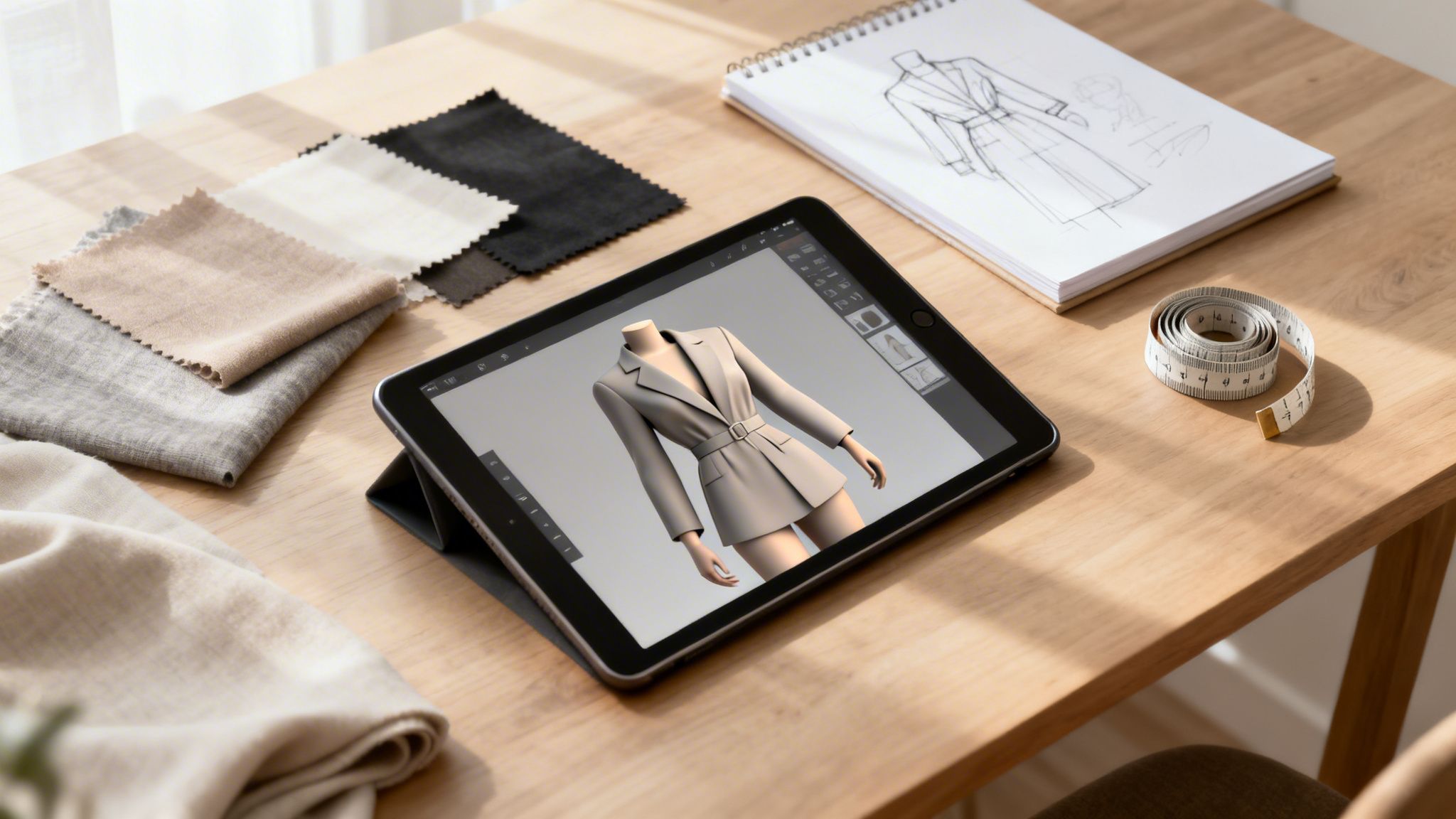
The traditional path from a design idea to a finished garment is notoriously inefficient, paved with guesswork, endless physical samples, and painfully long lead times.
AI is transforming this process, delivering real operational savings and a serious speed advantage.
Instead of relying solely on a designer's intuition, AI platforms can analyze massive amounts of real-time data from social media, runway shows, and e-commerce trends. This enables brands to identify what shoppers actually want, long before a design is sketched.
Imagine knowing which silhouettes, colors, and patterns are about to trend on TikTok this week, not six months from now. AI tools provide that foresight, helping designers make data-backed choices that are far more likely to sell out.
Once a design direction is locked in, AI-powered 3D design software eliminates the sample-making bottleneck.
By creating photorealistic digital versions of garments, designers can tweak the fit, texture, and color in hours, not weeks. This digital-first approach allows you to perfect a design before a single inch of fabric is cut, saving a tremendous amount of time and money.
According to a report from Forbes, AI-powered tools are helping brands slash sample-making time by up to 50% with 3D design. You can discover more insights on how these technologies are reshaping the industry.
The benefits of this accelerated cycle are clear:
- Faster Speed-to-Market: Launch collections that are in sync with current trends, not six months behind.
- Reduced Material Waste: Fewer physical samples is a major win for sustainability and your bottom line.
- Lower Production Costs: Every physical sample you avoid saves money on materials, manufacturing, and shipping.
By integrating AI into the design process, fashion brands can finally break free from the slow, linear model and build a more nimble, profitable company from the start.
How Predictive Analytics Sharpens Merchandising Strategy
For too long, fashion merchandising has relied on gut feelings and last season’s sales reports, a process that often leads to costly overstock or frustrating sell-outs.
AI for fashion is turning merchandising from a guessing game into a predictive science. AI algorithms analyze real-time data — sales history, web traffic, social media buzz, even weather forecasts — to predict demand with an accuracy that was once unimaginable.
This allows brands to stop guessing and start making sharp, data-backed decisions. Instead of ordering 1,000 units of a new jacket because a similar one sold well last year, AI can provide a detailed plan, suggesting exactly how many to stock in specific sizes, colors, and regions.
Predictive analytics also unlocks dynamic merchandising strategies that adapt to the market in real time. Imagine a fast-fashion brand notices a dress style gaining traction on social media. An AI system can automatically:
- Adjust pricing dynamically to capitalize on high demand.
- Create smarter product bundles to increase average order value.
- Optimize on-site placement by pushing the trending item to the homepage.
Stitch Fix is a prime example. The company's entire business model is built on using data science and AI to understand a customer’s personal style and ship them a curated box of clothes, keeping returns low and building incredible loyalty.
The impact on core business metrics is direct and measurable. According to McKinsey, AI-powered forecasting can reduce errors by 20–50%. This leads to:
- Reduced overstock and fewer margin-killing sales.
- Eliminated stockouts on best-selling items.
- Increased profitability through dynamic pricing and smart bundling.
Predictive analytics gives fashion brands a massive strategic advantage, allowing them to anticipate customer demand and make decisions with data-backed confidence.
How to Craft Personalized Shopping Experiences That Convert
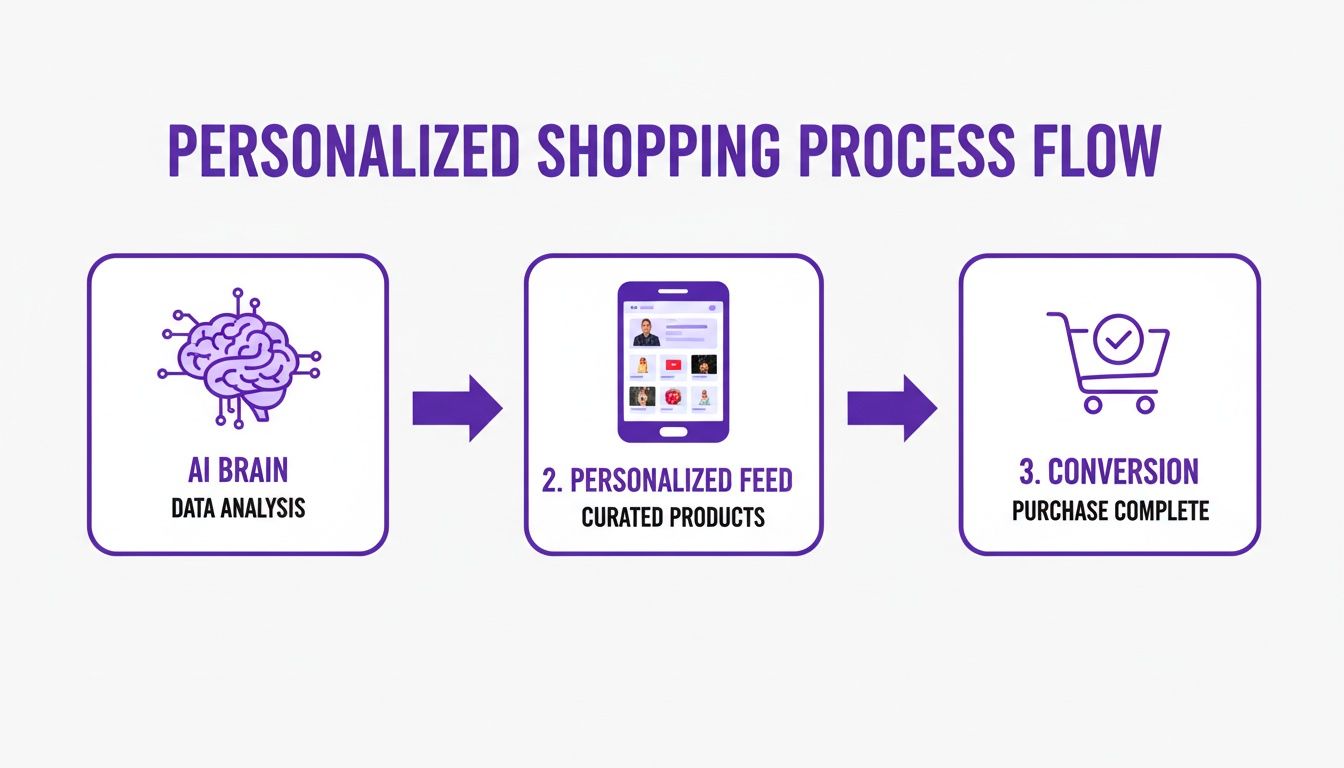
The one-size-fits-all storefront is dead. Today’s shoppers expect a curated experience that understands their style. While this was once a logistical challenge, AI for fashion is making it the new standard.
A recent report highlights that 53% of shoppers are already using generative AI for product discovery. As this detailed fashion report notes, brands that embrace AI-powered personalization will gain a significant competitive edge.
Modern AI engines build a hyper-personalized experience from the moment a user lands on your site by analyzing:
- Browsing History: Which products and pages did they view?
- Purchase Data: What have they bought before? What are their preferred sizes and colors?
- Visual Preferences: What styles and aesthetics capture their attention?
With this intelligence, the AI reshapes the user experience on the fly. If a shopper consistently views minimalist, neutral-toned basics, their homepage will feature new linen shirts and classic-fit denim, not loud graphic tees. This makes the experience feel less like an advertisement and more like a personal styling session.
Online retailer Revolve uses AI to analyze customer data and social media trends. The system identifies which influencers and styles resonate with specific customer segments, then automatically promotes those products to boost engagement and sales.
AI-powered chatbots are also transforming customer interactions. These virtual stylists are available 24/7, ready to help shoppers with queries like, "I need a blue dress for a summer wedding." The AI can serve curated options and ask follow-up questions to refine the search, guiding customers toward a confident purchase. Dive deeper into the mechanics of artificial intelligence personalization to see how it's reshaping customer interactions.
Personalization is no longer a "nice-to-have" — it's a core expectation. AI provides the tools to meet it, creating a shopping journey that not only converts but also builds lasting brand loyalty. For more on this, our guide on virtual try-on technology explores another powerful way AI engages customers.
Takeaway: Your 3-Step Plan for AI Adoption
Integrating AI into your fashion brand doesn't require a complete overhaul. The most successful brands start with a focused pilot project to prove the ROI, then scale from there.
Audit Your Content Costs. Before you can measure savings, you need a clear baseline. Tally up every expense from your last photoshoot: photographer fees, model bookings, studio rentals, and post-production. This is the number to beat.
Run a Pilot Project. Choose one upcoming product or a small capsule collection for a test. Use an AI tool like Picjam to create all your visual assets. The goal is to compare the cost and timeline directly against your traditional workflow. A clear win — like cutting content costs by 90% — becomes an undeniable internal case study.
A/B Test Your Creative. Use the variety of AI-generated images to run A/B tests in your ads and on product pages. Test different models, backgrounds, and concepts to see what your audience truly responds to. This data-driven approach ensures you get more out of every marketing dollar.
The first step is understanding your potential savings. Use our calculator to compare your current photography costs with the Picjam AI-powered approach.

Picjam team
The Picjam team blends AI, product, and creative expertise to eliminate the cost and delay of traditional photography for modern eCommerce brands.