A Brand's Guide to Virtual Try-On Technology
Discover how virtual try on technology elevates fashion e-commerce. This guide explains AR, AI, key business benefits, and how to integrate VTO for your brand.
When Gucci lets shoppers “wear” sunglasses using their phone's camera, it’s more than a cool feature — it’s a direct solution to e-commerce’s biggest problems: high return rates and low purchase confidence.
This is virtual try-on (VTO), a technology that creates a digital bridge between browsing and buying.
For apparel brands, where return rates often exceed 30%, according to Statista, VTO is becoming a critical tool. It gives shoppers the confidence to click “buy,” transforming a guessing game into a confident purchase.
How Virtual Try-On Slashes Fashion's 30% Return Rate
For as long as online shopping has existed, the inability to physically try on an item has been its Achilles' heel. We’ve all ordered multiple sizes, knowing most of it is going straight back. This behavior crushes profit margins.
VTO tackles this problem head-on by creating a digital fitting room.
When a customer sees how a dress might hang on their body type or how a pair of frames fits their face, that nagging uncertainty fades. For a business, that shift is everything.
Why Your VTO Is Only as Good as Your Product Photos
Virtual try-on systems are only as good as the digital assets you feed them. They need a steady diet of clean, consistent, and high-resolution product images to work their magic.
Blurry or inconsistent photos create a cheap and unconvincing try-on experience, which can do more harm than good for your brand.
This is where AI streamlines the process. Instead of costly, time-consuming photoshoots, brands can use an AI studio like Picjam to generate all the necessary on-model images from the start, saving both time and money.
By creating studio-perfect, on-model imagery first, brands streamline the entire VTO pipeline. This approach saves significant costs on traditional photography and accelerates getting products ready for digital try-on.
Connecting Your Assets to Actionable Sales
Think of the assets you create as building blocks. Let's say you use AI to generate images of one sweater on 10 different AI fashion models. That becomes the core data your VTO system needs to accurately project that sweater onto a customer's real-life photo.
These perfect digital assets ensure the VTO tool understands the garment's texture, color, and drape.
Suddenly, your product photography isn't just a marketing task — it's a strategic investment. Every high-quality image you create becomes a working part of an interactive sales tool. By understanding what a virtual model is, you build an asset library ready for the future of online retail.
A smart VTO strategy starts with a commitment to creating flawless digital assets in a smarter, more efficient way. Get that right, and you’re setting the stage for a shopping journey that builds confidence and boosts conversions.
Understanding the Core Virtual Try-On Technologies
To pick the right virtual try-on, you need to understand the tech behind the screen. Not all VTO tools are created equal; each is built for specific products and customer needs.
Getting a handle on these differences is key to matching the right solution to your business goals — and your budget.
The goal is to move past the "cool factor" and find a tool that solves a real problem, like chipping away at that brutal 30% average return rate for online apparel.
This simple decision guide shows when VTO stops being a nice-to-have and becomes a must-have.
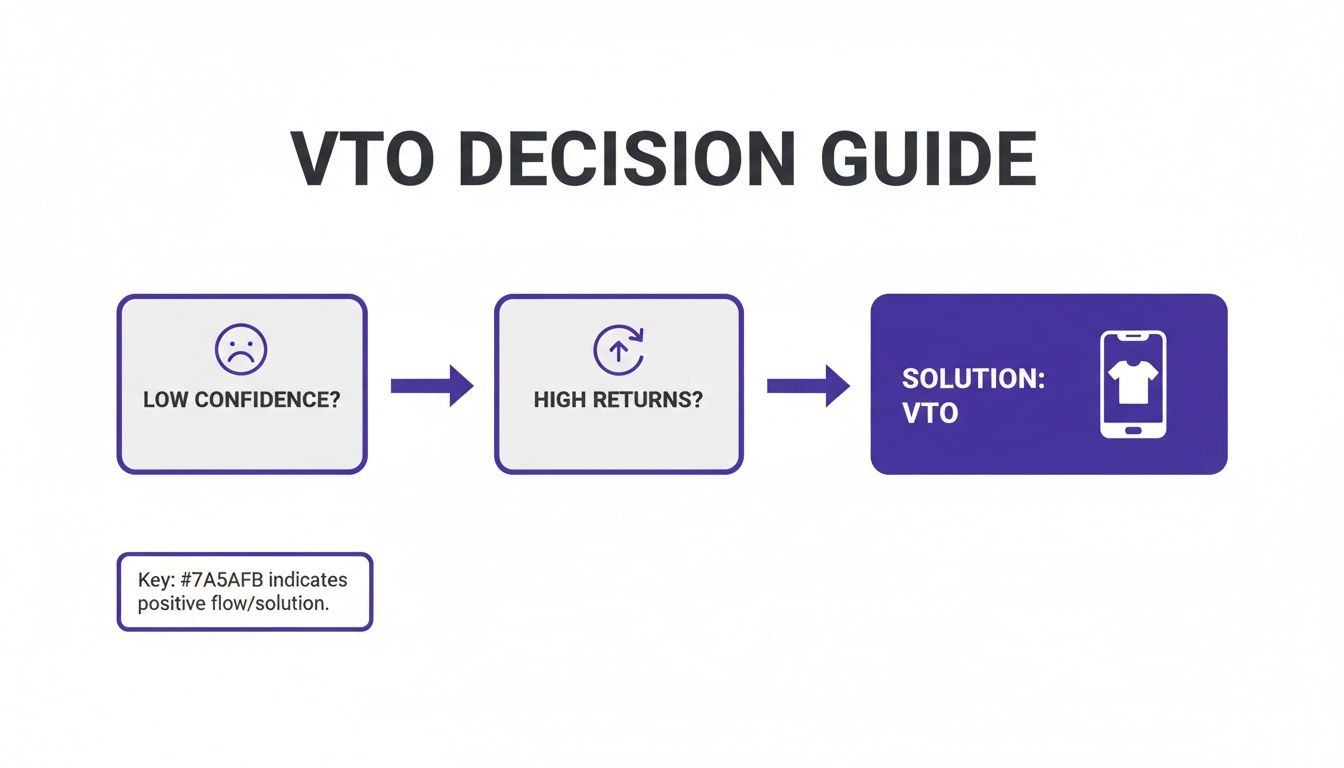
As the flowchart shows, low customer confidence and high return rates point directly to VTO as the solution. Let's break down the main technologies.
Augmented Reality (AR) Overlays for Instant Engagement
Think of AR as a smart, digital filter. Using a smartphone camera, AR tech places a digital product onto a customer’s live image. It's fantastic for showing how accessories look in relation to a person's features.
Eyewear brand Warby Parker is the classic example. Their app maps a customer’s face and places digital glasses on them in real time. For items where proportion is everything, this interactive experience is a massive confidence builder.
- How it Works: Uses a device's camera to superimpose a 2D or 3D product model onto the user's live video feed.
- Best For: Accessories like glasses, hats, jewelry, and makeup.
- Key Benefit: It feels personal and engaging because it’s happening live.
3D Rendering for Showcasing Product Details
Next is 3D rendering, which creates a fully interactive "digital twin" of your product. Instead of layering an item onto a person, this tech lets shoppers spin, zoom, and inspect a hyper-realistic 3D model from every angle.
Platforms like Shopify make it easier for brands to add 3D models to product pages. This gives customers an almost tactile sense of a product — from a handbag's leather grain to a sneaker's sole.
By letting customers examine a product from all sides, 3D rendering answers questions about quality and craftsmanship before they’re even asked. That alone can give your conversion rates a serious boost.
Many advanced VTO systems rely on computer vision and AI for seamless background removal to make the experience feel clean and believable.
AI Model-Based Technology for Solving the Fit Problem
This is the big one for apparel. AI Model-Based VTO is all about solving the single greatest challenge in selling clothes online: fit. This technology intelligently drapes a digital garment onto a model whose body type is similar to the shopper's.
Walmart went all-in on this approach after acquiring Zeekit. Their system lets shoppers choose a model who best represents their own height, shape, and skin tone, giving a truer sense of how a piece will actually fit their body.
This is where generative AI studios create huge savings. Instead of photo shoots for every item on dozens of models, brands can generate all the diverse, on-model assets they need in minutes. Check out our deep dive on AI body swap for apparel.
Comparing Virtual Try-On Technologies
AR provides playful interaction. 3D rendering lets customers inspect every stitch. And AI-driven models finally answer the question: "But how will it look on me?"
How Virtual Try-On Drives Measurable Business Growth
A virtual try-on experience is cool, but its real power is in the tangible return on investment it delivers. Once you get past the "wow" factor, you’ll find that VTO is a serious financial tool that boosts key business metrics.

The first place you’ll see an impact? Your return rates. For any online apparel brand, returns aren’t just a headache — they’re a margin killer.
Slashing the High Cost of Apparel Returns
The core promise of VTO is brilliantly simple: it gives customers the confidence that an item will fit and look good before they buy. This confidence is the perfect antidote to "bracketing" — ordering multiple sizes of the same item.
Online apparel return rates often soar past 30%. Each return chips away at margins through shipping and logistics costs.
When a brand like ASOS rolls out a VTO feature, it's a calculated move to shield their bottom line from the crushing costs of processing, restocking, and marking down returned inventory.
Boosting Conversions and Average Order Value
That same confidence actively encourages people to buy. When a shopper feels sure about how something will look, the hesitation between browsing and buying vanishes, creating a direct lift in conversion rates.
This confidence also makes customers more willing to add more to their cart, pushing up the average order value (AOV).
VTO transforms a static product page into an interactive fitting room. This keeps shoppers engaged, deepens their connection with your products, and makes them far more likely to make a purchase.
To get a true picture of VTO's impact, it’s worth exploring simple strategies to measure marketing ROI to capture the full value of the technology.
How AI Streamlines Your Content Production Costs
A good VTO strategy positively impacts your entire content pipeline. Most VTO systems run on a library of high-quality, consistent on-model photography.
This is where AI studios like Picjam create massive savings. Instead of staging expensive photoshoots, brands can generate all necessary digital assets first.
This creates a powerful, efficient cycle:
- Reduced Sampling: VTO tools can cut the need for physical samples by up to 70%.
- Lower Production Costs: AI-generated assets sidestep the overhead of traditional photoshoots.
- Faster Time-to-Market: Digital assets are ready in minutes or hours, not weeks.
By pairing AI asset creation with a virtual try-on experience, brands amplify efficiency from the start, turning a customer-facing feature into an operational advantage.
Weaving VTO Into Your E-Commerce Workflow
Integrating a virtual try-on solution is an actionable process hinged on the quality of your product assets. Any VTO experience is only as good as the images it’s built on.

An AI content platform like Picjam gives you a massive head start. Instead of inconsistent lighting from a traditional photoshoot, AI generates perfectly consistent, studio-grade photos on diverse models — the ideal raw material for any VTO system.
Starting with AI-generated assets doesn't just save money on photography. It builds a clean, reliable dataset that makes your VTO integration smoother and more effective.
Choosing a Partner and Planning a Phased Rollout
With your asset pipeline sorted, the next move is picking a VTO technology partner. As you evaluate providers, zoom in on a few key areas.
Ask direct questions about their integration process. A seamless API and clear documentation can save your development team hundreds of hours. Get details on scalability and pricing models to ensure they align with your growth plans.
Start with a pilot program focused on a handful of your best-selling SKUs. This controlled test lets you gather real-world data, see the impact on conversions and returns, and fine-tune the user experience before committing to a site-wide implementation.
This methodical approach minimizes risk. For example, a brand could test a virtual try-on for its top 10 dress styles to gather baseline data on user engagement and return rates for that category.
A Step-by-Step Integration Framework
Breaking the process into manageable stages makes the project less intimidating. A successful VTO integration follows a logical path.
- Asset Generation: Use a tool like Picjam to create a complete set of high-quality, on-model images for your pilot products. This ensures your VTO partner gets clean, standardized inputs.
- Partner Selection: Choose a VTO provider whose tech aligns with your product type (AR for sunglasses or AI-based for dresses) and whose integration process fits your team's resources.
- Pilot Program Launch: Implement the VTO feature on a limited selection of product pages, such as 5-10 popular items that also have a high return rate.
- Data Collection and Analysis: During the pilot, track conversion rates, add-to-cart rates, session duration, and, most importantly, the return rate for VTO-enabled items compared to those without.
- Iterate and Expand: Use pilot data to make improvements. Once you have a model that shows a positive ROI, you can confidently plan a broader rollout.
This structured workflow transforms adding a virtual try-on system from a technical headache into a smart, strategic business move.
Takeaway
Integrating a virtual try-on solution is a strategic process, not a simple plug-and-play feature.
- Assets First: The quality of your digital assets is the most important success factor, making AI content generation a critical first step to save time and money.
- Pilot Small: Start with a small pilot program on your best-sellers to collect data, prove the concept's value, and build a strong business case for a wider rollout.
How VTO and AI Will Shape the Future of Commerce
Virtual try-on is evolving from a neat feature into a cornerstone of AI-driven retail, making every interaction smarter and more personal.
The market growth is explosive. According to Grand View Research, the virtual try-on market, valued at USD 9.17 billion in 2023, is forecast to hit a staggering USD 46.42 billion by 2030. That’s a compound annual growth rate of 26.4%. You can see the virtual try-on market projections on Grandviewresearch.com.
From Product Viewer to Personal Stylist
The next leap isn't just showing customers how clothes look — it's telling them what they'll love. Imagine a shopping journey where VTO is tied directly to an AI recommendation engine.
The system would present a curated collection matched to a shopper's body type, purchase history, and even their Pinterest boards.
This flips browsing from a manual search into a personalized styling session. A company like Stitch Fix, which already lives on data, could use VTO to let clients see how a stylist's picks look before the box is even packed.
Bridging the Physical and Digital Worlds Seamlessly
We're also seeing the rise of "phygital" retail, where the lines between online convenience and in-store tangibility blur. Virtual try-on is the perfect bridge.
Imagine these scenarios:
- An in-store smart mirror lets a shopper try on items that are out of stock in their size, then instantly order them for home delivery.
- A customer uses VTO at home to build a wishlist. When they enter the physical store, those items are waiting in a fitting room.
This seamless connection creates a more fluid and helpful customer journey.
The goal is no longer just to sell a product online. It's to create an intelligent, customer-centric ecosystem where VTO is the common thread connecting digital discovery to physical experience.
Why Generative AI Is the Engine Powering It All
This future hinges on one critical component: a massive, diverse library of high-quality digital assets. Traditional photoshoots simply can't produce the volume or variety of images needed to power hyper-personalized VTO at scale.
Generative AI studios like Picjam are the engine for this evolution. By enabling brands to instantly create a nearly endless supply of on-model assets, they provide the fuel for these next-generation virtual try-on experiences. AI’s savings on content production make this future accessible for brands of all sizes.
Takeaway
The future of virtual try-on is intertwined with AI-powered personalization and phygital retail.
- Think Foundational, Not Feature: See VTO as a core technology for creating smarter, more engaging customer experiences.
- Build Your Asset Pipeline: The first step is creating a scalable and cost-effective pipeline for high-quality digital assets — this content will fuel every future AI-driven initiative.
Frequently Asked Questions About Virtual Try-On
Even with a solid strategy, a few practical questions almost always come up before brands pull the trigger on virtual try-on technology.
Let's dive into the big questions we hear most often from fashion founders and e-commerce managers.
How Accurate Is This Technology for Sizing?
This is the million-dollar question, and the honest answer is: it depends on the tech. For something like glasses, AR overlays nail proportion almost perfectly.
For clothing, AI model-based systems have made incredible leaps in showing how a garment might drape. But it's crucial to think of them as a tool for visualizing style rather than guaranteeing a perfect, down-to-the-centimeter size match.
The key is managing customer expectations. Position VTO as powerful style visualization and fit guidance, not a substitute for a size chart. Even with that caveat, advanced VTO providers report their solutions can cut size-related returns by 20-40%.
What Is the Real Cost to Implement VTO on My Site?
The cost of a virtual try-on solution typically has two components: a one-time setup fee and a recurring subscription.
- Setup Fees: These can start at a few thousand dollars and climb into the tens of thousands, depending on the complexity of the integration with your e-commerce platform.
- Subscription Costs: Monthly fees are usually tied to site traffic or the number of SKUs enabled with VTO, ranging from $500 to over $5,000 per month.
It's easy to focus on the upfront investment, but the ROI for VTO comes from the money you stop spending — fewer returns, lower photography costs, and better conversion rates. The savings on AI content production alone can often cover a huge chunk of the subscription cost.
What Kind of Product Images Do I Need for This to Work?
This is the most important question, because your product assets are the foundation of the entire virtual try-on experience. The system needs clean, consistent, and well-lit photos.
Most VTO providers will ask for simple flat shots of the garment, front and back, against a plain background.
This is where AI content creation tools change the game. Instead of budgeting for expensive, slow photoshoots, an AI studio like Picjam can generate perfectly standardized, studio-quality images already optimized for VTO systems, delivering massive cost and time savings.
Takeaway
Integrating a virtual try-on solution is a powerful move, but success hinges on a few key actions.
- Prioritize Asset Quality: Your VTO experience is only as good as your product photos. Start by creating a library of clean, consistent, high-quality images. Using AI can streamline this process and significantly reduce costs.
- Launch a Smart Pilot: Don't try to boil the ocean. Test VTO on 5-10 of your top-selling products to gather performance data on conversions and returns. This data will build a powerful business case for a wider rollout.
- Focus on ROI: A successful pilot transforms the conversation from "we think this will work" to "we have data showing this works." Use this data to prove VTO is a strategic investment that reduces returns and boosts sales.
Ready to see how much you could save on the foundational asset creation step? Calculate your potential savings with Picjam’s photography cost calculator and start building your VTO strategy on a solid, cost-effective foundation.

Picjam team
The Picjam team blends AI, product, and creative expertise to eliminate the cost and delay of traditional photography for modern eCommerce brands.