Creative Editorial Fashion Photography: A Guide for Brands in 2026
Discover how brands leverage creative editorial fashion photography to tell compelling stories and drive sales. Get actionable insights for your next campaign.
By Michael Pirone, Founder of Picjam & Vidico
In fashion, a picture doesn't just sell a product; it sells a feeling. When Jacquemus shot their "Le Chouchou" collection at the Palace of Versailles, they weren't just showing handbags — they were selling a dream of modern royalty. This is the power of creative editorial fashion photography: it transforms products into stories, turning browsers into brand loyalists.
How Story-Driven Visuals Cut Through the Noise
Think about the standard e-commerce grid: clean photo, white background. It's functional, but it doesn't build a brand. According to McKinsey, 75% of online shoppers say compelling product photos are the deciding factor in a purchase. Editorial shots are what make those photos compelling.

They build a world around your collection. They invite customers to picture themselves not just in the clothes, but in the life that comes with them.
Brands like Ganni or Simon Miller do this masterfully. Their campaigns bottle a vibe — a sun-drenched vacation, a quirky city afternoon. That emotional pull is something a sterile product shot can’t replicate.
High-Concept Visuals Are No Longer a Luxury
Not long ago, creating this kind of imagery was a massive undertaking requiring models, stylists, photographers, and studios. The cost was a non-starter for many brands.
AI is breaking down those barriers, making editorial-quality photography accessible to everyone.
Tools like Picjam are leading this shift. With AI, brands can now:
- Generate entire shoots with diverse, on-brand AI models in minutes.
- Test dozens of background and lighting concepts without physical gear.
- Lock in a consistent, high-fashion aesthetic across every channel.
What was once a costly, one-off project is now a scalable part of your content strategy. Finding smart strategies to make your ecommerce brand stand out is just as critical as the creative itself.
An indie brand can now produce visuals with the same polish as a legacy fashion house, using AI to level the playing field. You're no longer competing on budget; you're competing on vision.
This is about building a brand people want to be part of. By pairing a strong creative vision with the right tools, any brand can stop just selling products and start building an icon.
Building Your Narrative From Mood Board To Campaign Concept
Every great editorial shoot begins long before anyone picks up a camera. It starts with a story. This is the foundational step where you translate your brand's soul into a visual campaign.
Think of it like a one-page script for your collection. A solid concept acts as your north star, guiding every decision and preventing costly "let's just try stuff" indecision on set.
From Vague Idea To A Skimmable Visual Blueprint
A mood board isn’t just a pretty collage; it’s a strategic document. Its job is to build a visual language for your shoot that the entire team — from the stylist to the photographer — can understand and execute.
First, define your core message. Are you channeling ‘urban romanticism’ or ‘dopamine dressing’? Answering that one question helps filter out every image that doesn't serve the story.
A useful mood board should detail:
- Color Palette: Is it muted and earthy, or vibrant and saturated?
- Textures and Materials: Include textures from nature, architecture, or art that evoke the right feeling.
- Lighting and Mood: Are you aiming for dramatic, high-contrast shadows or soft, ethereal light?
- Posing and Energy: Capture the attitude. Is it powerful and static, or fluid and in motion?
This is where tools like Picjam can streamline the process. Instead of guessing, you can quickly generate visual concepts with AI models and different backgrounds, helping you see what clicks before you spend a dime on real-world resources.
Making Your Concept Actionable and Cost-Effective
Once your mood board is locked in, it becomes the definitive guide for your shoot. Every decision can be checked against it. Does this location match our mood? Does this model’s look align with our story?
A strong concept is your best defense against a chaotic shoot. It’s the difference between a few lucky shots and a powerful, cohesive body of work.
Let’s say your concept is "rebellious luxury." Your mood board might feature brutalist architecture and high-flash photography. This immediately tells the team to scout industrial locations and plan for specific lighting.
This conceptual work is the foundation of creative editorial fashion photography. With it, you're building a world your customers want to be a part of. The story comes first; the photography serves the story.
How to Direct Styling and Posing for Authentic Connection
This is where the concept starts to feel real. Styling is more than picking cool clothes; it’s translating your mood board’s story into tangible, deliberate choices. Every garment, accessory, and prop must belong in the world you’re building.

Think of your stylist as a co-author. It’s their job to turn ideas like ‘dopamine dressing’ into specific combinations of fabric and silhouette. A solid brand storytelling framework helps ensure every decision feels connected.
Here's how different brand identities can inform styling and direction.
Editorial Styling Concepts For Different Brand Identities
| Brand Archetype | Styling Elements | Model Direction & Posing | Example Mood |
|---|---|---|---|
| The Rebel | Deconstructed denim, leather, vintage band tees, chunky hardware. | Confident, direct gazes. Unposed, in-motion shots. | Urban grit, unapologetic self-expression. |
| The Romantic | Flowing silks, delicate lace, soft knits, floral prints, puff sleeves. | Soft, dreamy expressions. Gentle, fluid movements. | Whimsical, ethereal, nostalgic. |
| The Minimalist | Monochromatic palettes, clean lines, structured tailoring, high-quality fabrics. | Strong, architectural poses. Stillness, quiet confidence. | Polished, sophisticated, understated luxury. |
| The Adventurer | Utilitarian fabrics, cargo pockets, earth tones, practical layers. | Active, dynamic poses. Walking, looking into the distance. | Rugged, exploratory, authentic capability. |
The magic happens when you mix and match these elements to create a unique story true to your brand.
Eliciting Authentic Poses That Stop the Scroll
Once the wardrobe is set, your attention shifts to the person wearing it. Shoppers are over stiff, "perfect" poses. What stops the scroll now is authenticity — the micro-expressions and candid moments that feel genuine.
The era of the blank-faced, static model is over. Genuine emotion and believable movement are what connect with an audience.
How do you get that authenticity? Treat your direction like a conversation. Instead of telling a model to "look happy," give them a reason to be.
Try prompts that spark a real reaction:
- "Walk toward the camera like you just spotted an old friend."
- "Imagine the feeling of the first warm day of spring."
- "Picture yourself heading to your favorite coffee shop on a Saturday."
These scenarios unlock natural movement, making your images feel like a snapshot from a real moment. Our guide on capturing stunning model fashion poses is packed with more inspiration.
How AI De-Risks Expensive Styling and Casting Choices
Here's the problem with traditional shoots: styling and casting decisions are expensive mistakes. You might get on set and realize a key outfit isn't working. By then, you've sunk the budget.
This is where Picjam becomes a game-changer. Before you book a studio, you can test-drive your entire creative vision.
With Picjam, you can generate and test hundreds of styling combinations on different AI models in minutes. Refine your concept and pinpoint winning looks without the cost and risk of a physical shoot.
Imagine you're torn between 3 styling concepts. Instead of guessing which will perform best, use Picjam to generate all 3. Place them in different virtual locations and see what works.
This AI-powered pre-visualization saves massive resources. You walk onto the set with a clear, validated plan, confident that every pose and piece of clothing is working for your story.
Mastering Light and Composition to Create Editorial Impact
Great editorial shots are made, not just taken. While a strong concept and killer styling are key, it’s the technical execution — the light and the composition — that truly elevates a photo.

The right lighting sets the entire mood. It dictates whether a shot feels romantic and dreamy or edgy and dramatic. Think of light as another character in your scene.
Choosing a Lighting Style to Amplify Your Narrative
Your lighting choices should always serve the narrative you built in your concept. The most effective choice is the one that amplifies the emotion you want your audience to feel.
In creative editorial fashion photography, a few approaches work wonders:
Soft, Diffused Light: This is your go-to for a gentle, romantic look. Find it on overcast days or create it with large softboxes. It’s perfect for conveying serenity or nostalgia.
Hard, High-Contrast Light: Think direct sunlight or a bare-bulb flash. This carves out deep shadows and bright highlights, creating a dramatic, cinematic feel. It’s perfect for stories that need an edge of mystery or power.
"Strong light creates strong photographs. Don’t avoid sunlight or shadows — learn to use them to your advantage." — George Eastman
Our guide on essential photography lighting basics is a great place to start experimenting.
Composing the Shot for Skimmable Visual Interest
Composition is how you arrange elements in the frame to guide the viewer's eye. While there are "rules," the best photographers know when to break them for maximum impact.
Get these core principles down cold:
The Rule of Thirds: Imagine a 3x3 grid over your screen. Placing your model along those lines or at their intersections creates a more compelling image than centering your subject.
Leading Lines: Use roads, fences, or staircases to draw the viewer's eye right to your subject. It creates depth and movement.
Negative Space: Don't be afraid of empty space. The area around your subject can make your product pop or give the image a clean, minimalist feel.
How AI Can Save Thousands on Location and Lighting Tests
In the past, experimenting with light and composition was a huge time and money sink. A cloudy day could ruin a "sunny day" shoot.
A modern workflow, powered by a tool like Picjam, gives you an almost unfair advantage. You can take a single product photo and instantly test a dozen creative variations without a reshoot.
Imagine you have a great shot of a model in a new trench coat. With Picjam, you can:
- Drop the model into a soft, sun-drenched field to test a romantic concept.
- Then, place that same model in a high-contrast, shadowed city alley for a grittier feel.
- Play with different times of day, from the warm glow of golden hour to the cool tones of twilight.
This ability to A/B test creative ideas de-risks the entire process. It lets you explore bold ideas and find the exact visual tone that will connect with your audience.
Your Guide to a Modern, Cost-Effective Post-Production Workflow
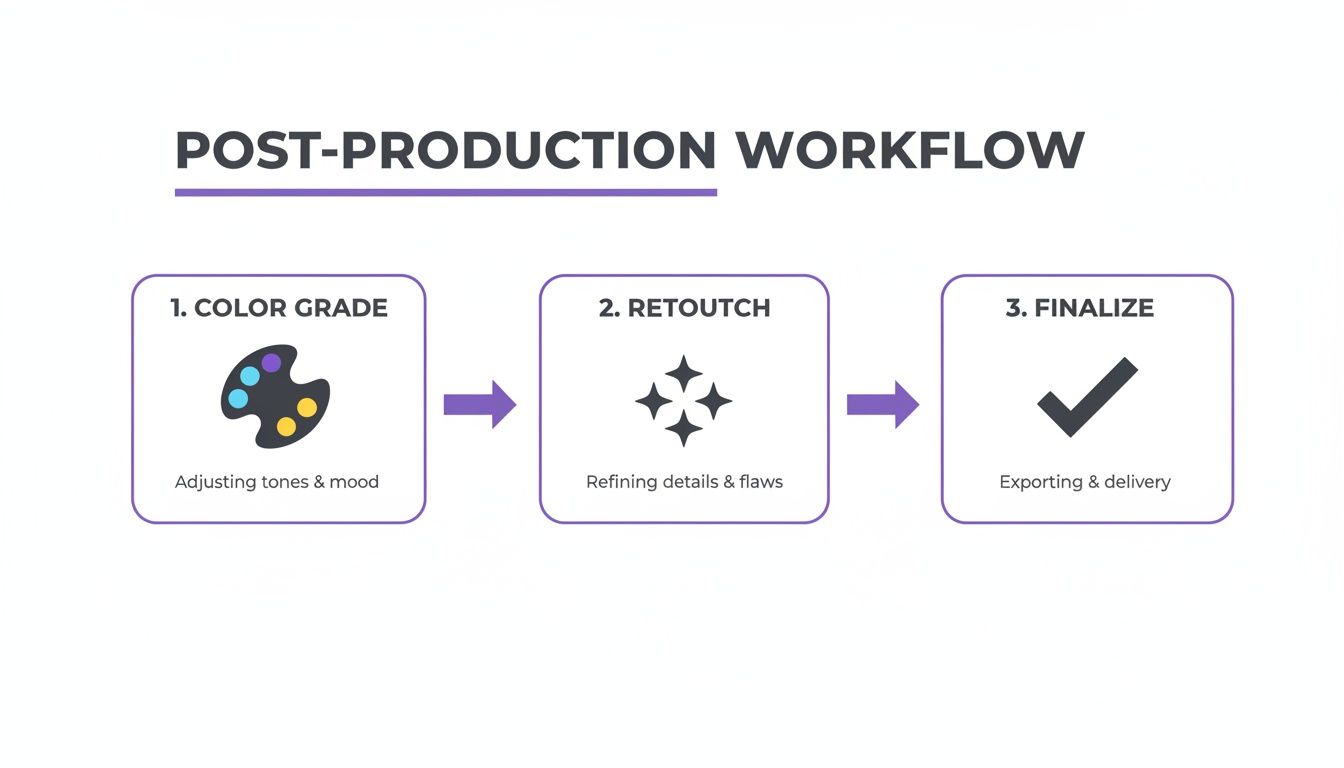
Post-production is where the real magic happens. It’s about amplifying the mood and story you captured on set. A modern workflow enhances reality, ensuring every shot feels part of a cohesive, impactful campaign.
The goal is to make every image feel like part of a single visual family through consistent color grading.
Defining Your Campaign's Mood With Color Grading
Color is the heartbeat of your campaign. Is the vibe a warm, hazy summer memory, or the cool feel of a city street? Your answer should tie back to your mood board.
For a "70s bohemian" feel, you might lean into warm, golden tones and slightly faded blacks to mimic vintage film. A minimalist tech-wear brand would likely go for clean, cool whites and deep, true blacks.
Post-production isn't about fixing mistakes; it's about making deliberate artistic choices. Your color palette should be as intentional as your styling.
By setting a consistent white balance on set and applying a unified grade in post, you create a seamless experience. We dive deeper into this in our guide to mastering ecommerce photo editing.
Retouching With an Emphasis on Authenticity
In an era where authenticity is everything, the goal of retouching has shifted. It’s about enhancing, not erasing. Preserving the natural texture of both the clothes and the model’s skin is non-negotiable.
Overly smoothed skin and digitally perfected fabrics create distrust and can lead to more returns when the real product doesn't match the image.
Instead, focus on subtle adjustments:
- Blemish Removal: Clean up temporary distractions like a small spot or stray hair, but leave permanent features like freckles or fine lines.
- Dodge and Burn: Subtly add shape and dimension by enhancing the natural play of light and shadow.
- Texture Preservation: Ensure your process doesn't soften the weave of a wool coat or the crispness of a cotton shirt.
How AI Can Cut Your Post-Production Time in Half
The traditional post-production process is a notorious time-sink. AI-powered tools automate the most repetitive tasks without sacrificing quality.
Platforms like Picjam give your workflow a massive speed boost. Imagine uploading your final selects and having an AI handle the initial grunt work — like removing distracting background elements or fixing minor imperfections.
This frees up your retoucher to focus on high-impact, artistic work like color grading and nuanced skin work. It's a blend of human artistry and AI efficiency that defines the new standard.
The Takeaway: 3 Steps to Elevate Your Next Campaign
How do you apply these ideas to your next campaign? It's about making small but powerful shifts that move you from just taking pictures to crafting a visual story that sells.
Write a One-Page Story First. Before thinking about a camera, write a one-page story for your collection. This creative anchor guides every decision, from casting to location scouting.
Test 3 Concepts with AI. Before committing your budget, validate your story. Use a tool like Picjam to generate 3 distinct concepts with different AI models and backgrounds. This simple step removes huge risk from the process.
- Direct for Micro-Expressions. On set, focus on capturing authentic micro-expressions, not just perfect poses. The unguarded, in-between moments are what connect with people and make your brand feel human.
Combining a strong narrative with tech-powered validation helps you create visuals that don't just look beautiful — they perform better and cost less to produce.
Curious what this workflow could mean for your budget? Plug your numbers into the Picjam savings calculator. It’s an eye-opener.
Frequently Asked Questions
Not every brand has a six-figure photoshoot budget. One of the biggest questions is how smaller brands can achieve a high-end, editorial feel without emptying their bank account.
The trick is to be resourceful. Focus on a single, powerful story. Scout free locations that tell a story — the brutalist lines of a building, the way light hits an alley, or a gritty, textured wall can be more compelling than a sterile studio.
This is also where you can bridge the budget gap with AI. Instead of blowing your budget on a dozen models, a tool like Picjam can take a single shot and test it on countless AI models, creating a campaign’s worth of diversity from one photo.
How many images do I really need for a campaign?
This depends on where the images will live, but the goal is variety, not volume.
For a product detail page, aim for 5–8 images. Mix in standard product shots with at least 2–3 editorial or lifestyle images.
For social media, plan for at least 3–5 unique visuals per week for each hero product. "Unique" doesn't always mean a new photoshoot. One photo can be repurposed by cropping it, shifting the color grade, or adding text.
What’s the real difference between lifestyle and editorial?
This isn't just semantics; it's a crucial strategic decision.
Lifestyle photography shows your product in a relatable, everyday context. It’s aspirational but achievable. Think of someone laughing with friends while wearing your jacket. It sells a moment the customer can see themselves in.
Creative editorial fashion photography sells a fantasy. It's more artistic, conceptual, and built around a narrative. It's about creating a dream or a powerful feeling, not just showing a product.
Lifestyle demonstrates how a product is used, while editorial builds the world the brand lives in.
Ready to see how this modern workflow impacts your bottom line? Use our savings calculator to compare costs against traditional photoshoots and discover how much you could save. Start calculating your savings here.

Picjam team
The Picjam team blends AI, product, and creative expertise to eliminate the cost and delay of traditional photography for modern eCommerce brands.