How AI Ecommerce Image Editing Services Cut Content Costs for Fashion Brands
Discover ecommerce image editing services that elevate fashion brands with AI and traditional methods. Compare costs, speed, and the ideal partner.
How to start saving money
Lorem ipsum dolor sit amet, consectetur adipiscing elit lobortis arcu enim urna adipiscing praesent velit viverra sit semper lorem eu cursus vel hendrerit elementum morbi curabitur etiam nibh justo, lorem aliquet donec sed sit mi dignissim at ante massa mattis.
- Neque sodales ut etiam sit amet nisl purus non tellus orci ac auctor
- Adipiscing elit ut aliquam purus sit amet viverra suspendisse potent i
- Mauris commodo quis imperdiet massa tincidunt nunc pulvinar
- Adipiscing elit ut aliquam purus sit amet viverra suspendisse potenti
Why it is important to start saving
Vitae congue eu consequat ac felis placerat vestibulum lectus mauris ultrices cursus sit amet dictum sit amet justo donec enim diam porttitor lacus luctus accumsan tortor posuere praesent tristique magna sit amet purus gravida quis blandit turpis.

How much money should I save?
At risus viverra adipiscing at in tellus integer feugiat nisl pretium fusce id velit ut tortor sagittis orci a scelerisque purus semper eget at lectus urna duis convallis. porta nibh venenatis cras sed felis eget neque laoreet suspendisse interdum consectetur libero id faucibus nisl donec pretium vulputate sapien nec sagittis aliquam nunc lobortis mattis aliquam faucibus purus in.
- Neque sodales ut etiam sit amet nisl purus non tellus orci ac auctor dolor sit amet
- Adipiscing elit ut aliquam purus sit amet viverra suspendisse potenti
- Mauris commodo quis imperdiet massa tincidunt nunc pulvinar
- Adipiscing elit ut aliquam purus sit amet viverra suspendisse potenti
What percentage of my income should go to savings?
Nisi quis eleifend quam adipiscing vitae aliquet bibendum enim facilisis gravida neque. Velit euismod in pellentesque massa placerat volutpat lacus laoreet non curabitur gravida odio aenean sed adipiscing diam donec adipiscing tristique risus. amet est placerat imperdiet sed euismod nisi.
“Nisi quis eleifend quam adipiscing vitae aliquet bibendum enim facilisis gravida neque velit euismod in pellentesque massa placerat”
Do you have any comments? Share them with us on social media
Urna ut fermentum imperdiet lacus, elementum etiam maecenas libero nunc, suspendisse massa, nisl, elit curabitur feugiat in quis ut nibh enim in tristique aliquam sed vitae dui, dis adipiscing pharetra aliquam turpis turpis nibh rhoncus enim, pellentesque leo laoreet neque in sed bibendum fermentum suspendisse tempus non purus adipiscing suscipit fringilla adipiscing convallis dolor nulla fermentum facilisis ullamcorper ut vehicula tortor libero metus donec velit, tristique fermentum, dictum euismod diam scelerisque enim non pharetra tristique lectus habitant pharetra est id
When ASOS tested AI-generated models, they saw a staggering 30% drop in photoshoot costs for specific product lines. This wasn't a minor tweak — it was a signal of a massive shift in how fashion brands create visual content. We've moved far beyond simple background removal; modern ecommerce image editing services now use AI to build entire campaigns from a single photo, often eliminating the need for a physical shoot.
What AI-Powered Imagery Means for Fashion Brands Today
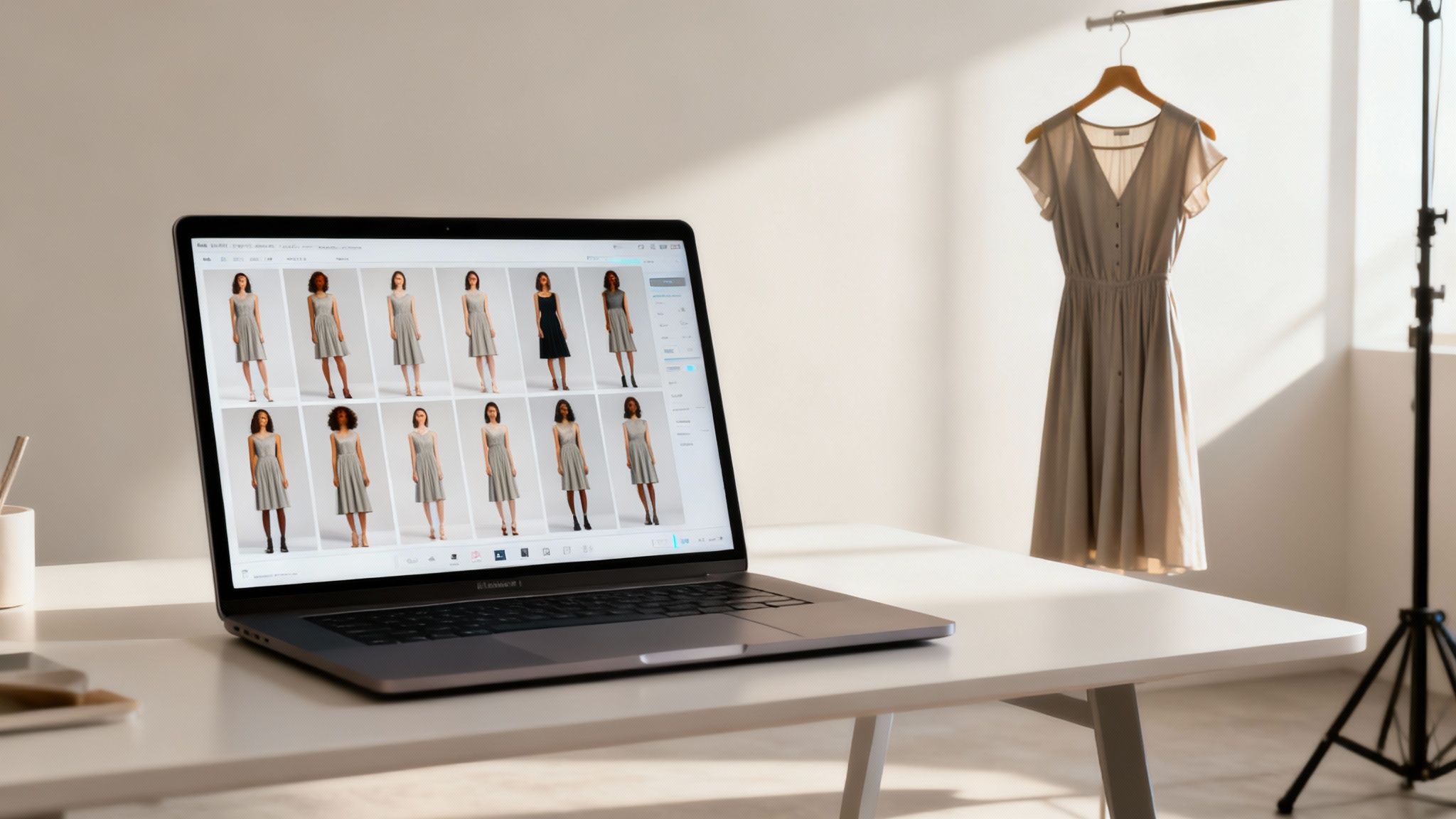
Sinking huge budgets and weeks of coordination into a single product shoot is becoming an outdated model. Success in fashion ecommerce is now about agility and scale.
Brands need a constant stream of fresh, diverse, and on-brand visuals for product pages, social feeds, and ad campaigns.
This is where a new standard is being set by platforms like Picjam. Instead of just cleaning up existing photos, the goal is to generate entirely new assets.
Imagine taking one flat-lay shot of a new dress. In under a minute, you can create a complete lookbook with different models, backgrounds, and lighting setups. That's the new reality.
How AI-Driven Editing Meets Digital Marketplace Demands
This isn't just a cost-saving gimmick; it's a strategic pivot. The AI product photography market, valued at $450 million in 2023, is projected to hit $5 billion by 2035, according to a recent industry report.
This explosive growth shows how quickly brands are adopting AI to get studio-quality results, instantly.
This operational speed unlocks serious advantages:
- Test creative faster: A/B test different models or scenes in social ads without booking expensive reshoots.
- Increase diversity: Effortlessly showcase products on a wider, more representative range of virtual models.
- Improve consistency: Lock in a cohesive brand look across thousands of SKUs automatically.
Investing in top-notch product imagery is a cornerstone of this new standard. Why? Because visually stunning products are a huge factor in how you improve ecommerce customer experience and grow your bottom line.
"Today’s challenge isn’t just about creating a beautiful image," a leading fashion marketer noted recently. "It’s about creating hundreds of them, tailored to different channels and audiences, without slowing down your product launch. AI makes that possible."
This new workflow gives brands the creative freedom and ruthless efficiency needed to stay competitive. It elevates your visual identity while unclogging your content production pipeline.
4 Core Services That Transform Product Photos
Today’s ecommerce image editing services are powerful creative engines, capable of turning a single photo into a whole library of visual assets.
These core features aren't just about making pictures look better; they're built to solve real business problems.
Each service plays a distinct role in transforming a basic product shot into a high-performing marketing tool.
Let's break down the most essential services you'll find on leading platforms.
1. How AI Model Generation Increases Representation
Imagine taking one photo of a new dress and instantly seeing it on 5 different models, each representing a key customer demographic. That's the power of AI model generation.
For a brand like Reformation, this means they can test which model resonates most with their audience in Paris versus Los Angeles — without booking a single extra photoshoot.
This technology directly answers the demand for inclusive representation in fashion. Instead of being limited by available models, brands can generate an endless variety of realistic, on-brand virtual models.
A study by McKinsey found that brands with more diverse leadership are 36% more likely to outperform their peers financially. This principle of representation applies directly to marketing, where customers reward brands that reflect their own identities.
2. How Background Removal and Replacement Saves Thousands
Background removal creates the clean, white-backdrop images required by marketplaces like Amazon. It's a non-negotiable for any serious seller.
But the real creative power is in background replacement. An AI platform can take that same isolated product and place it into hundreds of different lifestyle scenes.
A winter coat can suddenly appear on a snowy street in Aspen or a chic urban corner in New York, all generated in seconds. This allows brands to create contextually relevant campaigns at a fraction of the cost of on-location shoots.
3. How Flawless Product Retouching Builds Trust
Great product retouching perfects details without making the product look fake. It preserves the natural texture of fabrics like denim, silk, or wool. The best ecommerce photo retouching services use AI to achieve this with precision.
Key retouching tasks include:
- Wrinkle and Crease Removal: Smoothing out fabric for a pristine, just-off-the-hanger look.
- Color Correction: Ensuring the color on screen perfectly matches the real-life product, which reduces returns.
- Blemish Removal: Getting rid of dust, stray threads, or pins left over from the initial shoot.
This attention to detail builds customer trust. A meticulously presented product signals quality and gives shoppers the confidence to click "buy."
4. How AI Upscaling and Optimization Boosts Conversions
A beautiful image is useless if it's blurry or loads slowly. AI upscaling increases an image's resolution without losing quality, ensuring photos look sharp on high-definition screens.
Beyond clarity, it’s about performance. Specialized services also optimize images for web to guarantee fast loading times.
Fast-loading pages are known to improve conversion rates and SEO rankings, making optimization a critical final step.
In-House vs. Agency vs. AI: Which Model Saves More?
How you handle visual content shapes your budget, speed to market, and creative ceiling. There are three paths: an in-house team, a creative agency, or an AI SaaS platform.
The in-house route offers total creative control but comes with the heavy overhead of salaries and software licenses. It struggles with the seasonal nature of fashion photography.
Outsourcing to an agency can remove the management burden but often involves steep per-image costs and longer turnaround times, creating bottlenecks for fast-moving brands.
How AI Changes the Cost-Benefit Equation
The third option, an AI SaaS platform, completely redraws the map. It offers the control of an in-house team with the scalability of an agency, while slashing both cost and time.
This flips post-production from a manual service into a tech-driven system. It eliminates bottlenecks tied to human availability.
A brand can generate hundreds of campaign-ready images in the time it would take an agency to return a single batch of edits.
The flowchart below lays out a decision tree to help you see which path makes sense for different creative goals.
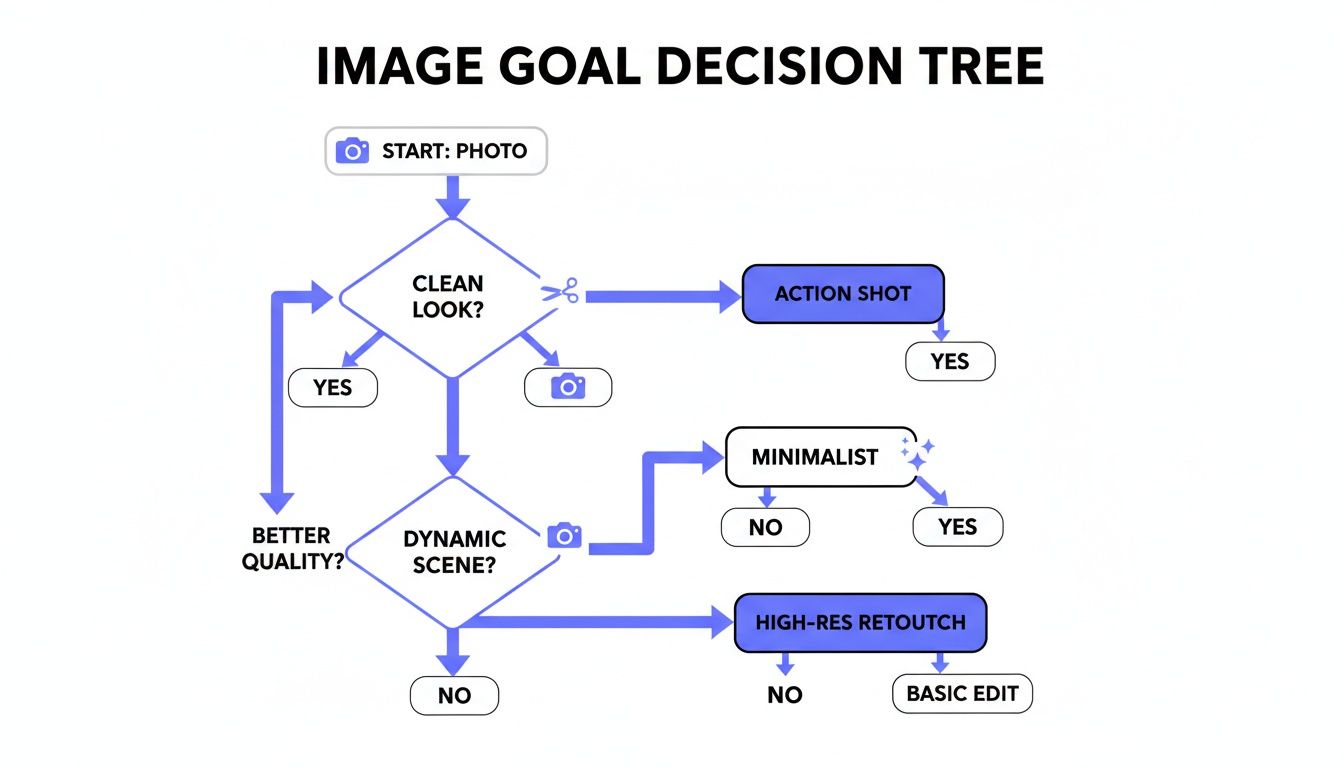
The need for clean product shots or scalable scenes often points toward an automated, AI-driven solution to hit the sweet spot of speed and quality.
A Head-To-Head Comparison of Editing Models
How do these three models stack up? Let's get into a direct comparison.
Image Editing Service Model Comparison
This table breaks down the core differences in cost, speed, and scalability.
AI platforms offer an undeniable advantage in speed and scalability. For a brand like Ganni, which thrives on dropping fresh, trend-responsive content, waiting weeks for images isn't an option.
The delay between a photoshoot and getting edited images online can represent weeks of lost sales. AI-powered ecommerce image editing services close that gap entirely.
When it comes down to it, the savings drive the decision for many brands. The cost of a single in-house retoucher can easily top $70,000 a year. An AI platform can deliver far greater volume for a fraction of that annual cost.
Why Mobile-First Fashion Imagery Demands AI

The fashion world now lives in the palm of our hands. This mobile-first reality forces a rethink of visual content, where images must be both stunning and lightweight.
Mobile devices now account for over 60% of ecommerce sales, according to Statista. This pressure for fast, scalable image creation is exactly where AI photography platforms shine.
You can get a deeper look at these evolving ecommerce photo trends on Colorexpertsbd.com.
How to Move from Sterile Studios to Authentic Scenes
Shoppers connect with products shown in relatable contexts. The classic white-background shot is essential for product pages but often falls flat on social media.
This is where AI bridges the gap. A brand can take a single photo of a handbag and instantly generate dozens of variations showing it in different scenes — a bustling city street, a quiet café, or a sun-drenched beach.
This creates visuals that feel genuine and speak directly to specific audiences, without the logistical nightmare of on-location photoshoots.
How Brands Like Zara A/B Test at Unprecedented Scale
For a fast-fashion giant like Zara, figuring out what grabs a user's attention is everything. Traditionally, testing hundreds of image variations for social ads would be financially impossible.
AI blows those limits away. Zara can generate countless ad creatives from one base image to A/B test which elements connect.
- Does a warm, golden-hour background pull better than a cool, urban one?
- Which model style drives more clicks from their Gen Z audience?
- Does a close-up shot of fabric texture convert better than a full-body look?
Answering these questions used to involve pricey market research. With AI, brands get data-backed answers in hours, creating a powerful feedback loop that constantly sharpens their marketing.
How AI Powers the Next Wave of Immersive Commerce
The future of fashion ecommerce is interactive. 3D product viewers and augmented reality (AR) try-ons are becoming more common.
These immersive experiences depend on one thing: a perfect base image. AI-edited photos provide the clean, high-resolution assets needed to build 3D and AR models.
By nailing the initial image, ecommerce image editing services lay the groundwork for these next-gen shopping tools. Learn more in our guide to AI product photography.
A 4-Step Checklist for Choosing the Right Editing Partner
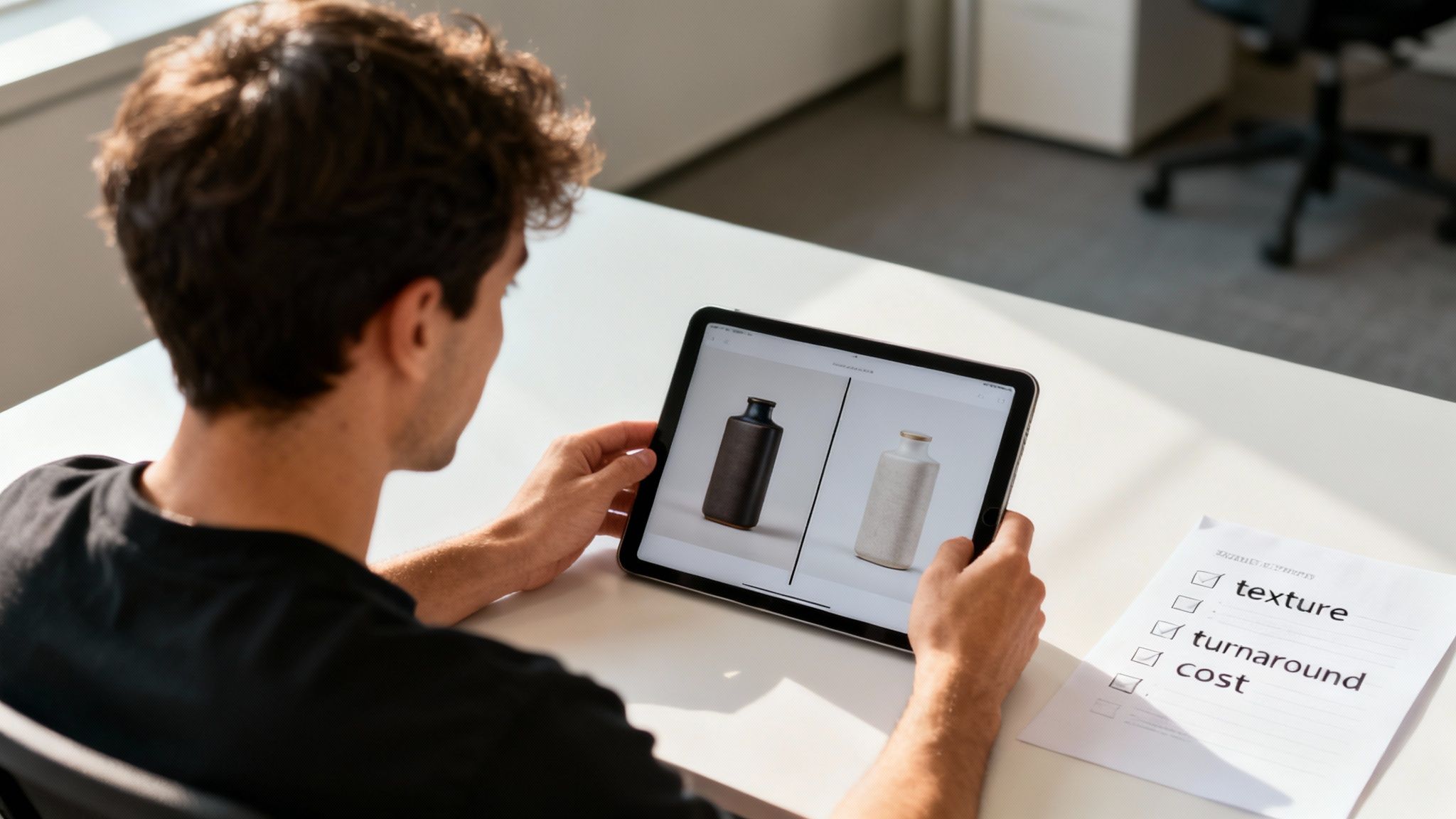
Picking the right ecommerce image editing services partner is a decision that can quietly make or break your brand's momentum. It goes deeper than finding the lowest price-per-image.
The best partner is an extension of your creative team — one who understands your quality standards, respects your budget, and is ready to scale.
Your Vendor Evaluation Checklist
Run every potential partner through this checklist.
Does it preserve critical fabric texture?
This is non-negotiable. The texture of denim or sheen of silk sells the garment. Ask to see before-and-afters from other apparel brands.Can it generate diverse, on-brand models?
A top-tier partner should let you showcase products on a wide range of virtual models. This is a massive strength of AI platforms, giving brands like Everlane the power to create inclusive campaigns without casting calls.What is the true turnaround time?
Speed to market is everything. An agency might promise a 24-hour turnaround, but AI services can process hundreds of images in minutes. Delays at this stage can stall a launch.How does the pricing scale with your catalog?
Your editing solution has to grow with you. A per-image fee becomes a bottleneck when you're adding hundreds of new SKUs. Subscription models, common with AI, offer predictable costs. Our guide on how much photoshoots cost offers a baseline for comparison.
The single worst way to select an outsourced image editing service is to take the lowest quoted per-image price. Success is determined by its total cost — measured in management time, workflow efficiency, and image quality.
Using these questions will help you find a partner that’s built to help your brand win.
Takeaway
To choose the right editing partner, get your hands dirty with these steps:
- Request a Fabric Test: Before signing anything, send 2–3 images of your trickiest products — think sequins, lace, or heavy wool. See how they handle the fine details.
- Audit Model Diversity: Ask to see the full library of virtual models a service offers. Hold it up against your target customer personas. If you don't see your customer reflected, it's not the right fit.
- Calculate True Cost: Tally up all photoshoot expenses, including coordination time, model fees, and internal review hours, to find your "true cost per image" before comparing it to an AI solution's subscription fee.
What To Do Next
Let's move from theory to action. Shifting your brand’s visual strategy into a lean, efficient system doesn’t require tearing everything down. It just takes a few smart steps.
The goal is to uncover the real return on investment that modern ecommerce image editing services can offer. Here are three concrete things you can do right now.
1. Audit Your Current Workflow
Before you can see the savings, you need to know your starting point. Calculate the total cost and time you're really spending on each product image.
This includes everything: coordinating the shoot, booking models, and the hours your team spends tweaking edits.
Here’s a simple way to do it: track one batch of 10 product photos from start to finish. Add up every cost and every hour spent. That number is your "true cost per image."
2. Test Drive an AI Alternative
The only way to grasp what AI can do is to see it in action with your own products.
Take 3–5 of your existing product photos. Upload them to an AI platform and start experimenting. Generate new images with different models, swap backgrounds, and test lighting setups.
This isn't a tech demo; it's a creative experiment. Judge the quality for yourself. This kind of hands-on test gives you tangible proof of what's possible.
3. Compare the True ROI
Now, connect the dots. Take the data from your audit and your AI test drive and project the potential savings over the next quarter.
If your "true cost per image" was $150 with a 2-week turnaround, and AI delivered similar quality in minutes for a fraction of the price, the business case writes itself.
To make the comparison razor-sharp, swap your estimates for hard numbers. Use a tool built for exactly this purpose to see the financial impact clearly.
Take the next step: See how your current photography costs stack up against an AI-powered workflow. Our savings calculator will show you exactly how much time and money your brand could get back. Calculate Your Savings Now.
Frequently Asked Questions
When we talk about bringing AI into the creative process, a lot of the same questions pop up. Let's clear up some of the most common questions from founders and creative teams.
How Do AI Image Editing Services Ensure Brand Consistency?
This is a big one. The short answer is: you teach it. Good AI platforms learn your specific brand DNA.
You start by feeding the system your brand kit or a detailed style guide. A brand like COS, known for its clean, architectural feel, can train the AI on that specific aesthetic.
The system then applies those rules to every single image, ensuring that shot #1 looks like it belongs with shot #1,000. It actually eliminates the minor human errors that can creep in.
Can AI Realistically Replicate Fabric Texture?
Absolutely. This is where the most advanced AI models flex their muscles. These systems are trained on massive libraries containing millions of images of different textiles.
They’ve learned the subtle difference in how light hits silk versus how it’s absorbed by heavy wool. This allows the AI to render the unique texture, drape, and sheen of materials.
The goal is to produce a photo that feels authentic, so the customer knows exactly what they’re getting.
What Is the Learning Curve for an AI Photo Platform?
While the tech underneath is complex, the user experience is built for creatives and marketers, not data scientists. The learning curve is surprisingly flat.
Platforms like Picjam are built with intuitive, drag-and-drop interfaces. The whole point is to get you from sign-up to stunning, on-brand images in minutes, not weeks.
They’re made to slide right into your existing workflow. Your team can start creating high-quality content almost immediately, without needing days of training.
Ready to run the numbers and see what an AI-powered workflow could mean for your bottom line? Use the Picjam savings calculator for a side-by-side comparison against what you're spending on photography right now.

Picjam team
The Picjam team blends AI, product, and creative expertise to eliminate the cost and delay of traditional photography for modern eCommerce brands.