How an E Commerce Shoot Studio Transforms Fashion Content Production
Learn how to build a high-performing e commerce shoot studio. This guide covers space, gear, workflow, and how AI can scale your fashion brand's content.
How to start saving money
Lorem ipsum dolor sit amet, consectetur adipiscing elit lobortis arcu enim urna adipiscing praesent velit viverra sit semper lorem eu cursus vel hendrerit elementum morbi curabitur etiam nibh justo, lorem aliquet donec sed sit mi dignissim at ante massa mattis.
- Neque sodales ut etiam sit amet nisl purus non tellus orci ac auctor
- Adipiscing elit ut aliquam purus sit amet viverra suspendisse potent i
- Mauris commodo quis imperdiet massa tincidunt nunc pulvinar
- Adipiscing elit ut aliquam purus sit amet viverra suspendisse potenti
Why it is important to start saving
Vitae congue eu consequat ac felis placerat vestibulum lectus mauris ultrices cursus sit amet dictum sit amet justo donec enim diam porttitor lacus luctus accumsan tortor posuere praesent tristique magna sit amet purus gravida quis blandit turpis.

How much money should I save?
At risus viverra adipiscing at in tellus integer feugiat nisl pretium fusce id velit ut tortor sagittis orci a scelerisque purus semper eget at lectus urna duis convallis. porta nibh venenatis cras sed felis eget neque laoreet suspendisse interdum consectetur libero id faucibus nisl donec pretium vulputate sapien nec sagittis aliquam nunc lobortis mattis aliquam faucibus purus in.
- Neque sodales ut etiam sit amet nisl purus non tellus orci ac auctor dolor sit amet
- Adipiscing elit ut aliquam purus sit amet viverra suspendisse potenti
- Mauris commodo quis imperdiet massa tincidunt nunc pulvinar
- Adipiscing elit ut aliquam purus sit amet viverra suspendisse potenti
What percentage of my income should go to savings?
Nisi quis eleifend quam adipiscing vitae aliquet bibendum enim facilisis gravida neque. Velit euismod in pellentesque massa placerat volutpat lacus laoreet non curabitur gravida odio aenean sed adipiscing diam donec adipiscing tristique risus. amet est placerat imperdiet sed euismod nisi.
“Nisi quis eleifend quam adipiscing vitae aliquet bibendum enim facilisis gravida neque velit euismod in pellentesque massa placerat”
Do you have any comments? Share them with us on social media
Urna ut fermentum imperdiet lacus, elementum etiam maecenas libero nunc, suspendisse massa, nisl, elit curabitur feugiat in quis ut nibh enim in tristique aliquam sed vitae dui, dis adipiscing pharetra aliquam turpis turpis nibh rhoncus enim, pellentesque leo laoreet neque in sed bibendum fermentum suspendisse tempus non purus adipiscing suscipit fringilla adipiscing convallis dolor nulla fermentum facilisis ullamcorper ut vehicula tortor libero metus donec velit, tristique fermentum, dictum euismod diam scelerisque enim non pharetra tristique lectus habitant pharetra est id
When Crocs tested AI-generated photos for their spring collection, they discovered a 60% faster campaign rollout. Their success highlights a critical shift: the modern e commerce shoot studio is no longer just a room with a camera. It’s a strategic hub where physical photography meets digital efficiency, allowing brands to scale content without inflating their budget.
How AI Cuts Content Costs for Brands Like Zara
Today's fashion brands are in a constant battle for fresh visual content. Giants like Zara learned that agility is everything; the old model of expensive, one-off photoshoots can’t keep up with the demands of product pages, social feeds, and ads. The challenge is producing high-volume visuals without costs spiraling.
This is where a smarter, hybrid approach comes in. It’s a mix of a lean in-house physical setup and powerful AI tools like Picjam. This combination creates a content engine built for speed, scale, and significant savings.
Unpacking the Costs of Traditional Shoots
A traditional photoshoot has a knack for adding up quickly. The costs go way beyond the photographer's day rate, making it impossible for growing brands to produce the volume of content they need.
Let’s break down a typical budget:
- Model Fees: Professional models can cost from $500 to over $5,000 a day.
- Studio Rentals: A proper space with pro lighting can easily run hundreds or thousands of dollars for a single day.
- Photographer and Crew: This includes assistants, stylists, and makeup artists, each with their own day rate.
- Post-Production: Every image needs editing, and those per-image costs add up fast.
For most brands, these expenses make frequent, large-scale shoots a non-starter, leading to ad fatigue from recycled images.
The Hybrid Studio: A Smarter, Cost-Effective Model
The modern e commerce shoot studio runs on a simple principle: capture once, create endlessly. Instead of outsourcing entire campaigns, you build a minimal in-house setup to get clean, consistent shots of your products on a mannequin or as a flat lay.
This one foundational asset becomes the raw material for AI. From a single high-quality product photo, you can generate hundreds of on-model variations, swap lifestyle backgrounds, and test concepts in minutes. This completely changes the economics of content creation.
To see the real-world impact of optimizing visual assets, this Product Gallery Image Optimization Case Study is a must-read.
A McKinsey report found that companies folding AI into their marketing and sales have seen profit margins jump by 5% to 15%. A huge chunk of that comes from operational wins in content production.
By shifting to a scalable, asset-driven system, brands can finally produce content at the speed the market demands.
Designing Your Studio for Maximum Efficiency
You don’t need a massive warehouse to produce professional fashion images. An effective e commerce shoot studio is less about sheer size and more about a smart, repeatable setup.
Think about brands like Everlane or Allbirds. Their visual identity is built on clean, consistent imagery — a look that's totally achievable even in a compact space.
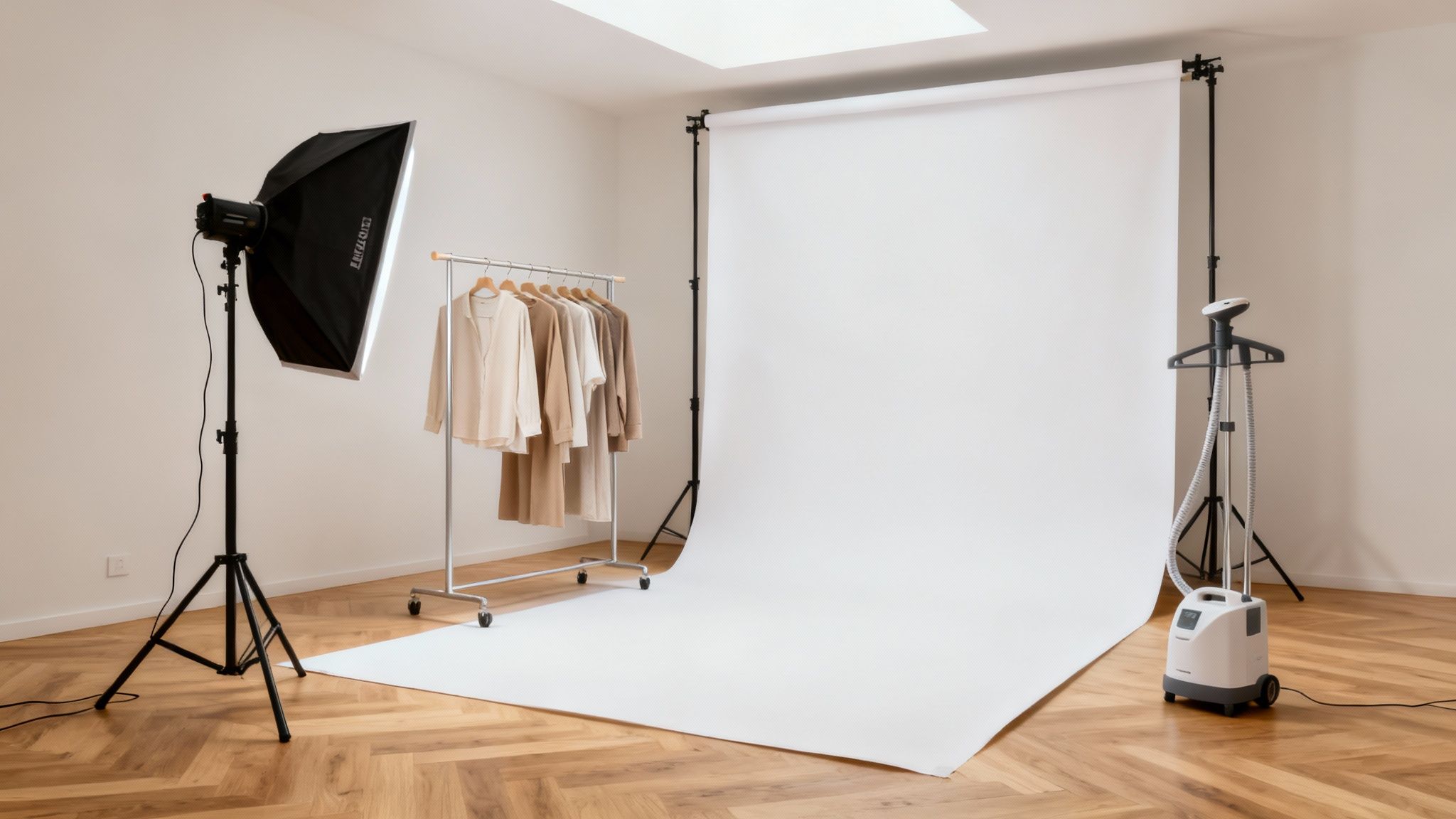
The goal is to create an environment you can replicate perfectly every time. A well-planned space slashes setup time and ensures every shot fits your brand’s aesthetic.
Blueprint for Your Physical Space
Getting the dimensions right is critical for quality and workflow. A cramped studio forces lighting compromises and can distort images.
For Flat Lays & Small Products: A 10x10 foot area is usually enough room for a table, lights, and your camera on a tripod. For items like jewelry, a dedicated light box for product photography guarantees perfect, even lighting.
For Full-Body Model Shots: Aim for at least 15 feet wide and 25 feet deep. That depth is crucial — it lets you use a 50mm or 85mm lens without unflattering distortion. It also gives you breathing room between your model, the backdrop, and your lights.
A ceiling that’s at least 10 feet high is a game-changer. It gives you the vertical space to get your lights up high, creating soft, flattering illumination.
Essential Non-Camera Gear
An efficient studio runs on more than just cameras and lenses. It’s the foundational tools that keep everything moving smoothly. Look at the crisp shots from a brand like Brooklinen. That polish is the result of a meticulously organized workflow, supported by the right gear.
A well-equipped studio isn’t about having the most expensive gear; it’s about having the right gear to create a repeatable process. Consistency builds a strong, recognizable brand identity.
Here's a checklist of the absolute must-haves:
- Seamless Paper Backdrops: White is the standard for clean e-commerce, but gray and black offer versatility. A 7-foot wide roll is a solid compromise for smaller studios.
- C-Stands: C-stands are more stable and versatile than flimsy kit stands. They are essential for securely holding lights and reflectors. Plan on getting at least 2.
- A Quality Garment Steamer: Wrinkles look unprofessional and create extra work in post-production. A professional-grade steamer pays for itself in editing time saved.
- Clothing Racks and Hangers: A chaotic prep area leads to a chaotic shoot. Keep garments organized and ready to go.
- Clamps and Gaff Tape: These are the unsung heroes of every photo set. You’ll use them for securing backdrops, taping cables, and adjusting garments.
Choosing the Right Gear Without Overspending
Your equipment directly impacts how your brand's visuals look and feel. In a modern e commerce shoot studio, the goal is to make smart, targeted investments that pay off in every shot.
High-end brands like Reformation have nailed a look that feels both polished and authentic. That balance comes from using the right tools to capture texture, drape, and color accurately.
Cameras and Lenses That Capture Every Detail
Almost any modern DSLR or mirrorless camera will deliver the quality you need. The real magic is in your lens choice. For fashion, prime lenses are king.
A 50mm Prime Lens: This is the workhorse of apparel photography. It captures clothing with a perspective close to the human eye, avoiding strange distortion.
An 85mm Prime Lens: When you need to highlight a specific detail — like fabric texture or embroidery — an 85mm lens is your best friend. It lets you fill the frame without physically crowding the subject.
By investing in one or two high-quality prime lenses, you ensure your images are sharp and professional. This is where a small budget increase makes a massive visual impact.
Mastering the 3-Point Lighting Setup
Consistent lighting is the single most important factor in professional product photography. The standard 3-point lighting setup is an industry benchmark because it’s simple, effective, and repeatable.
Here are the three core components:
- Key Light: Your main light source, positioned at a 45-degree angle to your product to create dimension and soft shadows.
- Fill Light: Placed opposite the key light, this less intense source "fills in" shadows, reducing contrast and revealing detail.
- Backlight (or Rim Light): Positioned behind the product, this light helps separate it from the background, making the product pop.
For a deeper dive, our guide to the essential equipment for studio photography offers more detailed recommendations.
Making Smart Choices on Modifiers and Stands
Light modifiers turn a harsh bulb into soft, flattering illumination. An octabox is often the best choice for a key light in fashion photography. Its large, round shape mimics soft window light.
Don't overlook the importance of sturdy C-stands. Investing in heavy-duty C-stands is a matter of safety and efficiency. They are far more stable and prevent costly accidents.
Essential Studio Gear Comparison
This table breaks down smart gear investments for your e commerce shoot studio, helping you balance your budget with professional requirements.
Choosing the right gear is about understanding where your money makes the biggest difference. Focus on lenses and light, and you'll be on your way to a professional setup.
Making Your On-Set Photography Workflow Bulletproof
An efficient workflow is the secret weapon of any productive e commerce shoot studio. High-volume retailers like ASOS live by checklists and standardized processes to manage thousands of images, keeping shoots on schedule and on budget.
This structure turns a stressful mess into a predictable content machine.
The Power of a Detailed Shot List
Walking onto a set without a clear plan is the fastest way to burn time and money. A detailed shot list is your roadmap for the day.
A solid shot list specifies:
- Essential Angles: Front, back, side, and a 45-degree view are the bare minimum.
- Detail Shots: Call out close-ups of fabric texture, zippers, or unique stitching. According to Statista, 22% of returns happen because the product looks different in person.
- Styling Notes: Document how each item should be styled, like "tucked in, sleeves rolled."
- Model Poses: Outline specific poses that match your brand's vibe for cohesion.
This prep work means less guesswork on set, allowing the team to flow from one look to the next.
Mastering On-Set Efficiency
Once the shoot begins, the game is all about consistency and speed. Two techniques are fundamental: tethered shooting and standardized settings.
Tethered shooting — connecting your camera directly to a laptop — is non-negotiable for a professional e commerce shoot studio. It lets the team see images on a large screen in real-time, catching issues with focus or lighting on the spot.
As Glossier's founder Emily Weiss once said, "Everything we do is a collaboration." Tethering brings that spirit to the set, allowing stylists and photographers to work together instantly.
Just as important is locking in your camera settings. Once you've dialed in the perfect aperture, shutter speed, and ISO, don't touch them. This guarantees every image has the same exposure and color balance.
This diagram breaks down the foundational 3-point lighting setup that helps you nail consistency.
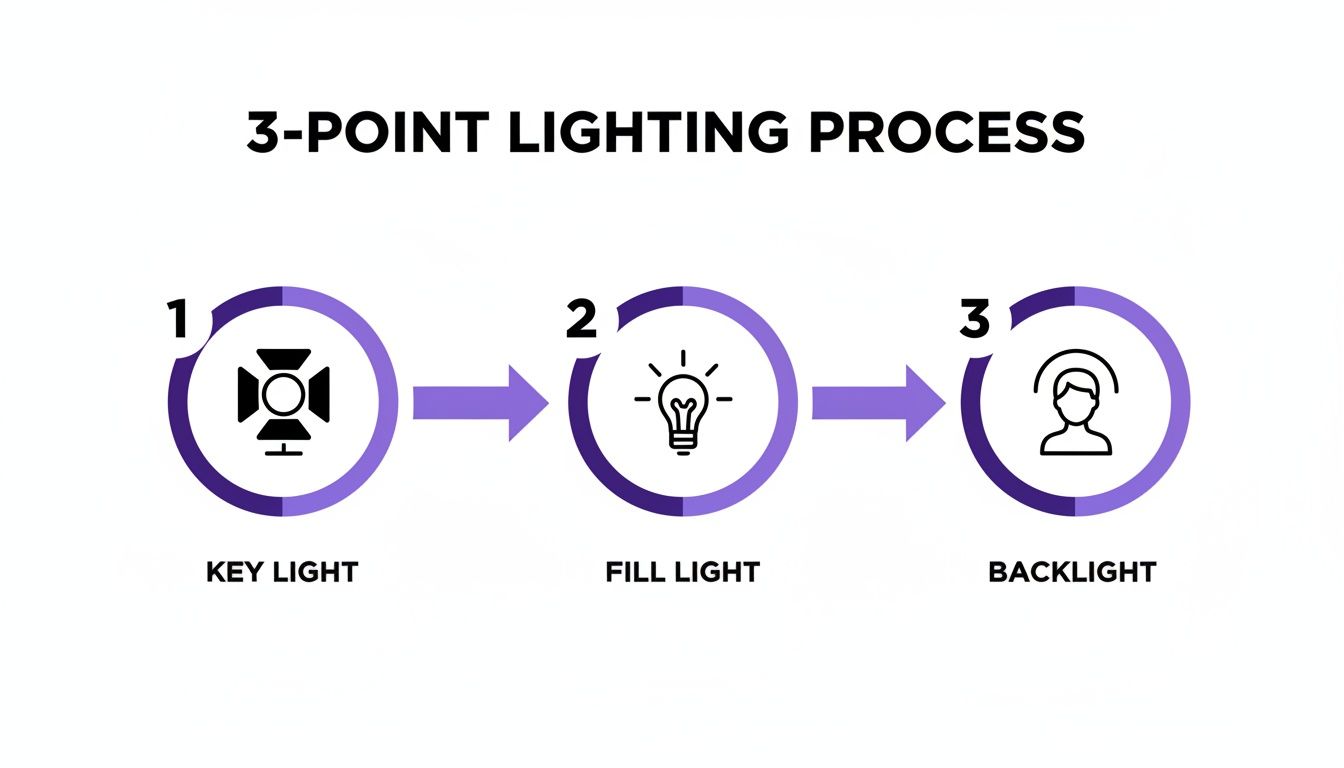
By methodically applying a key light, a fill light, and a backlight, you build a repeatable formula for professional, polished images.
A Sanity-Saving System for File Naming
A logical file naming convention will save you hours of frustration. Ditch generic names like "IMG_1234.jpg" for a system that works for you.
A great format could be:
[Brand][ProductSKU][Angle]_[SequenceNumber].CR2
Example: PICJAM_TS001_FRONT_01.CR2
This structure makes your images instantly searchable and simple to organize. It is a hallmark of an efficient, scalable production process.
How AI Slashes Costs and Scales Creativity
A physical studio setup gets you halfway there. The real magic happens when you transform clean product photos into a full-scale marketing campaign. This is where a hybrid e commerce shoot studio workflow, blending physical capture with AI generation, creates a massive competitive advantage.
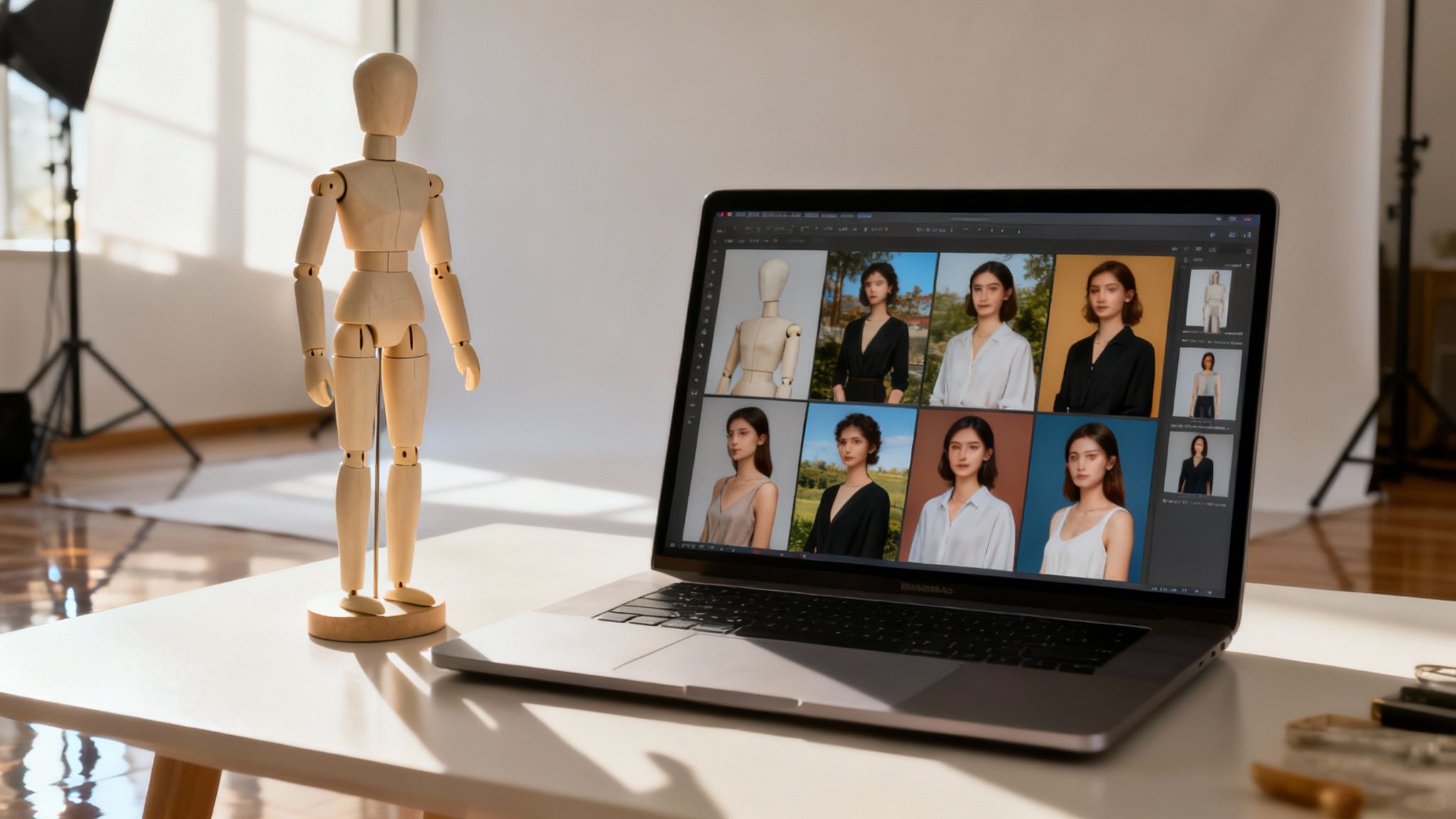
The traditional model meant every creative concept required starting the entire production process from scratch. Now, all you need is a single, perfect shot of a garment on a mannequin.
From One Photo to a Full Campaign
With a platform like Picjam, one clean product photo becomes the foundation for hundreds of variations. You just upload the image and generate on-model photos with a diverse range of AI-generated models in minutes.
This simple step eliminates some of the biggest photography budget items: model fees, location scouting, and travel expenses. Instead of flying a team to Italy, you can place your product in a Tuscan villa with a click.
Brands like Revolve built empires on showing apparel in aspirational contexts. AI levels the playing field, allowing emerging brands to create that same high-end feel from their in-house studio shots.
A New Era of Creative A/B Testing
One of the most powerful uses of AI in fashion is for rapid creative testing. Wondering if a product sells better on a blonde model versus a brunette? Or if a beach background outperforms an urban one?
Answering these questions used to involve expensive reshoots. Now, you can generate both versions in seconds and start running A/B tests immediately. This data-driven approach means you optimize creative based on what actually performs.
This shift moves marketing from a "best guess" approach to a precise, scientific process. You’re creating visuals engineered to convert based on what your specific audience responds to.
This speed gives you the agility to tailor imagery for different markets without booking another photoshoot.
Slashing Costs and Improving Accuracy
The financial impact is huge. A McKinsey report found that AI adoption in marketing can boost profit margins by 5% to 15%, driven by these operational efficiencies. You don’t just save money — you shrink production timelines from weeks down to minutes.
This efficiency also tackles one of the biggest headaches in fashion e-commerce: returns. A staggering 22% of products are sent back because they look different in person.
When you can generate multiple on-model shots showing how a garment fits different body types, you give customers a clearer, more realistic picture of what they’re buying. This builds purchase confidence and directly lowers return rates.
For a closer look at how AI elevates basic shots, check out our guide on creating stunning AI clothing product photos.
So, What's Next?
This guide is a roadmap for building an e-commerce photo studio that’s built for the future. It’s about creating a smarter, more nimble content engine.
If you’re ready to make a real change, here are 3 things you can do right now.
Tally Up Your Real Photography Costs
Before you make a move, know exactly where your money is going. Audit your last few photoshoots. Add up everything: photographer rates, model fees, studio rentals, and retouching.
This exercise reveals where a hybrid AI workflow can deliver the biggest, fastest savings.
Build a "Minimum Viable" Studio Kit
You can get stunning, professional-quality shots with a surprisingly lean setup. Start with the basics: one solid prime lens (a 50mm), a decent camera body, and a simple 3-point lighting kit.
This minimalist gear is all you need to capture the clean, consistent images that are perfect for AI workflows.
Run a Quick AI Test Drive
The fastest way to understand this approach is to see it with your own eyes. Take some of your existing product photos — even flat lays or mannequin shots — and upload them to an AI tool like Picjam.
Generate a handful of on-model options or place your product in a few different lifestyle scenes. This simple experiment shows you the ROI in minutes. As you start this path, integrating your e-commerce platform with Shopify will also be a game-changer.
Got Questions? We've Got Answers
Let's tackle some of the most common questions when brands build their own e-commerce shoot studio.
How Much Space Do I Really Need for a Studio?
For simple flat lays and accessory shots, a dedicated 10x10 foot corner often does the trick.
For full-body apparel, we recommend a space that's at least 15x25 feet, with 10- to 12-foot ceilings. That extra room is crucial for using a flattering 50mm or 85mm lens and maneuvering a versatile 3-point lighting setup.
Can I Just Use My iPhone for Product Photography?
Your iPhone is a powerhouse for social media content. But for the core e-commerce shots that drive sales, a DSLR or mirrorless camera is still king. It gives you the manual control needed for great images.
That said, a well-lit iPhone photo is a fantastic starting point for an AI platform like Picjam. The tech can transform a basic shot into a professional, studio-quality asset, bridging the quality gap without a massive gear investment.
What's the Biggest Mistake Brands Make with In-House Photos?
Hands down, the most common mistake is inconsistent lighting. When shadows and color temperatures are all over the place, it screams amateur and can mislead customers about how a fabric really looks.
The most critical step is to lock in a fixed, repeatable lighting setup and use the exact same camera settings for every shoot. This foundational consistency elevates your visuals.
Nailing this discipline saves countless hours in post-production. It’s the bedrock of a well-planned e commerce shoot studio and builds visual cohesion that makes customers confident enough to buy.
Takeaway
- Embrace the Hybrid Model: Combine a lean in-house studio for core product shots with AI tools like Picjam. This "capture once, create endlessly" approach drastically cuts costs associated with models, locations, and travel, allowing you to scale content production affordably.
- Invest Smart, Not Big, on Gear: Your most critical investments are a quality prime lens (50mm or 85mm) and a consistent 3-point lighting setup. This ensures sharp, true-to-life images that form the perfect foundation for AI generation, delivering a professional look without an extravagant budget.
- Standardize Your Workflow: Create a detailed shot list and use tethered shooting to maintain consistency and efficiency on set. A simple, logical file naming system will save you hours later. A bulletproof workflow transforms chaotic shoots into a predictable content engine.
Ready to see how this approach could transform your budget? Compare your current photography expenses with Picjam's AI-driven model using our savings calculator.

Picjam team
The Picjam team blends AI, product, and creative expertise to eliminate the cost and delay of traditional photography for modern eCommerce brands.