The Ultimate Guide to Ecommerce Photography for Fashion in 2026
Master ecommerce photography with this guide for fashion brands. Learn key techniques, styles, and how AI can elevate your visuals and boost sales.
When Crocs tested AI-generated photos for their spring collection, they discovered a 60% faster campaign rollout. For fashion brands selling online, your ecommerce photography is your digital storefront, your virtual fitting room, and your brand's first impression, all rolled into one. It's the art of visually communicating texture, fit, and feeling to a customer who can't physically touch the product.
Why High-Quality Ecommerce Photography Drives Sales
For any fashion brand selling online, strong photography isn't a "nice-to-have" — it's the engine that drives sales. In a digital aisle where customers can't feel the fabric or try on a garment, your images become the single most important piece of information they have. They are the bridge that turns a casual browser into a committed buyer, and their quality has a direct, measurable impact on your bottom line.
This isn't just an opinion; the data is crystal clear. Investing in better imagery doesn't just make a product page look good — it actively boosts crucial business metrics and prevents costly problems.
The table below breaks down the real-world consequences of your photography choices. Think of it as the return on investment for every pixel.
How Image Quality Impacts Your Bottom Line
| Metric | Impact of High-Quality Photography | Risk of Low-Quality Photography |
|---|---|---|
| Conversion Rate | A potential 94% increase — learn more in our guide on how to improve ecommerce conversion rates — as shoppers feel more confident in their purchase decision. | Stagnant or declining sales as customers hesitate or abandon carts due to uncertainty. |
| Return Rate | Lower returns because images accurately set expectations for fit, color, and texture. | Higher return rates, with 22% of returns happening because the item "looked different." |
| Brand Perception | Builds trust and signals professionalism, justifying premium pricing and fostering loyalty. | Erodes trust and positions the brand as amateur or low-quality, leading to price sensitivity. |
| Customer Trust | 9 out of 10 shoppers rank image quality as a key factor in their decision-making process. | Shoppers feel misled or disappointed, leading to poor reviews and negative word-of-mouth. |
Ultimately, the numbers show that skimping on photography is one of the most expensive mistakes a fashion brand can make. It directly hits your revenue, inflates your operational costs, and damages your brand's reputation over time.
How Photos Directly Impact Conversions and Returns
The connection between image quality and sales is incredibly direct. Industry studies consistently show that product pages with high-resolution images see a 94% higher conversion rate compared to those with blurry or uninspired photos. It makes sense — 9 out of 10 online shoppers say image quality is the most important factor when they're deciding to buy.
For apparel, this effect is even more pronounced. A staggering 74% of shoppers demand multiple product views before they'll even consider clicking "add to cart." This is exactly why bad photos are such a financial drain, contributing to 22% of all returns for the simple reason that the item "looked different in real life." You can dive deeper into the numbers by reviewing the full research on product photography statistics{target="_blank"}.
How Great Photos Build Brand Trust and Set Expectations
Great ecommerce photography does more than just move a single item; it builds your entire brand. When a customer lands on a page and sees crisp, color-accurate, and beautifully detailed photos, it sends a powerful signal of professionalism and a commitment to quality.
Think of a brand like Tabio, which sells high-end socks. They masterfully blend clean e-commerce shots with an editorial feel. Their specific lighting and styling choices don't just show you the sock; they tell a story about craftsmanship and modern fashion. This builds the trust needed to justify a premium price.
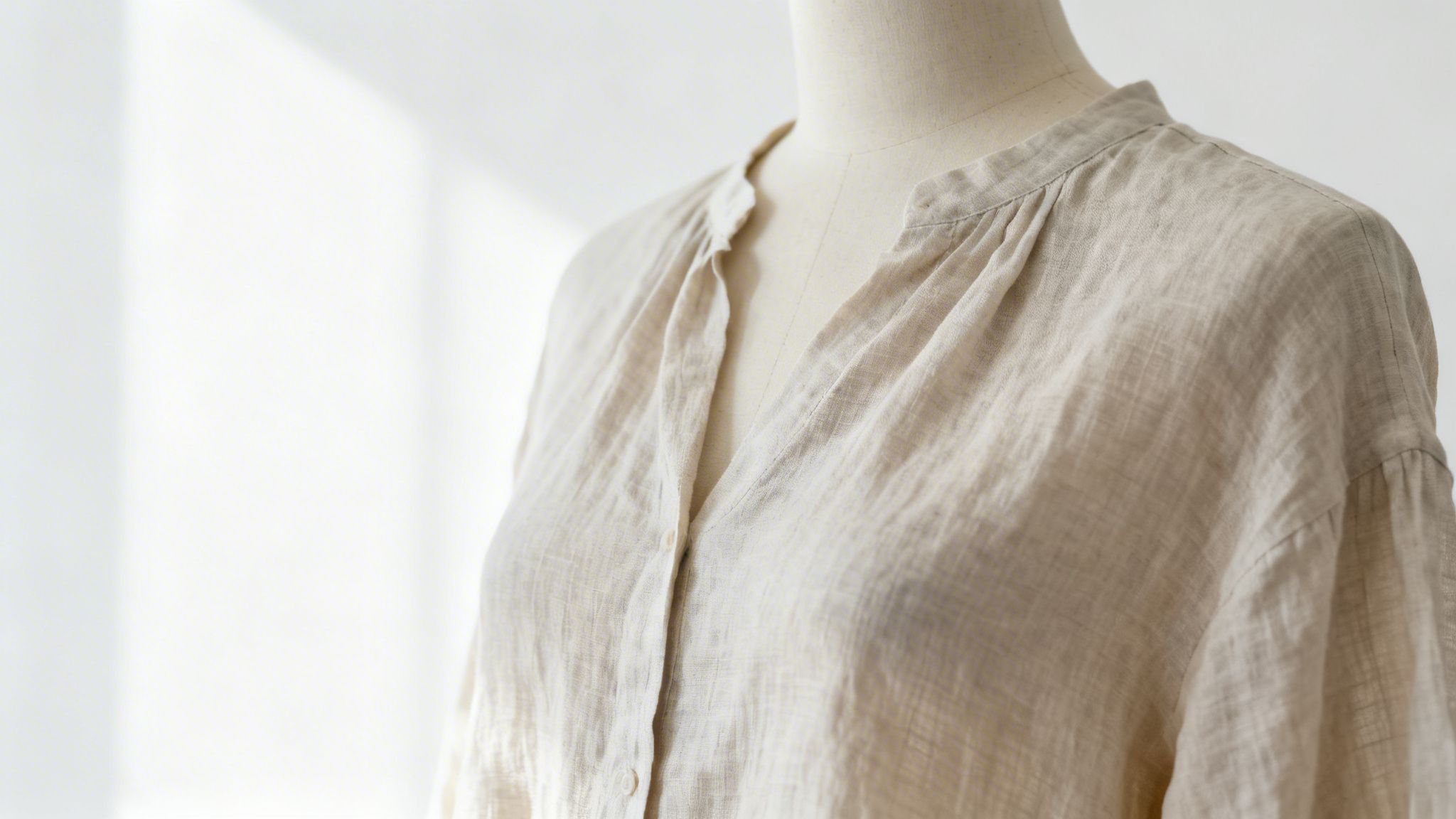
This visual honesty is also critical for setting the right expectations. A photo that clearly shows the slub texture of a linen shirt or the exact drape of a silk dress helps the customer make an informed decision. That leads to a happier customer and, you guessed it, fewer costly returns.
How Smarter Workflows Create a Competitive Edge
Not long ago, achieving this level of quality meant huge budgets for studios, models, and photographers — a barrier that kept many smaller brands out of the game. Thankfully, that production model is being completely upended.
Today, AI-powered platforms like Picjam{target="_blank"} are giving brands the power to generate studio-level quality far more efficiently and affordably. By transforming a single, basic product photo into a complete set of on-model and lifestyle images, brands can now:
- Generate an entire campaign without a physical photoshoot.
- Showcase products on a diverse range of AI models to resonate with a global audience.
- Dramatically slash content production costs and cut timelines from weeks to minutes.
This isn't about replacing photographers. It's about empowering brands to scale their visual content in ways that were previously unimaginable. It turns what was once a major cost center into an agile, powerful, and undeniable competitive advantage.
Exploring the Core Styles of Fashion Ecommerce Photography
Great ecommerce photography isn't just about taking one good picture. It's about having a visual conversation with your customer. Each style of photo answers a different question they might have, moving them from browsing to buying. Once you master these core styles — see how to take product photos — you can build a product page that anticipates every question and makes the "Add to Cart" button feel like the only logical next step.
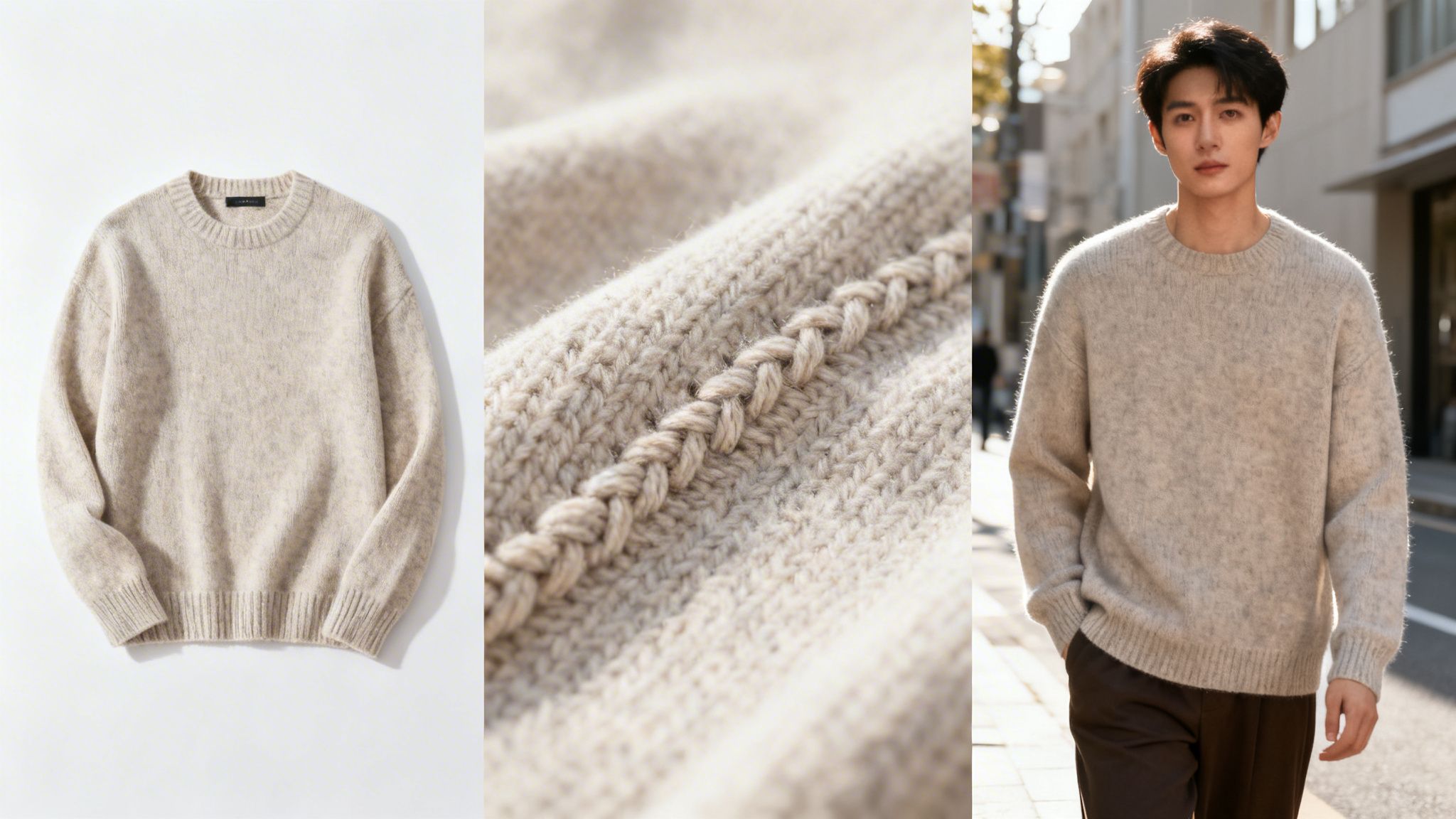
Think of it like a playbook. You combine clean product shots for pure clarity, detailed close-ups to show off quality, and in-context images to sell the dream. This mix works together to remove any doubt from a shopper's mind and replace it with genuine desire.
Clean Product Shots for Absolute Clarity
This is the bedrock of any product page. We're talking about images of the garment against a simple, neutral background — usually pure white, light grey, or a soft, on-brand color. Their only job is to show the product with zero distractions.
These shots are completely non-negotiable for a couple of big reasons:
- Marketplace Rules: Big players like Amazon and Google Shopping straight-up require your main image to be on a pure white background.
- Building Trust: They give the shopper an honest, unvarnished look at the product's real shape, color, and design.
- Catalog Consistency: A uniform background makes your entire store feel clean, professional, and much easier to browse.
A brand that absolutely nails this is Everlane. Their pages are built on minimalist, beautifully lit photos that make the garment the hero. This approach telegraphs transparency and quality, reassuring customers that what they see is exactly what they'll get.
Detailed Close-Ups to Showcase Quality
What does that fabric really feel like? How's the stitching finished? Is that zipper metal or cheap plastic? Detail shots are your answer to these questions. They are tightly cropped images that zero in on the specific features that scream craftsmanship and quality.
A high-resolution close-up of a sweater's knit pattern or a jacket's hardware does more than just show a feature; it justifies a price point. It helps the customer mentally bridge the gap between a digital image and a physical product, making them feel the texture and appreciate the fine points.
For fashion, these shots are make-or-break, especially for anything where texture and construction are selling points — think denim, leather, or knitwear. They're the proof that you've invested in good materials and careful production.
In-Context Shots to Sell the Vision
If product shots inform, in-context images inspire. These are the photos that show your garment as part of a whole look or in a compelling lifestyle setting. This is where you stop selling a piece of clothing and start selling an identity, a mood, or an aspiration.
In-context shots help customers picture themselves wearing the item in their own lives. Look at Free People's campaigns — they are masters of this, dropping their bohemian dresses into sun-drenched, adventurous scenes. The customer isn't just buying a dress; they're buying a piece of that free-spirited lifestyle. You can dive deeper into the different types of product photography{target="_blank"} and how they build a narrative in our dedicated guide.
The Rise of Stylistic AI Generation
Not long ago, getting this full spread of shots meant booking multiple, expensive photoshoots. Today, AI tools are completely rewriting that playbook. With a platform like Picjam, a single, clean product photo can be the starting point for a nearly endless stream of creative, on-brand images.
Brands can now generate on-model shots in seconds, drop products into aspirational lifestyle scenes, or A/B test different background concepts — all from one base image. This gives you the power to discover what truly connects with your audience without the time and expense of a physical shoot, letting you fine-tune your visual strategy in real time.
Mastering the Details: Where Lighting and Styling Make the Sale
Great ecommerce photography isn't about having the most expensive camera. It's born from the thoughtful control of light and a meticulous eye for styling. These are the details that separate a flat, uninspiring product photo from one that makes a customer stop scrolling and look closer.
Getting them right is how you build trust and create images that truly sell.
Once you understand the fundamentals of lighting and styling, the technical side of a photoshoot becomes much less intimidating. It gives founders and marketers the confidence to direct shoots effectively, ensuring the final images not only look great but also tell the brand's story.
The Critical Role of Lighting
Think of lighting as the soul of a photograph. It sets the mood, defines texture, and most importantly, guarantees color accuracy. In fashion, you'll mainly be working with two kinds of light: soft light and hard light. Knowing when and where to use each is a game-changer.
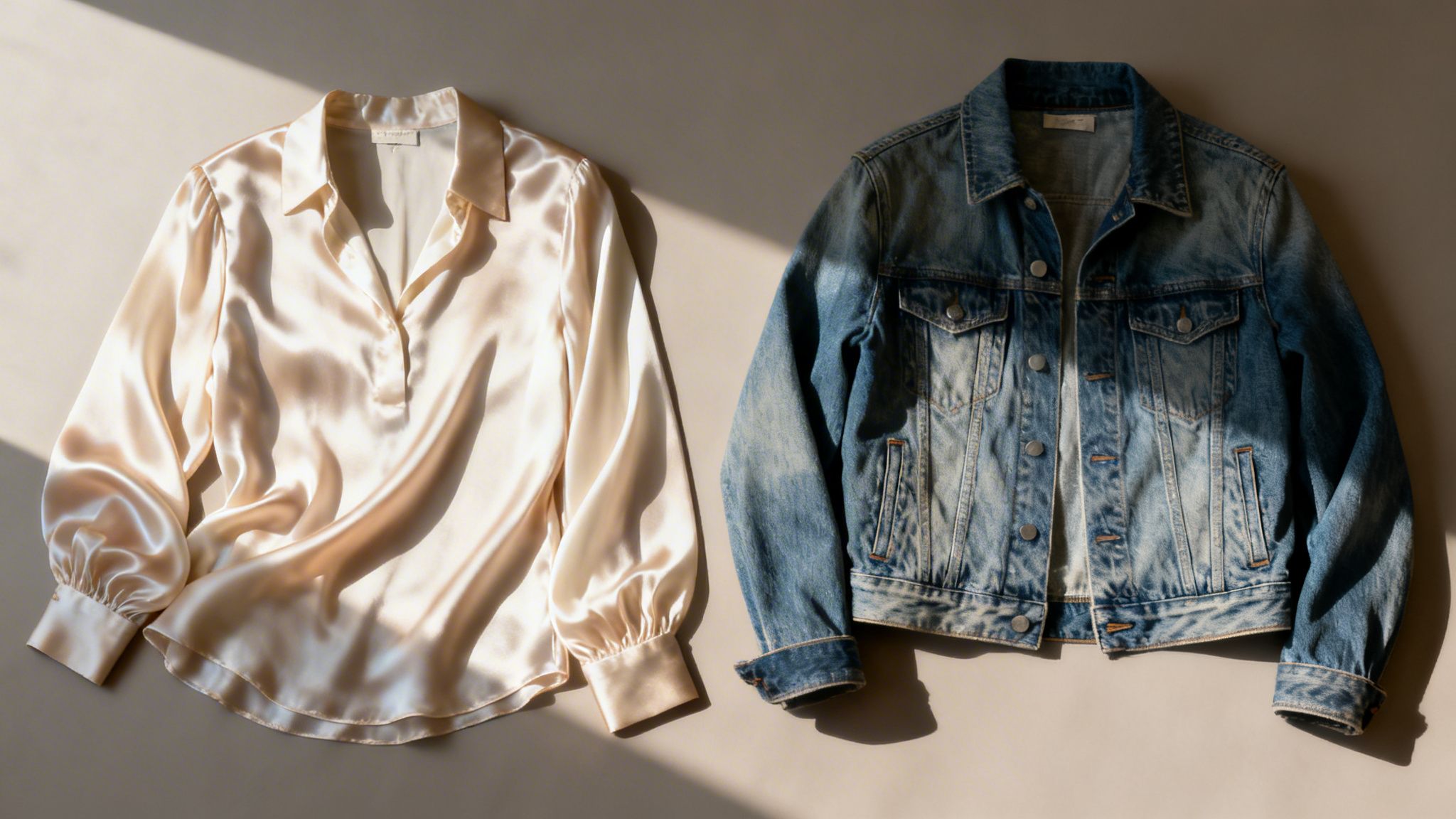
Soft Light: This is your workhorse for most apparel photography. It wraps around the product, creating gentle, diffused shadows and minimizing any harsh glare. The result is a clean, flattering, and approachable look. Soft light is perfect for showing off the flow of materials like silk or chiffon.
Hard Light: This kind of light is all about contrast, producing sharp, well-defined shadows. While you won't use it for your standard product-on-white shots, it's a powerful tool for adding drama or emphasizing texture. Think of a rugged denim jacket where you want every bit of the thick weave to stand out, or an edgy editorial shot with a strong mood.
Getting your lighting right is absolutely non-negotiable for color accuracy. Poor or inconsistent lighting is one of the top reasons customers return products — because what they got looks nothing like the photo. A well-lit shot ensures what they see is what they get.
For a deeper dive into setting up the perfect lighting environment, check out our complete guide on photography lighting basics{target="_blank"}. This knowledge is crucial whether you're directing a traditional shoot or creating a base image for AI generation.
Essential Styling Tricks for Flawless Garments
Styling is the art of making a garment look its absolute best on camera without faking its fit or shape. Wrinkles, awkward bunching, or a sloppy silhouette can instantly make a beautiful piece look cheap.
Your styling checklist should always include these 3 steps:
Impeccable Steaming: Every single garment has to be steamed thoroughly. This simple step erases all the wrinkles and creases from shipping and handling, and it has a massive impact on how customers perceive the quality.
Strategic Clipping: Use small clips and pins on the back of the garment (when shooting the front) to create a perfect, clean silhouette. This helps show the intended fit without the item looking baggy or shapeless. Just be careful not to pull it too tight, as that can mislead customers about how it actually fits.
Lint Rolling: A final pass with a lint roller right before the camera clicks. For post-shoot tips, see our ecommerce photo editing guide is non-negotiable. It picks up any stray dust, hair, or fibers that might be invisible to the naked eye but will definitely show up under bright studio lights.
Capturing the Non-Negotiable Camera Angles
To give customers a complete, 360-degree view of a product, you need more than just a single front-on shot. A standard set of angles gives a shopper the confidence they need to click "add to cart."
- Front View: The main hero shot that shows the full garment.
- Back View: Absolutely essential for showing details like zippers, back-seam designs, or closures.
- Side View: Helps illustrate the garment's profile and how it drapes on the body.
- 45-Degree View: A flattering angle that adds a sense of depth and shows more of the product's form.
- Detail Shot: A close-up of the fabric's texture, a unique button, a quality stitch, or any other feature that screams quality.
By mastering these details, you build a powerful visual foundation for all your ecommerce photography. This foundation not only elevates your traditional photos but also provides the perfect, high-quality input needed for AI tools like Picjam. It's how you scale production without ever sacrificing the details that matter most.
Optimizing Images for Performance and SEO
A brilliant photo shoot is only half the battle. Once you have a folder full of stunning images, you've got to make sure they get seen — by both your customers and search engines. This is where the technical work of image optimization turns beautiful assets into your hardest-working sales tools.
Optimized images load fast, make your store a pleasure to use, and send all the right signals to Google. Slow-loading pages are an absolute conversion killer; studies show that even a 1-second delay can slash conversions by 7%. For a fashion brand, where shoppers browse dozens of products, that delay adds up to a lot of lost revenue, fast.
Balancing Speed and Quality with Compression
The whole game with image optimization is shrinking your file sizes as much as possible without turning your gorgeous photos into a pixelated mess. A massive, uncompressed image might look incredible, but if it takes 5 seconds to load, your shopper is already gone.
This is where image compression comes in. You're looking for that perfect sweet spot between a tiny file size (for speed) and high resolution (for all that beautiful detail).
File Formats: For fashion ecommerce, JPEG is almost always your best bet. It offers fantastic compression for complex, colorful images like clothing photos. PNG is really for graphics that need a transparent background, but it creates much larger files for photographs.
Compression Tools: You can use tools like TinyPNG{target="_blank"} or ImageOptim{target="_blank"} to shrink file sizes automatically. Most ecommerce platforms like Shopify also have apps that can handle this for you.
The Goal: Aim for file sizes under 200 KB for your main product images. This keeps things loading quickly on desktop and mobile without looking blurry.
Getting this balance right is what keeps potential buyers clicking through your collections instead of clicking away.
Naming Files for Search Engine Discovery
This is one of those small details with a surprisingly big impact on your SEO. A default camera filename like IMG_4587.jpg tells Google absolutely nothing about your product. A descriptive filename, on the other hand, is a direct signal that helps search engines understand and rank your image.
A strong file naming convention is simple, clear, and descriptive.
Brand-Product-Color-View.jpg
For example, a file named everlane-dream-pant-black-front.jpg is infinitely more valuable than a random string of numbers. It's packed with the brand, the product name, and specific details that real customers are searching for.
This simple habit makes your images discoverable in Google Images, which can drive highly targeted organic traffic straight to your product pages. It's one of the easiest SEO wins on the table.
Writing Alt Text That Works for Everyone
Alt text (or alternative text) is a short, written description of an image that does 2 critical jobs. First, it makes your site accessible to visually impaired users who rely on screen readers to shop. Second, it gives search engines another powerful clue about what your image actually shows.
Good alt text should be concise but descriptive, weaving in relevant keywords in a way that feels natural.
- Bad Alt Text: "jeans"
- Good Alt Text: "Model wearing Good American straight-leg blue jeans with a white t-shirt."
- Excellent Alt Text: "Front view of Good American Good Legs straight-leg jeans in a light-wash blue denim."
That extra level of detail helps both people and search crawlers understand your product. Platforms like Picjam{target="_blank"} can help streamline this by suggesting SEO-optimized keywords for the on-model images it generates, saving you time while making your products more visible. By paying attention to these technical details, you ensure your ecommerce photography works as hard for your business as you do.
How to Cut Production Costs Without Sacrificing Quality
For any growing fashion brand, the content production machine is a hungry one. Traditional photoshoots — with their hefty price tags for models, photographers, studios, and travel — are a massive bottleneck. As you scale, these expenses don't just add up; they multiply, chewing into your margins and slowing down your ability to launch new products or test fresh creative.
That old model just isn't sustainable for today's agile brands.
The challenge is clear: how do you create more high-quality ecommerce photography without your budget spiraling out of control? The answer isn't about finding cheaper photographers. It's about moving away from the one-shoot-one-asset model and embracing a smarter, tech-driven approach.
The Problem with Traditional Photoshoot Economics
A typical photoshoot is an exercise in logistics and sunk costs. You book a studio, hire a photographer, cast and pay models, and maybe even fly a team to a specific location. After all that effort, you walk away with a finite set of images. Want to try a new background, feature a different model, or whip up a seasonal campaign? You have to fire up the entire expensive process all over again.
This workflow isn't just costly; it's painfully slow. It can take weeks to get from a concept to the final assets — a lifetime in the fast-paced world of online fashion. This makes it nearly impossible to react to trends, test ad creative on the fly, or refresh your product pages without a bottomless budget.
For example, a brand like Ganni might want to showcase a new dress for a summer campaign in Italy and a fall campaign in a studio setting. Traditionally, that would mean two separate, expensive shoots. Today, that entire process can be managed from a single desk.
How AI Offers a Smarter Alternative to Shoots
This is where AI-powered platforms like Picjam{target="_blank"} are completely changing the game. Instead of relying on physical shoots for every single asset, AI product photography offers a smarter alternative. Instead of relying on physical shoots, brands can now take one simple product photo — even a basic one on a mannequin — and generate a nearly infinite variety of on-brand, studio-quality images.
This new workflow flips the old model on its head. The process looks something like this:
- Start with one clean photo of your product.
- Generate dozens of on-model shots with diverse AI models that actually reflect your target audience.
- Place your product in any background imaginable, from a minimalist studio to an aspirational travel destination.
- Create an entire campaign's worth of assets in minutes, not weeks.
The savings in both time and budget are immense. Brands can test dozens of creative concepts for what it used to cost to produce a single image. This shift is fueling significant growth in the market, with the e-commerce photography service market projected to grow from $0.29 billion in 2025 to $0.58 billion by 2034, driven by startups eager to bypass those pricey shoots.
Unlocking Unprecedented Creative Agility
The biggest advantage here isn't just saving money; it's the speed and creative freedom it unlocks. Want to see how your new collection looks on 10 different models to improve inclusivity? You can do it in an afternoon. Need to create fresh ad creative for a flash sale? Generate it on demand. Our guide on AI product photography{target="_blank"} digs deeper into how this technology empowers brands to stay visually relevant.
To significantly streamline your visual asset pipeline and reduce overhead, it's worth exploring the power of advanced AI content creation tools{target="_blank"}. By embracing these modern workflows, fashion brands are no longer hemmed in by the physical constraints and high costs of traditional ecommerce photography. They can now produce more content, test more ideas, and scale their visual marketing with an agility that was once impossible.
Takeaway: Your Ecommerce Photography Action Plan
Alright, you've absorbed the theory. Now it's time to put it all into practice. Shifting your brand's visual strategy from just "good" to genuinely great doesn't mean tearing everything down and starting over. The biggest wins come from small, deliberate actions.
Think of this not as a summary, but as your strategic checklist. These are the steps you can take today to start seeing a real difference in your sales and how customers perceive your brand.
Takeaway 1: Audit Your Top 5 Product Pages
Your first move is a quick, high-impact audit. Pull up your store's analytics and find your top 5 best-selling products. Now, open each product page and try to see it through the eyes of a first-time customer.
Get brutally honest and ask yourself:
- Does the main photo show the entire product clearly?
- Is there a close-up shot that shows off the fabric's texture or a killer feature?
- Can a shopper see what the back and sides look like?
- Is there an image that puts the item in context, showing how it actually fits or looks in a real setting?
This simple exercise will immediately flag your biggest opportunities. You'll see exactly where a new angle, a detail shot, or an on-model photo could have answered a question and closed a sale.
To help you visualize the most efficient way to get those new shots, this chart breaks down the traditional path versus a modern, AI-powered one.
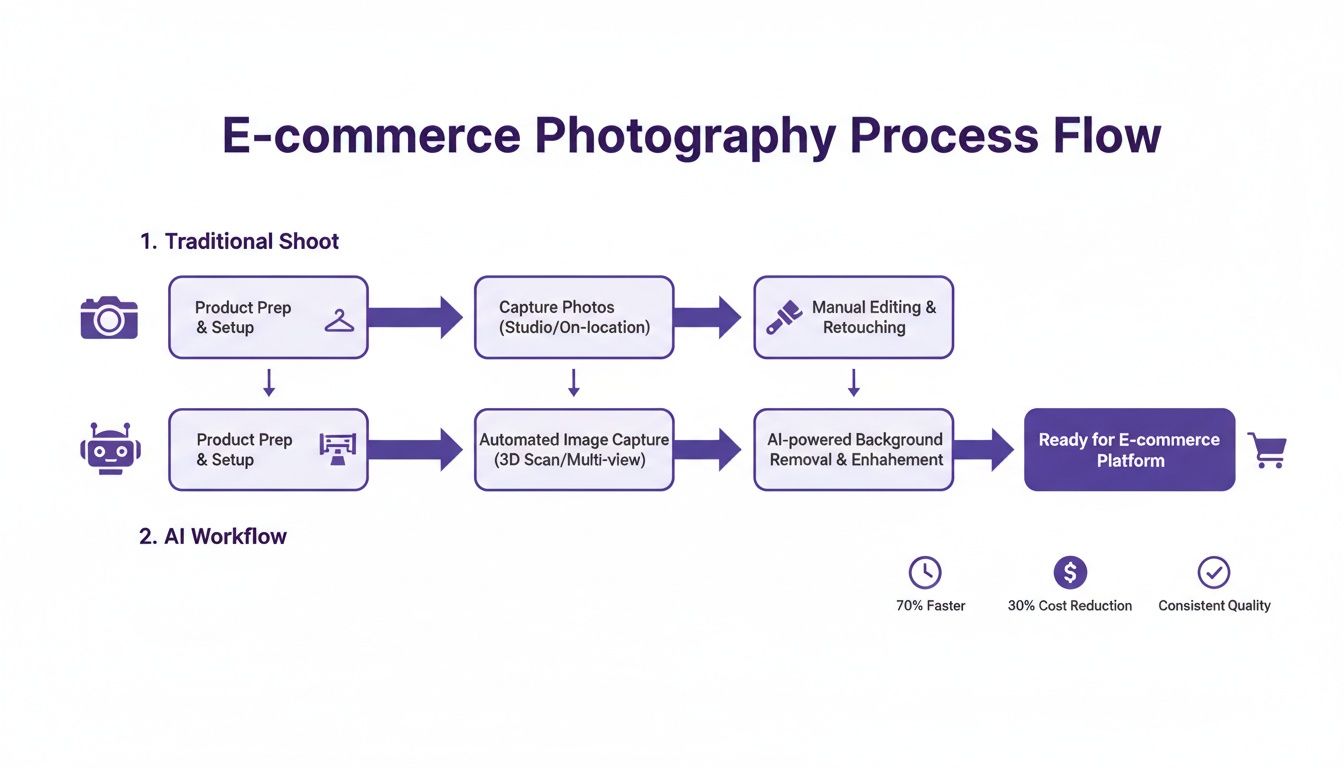
As you can see, an AI-driven approach collapses multiple expensive, time-consuming steps into a single, streamlined digital process.
Takeaway 2: Build a Smarter Shot List for Conversions
Before you shoot your next product, get intentional with your shot list. Your goal isn't just to capture the product; it's to tell its complete story. A great shot list is the blueprint for a product page that actually converts.
Here's your new standard shot list for every product:
- A clean, front-on product shot on a simple, neutral background. This is for pure clarity.
- A back and side view to give a full 360-degree understanding of the item.
- One high-quality detail shot focusing on the fabric, stitching, or a key piece of hardware.
- One aspirational on-model or lifestyle image to sell the feeling and the vision.
This mix of informational and inspirational shots is a proven formula for building trust and pushing customers to click "buy." Of course, getting the shots is only half the battle. To learn how to get those visuals in front of the right people, check out these powerful tips on social media marketing for photographers{target="_blank"}.
Takeaway 3: Calculate Your Potential AI Savings
It's time to get real about the numbers. The biggest roadblock to creating more content is almost always the perceived cost, but AI-powered platforms have changed that game entirely. Your next step is to figure out the exact savings for your brand.
Don't guess — calculate the actual cost difference. Pit what you currently spend on a single traditional photoshoot (studio time, model fees, photographer rates, the works) against the cost of generating 10x the creative assets with an AI platform.
The table below gives you a clear, side-by-side look at how these two workflows stack up at each stage.
Traditional vs. AI-Powered Photography Workflow
| Stage | Traditional Photoshoot | AI-Powered Workflow (with Picjam) |
|---|---|---|
| Planning & Prep | Days or weeks coordinating models, locations, and crew. | Minutes to upload a base photo and select styles. |
| Shooting | 1-2 days of on-set shooting, subject to weather and availability. | No physical shoot needed. Generation happens in the cloud. |
| Model/Location | High costs for professional models, studio rental, and travel. | Zero model or location fees. Access to infinite virtual models and scenes. |
| Retouching | 2-5 days of manual post-production for a limited set of images. | Automated, AI-driven editing and background generation in minutes. |
| Asset Delivery | 1-2 weeks total turnaround time for a handful of final shots. | Near-instant delivery of hundreds of on-brand, ready-to-use assets. |
| Cost | High fixed costs per shoot, typically thousands of dollars. | Low, predictable subscription cost. Up to 90% cheaper per asset. |
This comparison makes the financial and creative benefits crystal clear. You're not just saving money; you're gaining speed and a level of creative freedom that was impossible with traditional methods.
We even built a tool to make this calculation painless. Use the Picjam savings calculator{target="_blank"} to see the precise, data-backed ROI for your business. That number is what will empower you to make a strategic move that frees up your budget and massively accelerates your content output.
Frequently Asked Questions
This is where we tackle the most common, practical questions brand owners and marketers ask about e-commerce photography. Here are some straightforward, actionable answers to help you make better visual decisions for your store.
How Many Photos Do I Need Per Product?
For fashion, the sweet spot is 5 to 8 photos per product. This isn't just a random number — it's the range that consistently gives customers enough visual information to click "buy" with confidence. A complete photo set answers questions before they're even asked, removing doubt and hesitation.
Your go-to shot list should cover these essential angles:
- A clean front shot to establish the main view.
- A full back shot to show how it closes and any rear details.
- A side view to show the garment's silhouette and how it hangs.
- A 45-degree angle shot, which gives a better sense of depth and dimension.
- A detailed close-up of the fabric, stitching, or a unique button to signal quality.
- At least one lifestyle or on-model image to show fit, context, and sell the complete look.
When you combine these informational shots with more inspirational ones, you're not just showing a product; you're telling a complete story that helps close the sale.
What Are the Most Common Ecommerce Photography Mistakes?
So many brands fall into the same traps that quietly kill their sales and chip away at customer trust. Just knowing what they are is the first step toward avoiding them and improving your entire visual game.
The 3 biggest culprits are almost always:
Inconsistent Lighting: When your product photos have different color tones and shadows, your whole brand looks disjointed and unprofessional. Consistency signals that you're a reliable, detail-oriented business.
Inaccurate Color: This is a one-way ticket to a high return rate. If that vibrant red dress in the photo shows up looking like a dull maroon, you haven't just lost a sale — you've created a frustrated customer who won't be back.
Poor Styling: Wrinkled clothes, awkward draping, or a sloppy fit can make even a high-end product look cheap. Good styling is about making the product look its absolute best without misrepresenting how it actually fits.
Each of these mistakes hits your bottom line directly, either by racking up return costs or damaging your brand's reputation for quality.
Can I Use a Smartphone for My Product Photos?
Yes, you can — but with a pretty big "if." A modern smartphone can definitely capture a good starting image, especially if your lighting is perfect and controlled. The cameras on today's phones are surprisingly powerful.
The real challenge, however, isn't taking one good photo. It's producing dozens of perfectly lit, color-accurate, and uniformly styled images that make your entire catalog look cohesive and trustworthy. Doing that with just a phone is incredibly difficult.
This is where a hybrid approach can be a game-changer. You can use your phone to grab a simple, clean shot of your product. Then, a platform like Picjam{target="_blank"} steps in to elevate that basic image, transforming it into a full set of studio-quality on-model and lifestyle photos.
This workflow gives you the scale of a professional studio without the huge investment in gear, time, and people. It's a smarter way to turn basic photos into assets that actually drive sales.
Ready to see what the real cost difference is between your current photoshoots and an AI-powered workflow? Use the Picjam savings calculator to get a precise, data-backed ROI for your brand.
Compare my photography costs now{target="_blank"}

Picjam team
The Picjam team blends AI, product, and creative expertise to eliminate the cost and delay of traditional photography for modern eCommerce brands.