Finding the Best Photoshoot App for Fashion Brands in 2024
Discover the best photoshoot app for your fashion brand. This guide covers how to choose, test, and use AI tools to cut costs and elevate your content.
When luxury brand Casablanca tested AI-generated campaigns, they didn't just create new images — they unlocked a level of creative speed that was previously impossible. Finding the best photoshoot app is about answering one question: can this tool create on-brand, high-quality content faster and cheaper than your current process? For a growing number of fashion brands, the answer is a resounding yes.
How Smart Brands Are Slashing Photoshoot Costs with AI
The days of shelling out thousands for a single photoshoot are numbered. For today’s agile fashion brands, the old model — booking studios, hiring models, and managing complex logistics — is too slow and expensive to keep up with the pace of modern e-commerce.
A brand like Crocs, for example, could see a 60% faster campaign rollout simply by shifting to AI-generated visuals instead of organizing a resource-heavy, multi-day shoot.

Why Traditional Photoshoots Drain Budgets and Time
Traditional photoshoots are a significant financial and operational drain. A single session can easily burn through $5,000 to $10,000 after adding up costs for photographers, models, stylists, location fees, and post-production. All that investment often yields a limited set of images that feel stale in weeks.
This is exactly where AI-powered platforms like Picjam come in. They are built to smash these bottlenecks. By turning a simple product photo into hundreds of on-model and lifestyle variations, brands generate an entire campaign’s worth of assets in minutes — not weeks. This is why McKinsey estimates AI could add up to $275 billion to the apparel, fashion, and luxury sectors' profits.
The numbers below paint a clear picture. We've broken down the costs and time involved in a typical photoshoot versus what you'd see using an AI app.
Cost & Time: Traditional vs. AI Photoshoot App
The difference isn't just incremental. It represents a fundamental shift in how content gets made, allowing emerging brands to compete visually with established giants.
How a Photoshoot App Delivers Unmatched Creative Agility
The real advantage isn't just saving money; it's gaining creative agility. Think about a fast-fashion brand like Zara. Instead of commissioning separate photoshoots for every market, they could use an AI tool to:
- Generate images with models reflecting local demographics in Europe, Asia, and the Americas.
- Instantly place new products in backgrounds relevant to specific regions, like a winter coat in a snowy setting.
- A/B test dozens of creative concepts for ads without spending a dime on additional production.
This ability to create, test, and deploy visuals at speed separates the brands of the future. It’s a move from a rigid, quarterly production schedule to a fluid, on-demand content engine that reacts to trends instantly.
What to Look for in a High-Impact Photoshoot App
Not all AI photoshoot apps are created equal. To find the right tool, look past the promises and zero in on features that produce true-to-life images. The goal is to find a tool that generates assets capable of completely replacing your expensive, time-consuming photography workflow.

Imagine a boutique label like Reformation launching a new dress collection. They need product page shots, social media content, and ad creatives. Instead of blocking out days for a physical shoot, they upload one clean, flat-lay photo of the dress. The app takes over from there.
Core Features That Drive Realism and Consistency
The make-or-break features are those that protect your product's integrity while placing it in a believable, on-brand scene. You need functions that give you surgical control over the final image.
Here are the key features to look for:
- Fixed Product: This is non-negotiable. The feature locks your garment in place, forcing the AI to build the model and background around it. This preserves the exact details, texture, and color of your product without distortion.
- Fit to Model: A great app intelligently drapes clothing onto the AI model, creating natural folds and contours. It avoids the cheap, “pasted-on” look and makes the garment feel like it was actually worn on set.
- Swap Model: With one click, this feature lets you try the same outfit on different AI-generated models. It’s a game-changer for creating diverse campaigns that connect with different customer segments.
For a deeper dive, our guide on the AI product photo generator breaks down how these features work together to create hyper-realistic visuals.
How to Turn a Single Photo into a Full Campaign
Let’s go back to our boutique brand. Armed with a single dress photo, they can use an app like Picjam to build an entire campaign. First, they generate a set of clean, on-model PDP images against a simple background, using the Fixed Product feature.
Next, lifestyle shots. The team generates images of a model wearing the dress in a sun-drenched Italian villa — a scene that would have cost thousands to produce traditionally. Then, for a different aesthetic, they create another set in an urban environment, like a model strolling through SoHo.
Finally, they can spin up countless ad variations by generating close-ups, trying different poses, and using diverse models. This entire process — from one flat-lay to a complete multi-channel campaign — can be done in less than an hour.
How AI Can Transform Your Content Production Workflow
For a fast-fashion giant like Zara, the content machine never stops. The cost and complexity of producing unique on-model imagery for every new SKU across dozens of markets is immense. This is where an AI-powered workflow becomes a strategic necessity.
Instead of coordinating countless photoshoots, Zara’s creative team could upload one clean product shot of a new blouse. From there, using a platform like Picjam, they can instantly generate hundreds of on-model variations. This sidesteps the overhead tied to traditional photography, turning a weeks-long cycle into a single afternoon.
From Global Scale to Granular Targeting
The magic of this workflow is creating hyper-targeted content at scale. For a launch in Japan, the team can generate visuals with models that reflect local demographics. For the Scandinavian market, they can place that same blouse in a minimalist, hygge-inspired setting.
This approach also unlocks powerful A/B testing. Zara could test the same product on 10 different AI models in social ads to see which drives the most engagement, all without a single reshoot. For more on this, our guide on the AI fashion photoshoot offers a great overview.
The data speaks for itself.
Brands using AI for on-model imagery, like the clients of Vue.ai, produce them at one-quarter the cost and 5x the speed of old-school methods. This leads to tangible results, including 87% revenue uplifts and 3x conversion boosts. You can explore more data on how AI delivers these efficiency gains.
Building a Future-Proof Content Engine with the Best Photoshoot App
Adopting the best photoshoot app isn't just about trimming the budget; it's about building a resilient, agile content engine. It allows a brand’s creative vision to finally keep pace with e-commerce, ensuring every product is showcased compellingly for every market.
This strategic shift streamlines operations, multiplies creative output, and ultimately elevates the customer experience. By turning a single SKU photo into a global campaign, brands are building a smarter, more responsive approach to fashion marketing.
How to Run a No-Risk Pilot Test for Your Brand
Jumping into new technology doesn't have to be a huge commitment. A pilot test is your chance to see the real-world impact on a small scale. Committing to the best photoshoot app for your brand shouldn’t be a leap of faith — it needs to be a decision backed by your own data.
A structured test removes the guesswork and shows you what the tech can do with your products. For a brand like Everlane, whose minimalist aesthetic is everything, a pilot would be their way to prove AI-generated images can uphold their clean, elevated brand identity without compromise.
Your Step-by-Step Pilot Workflow
A successful pilot is about having a clear plan. Randomly generating images won't provide measurable results. You need a simple workflow that produces assets you can compare directly.
The whole process is surprisingly straightforward and can be broken down into a few key stages.
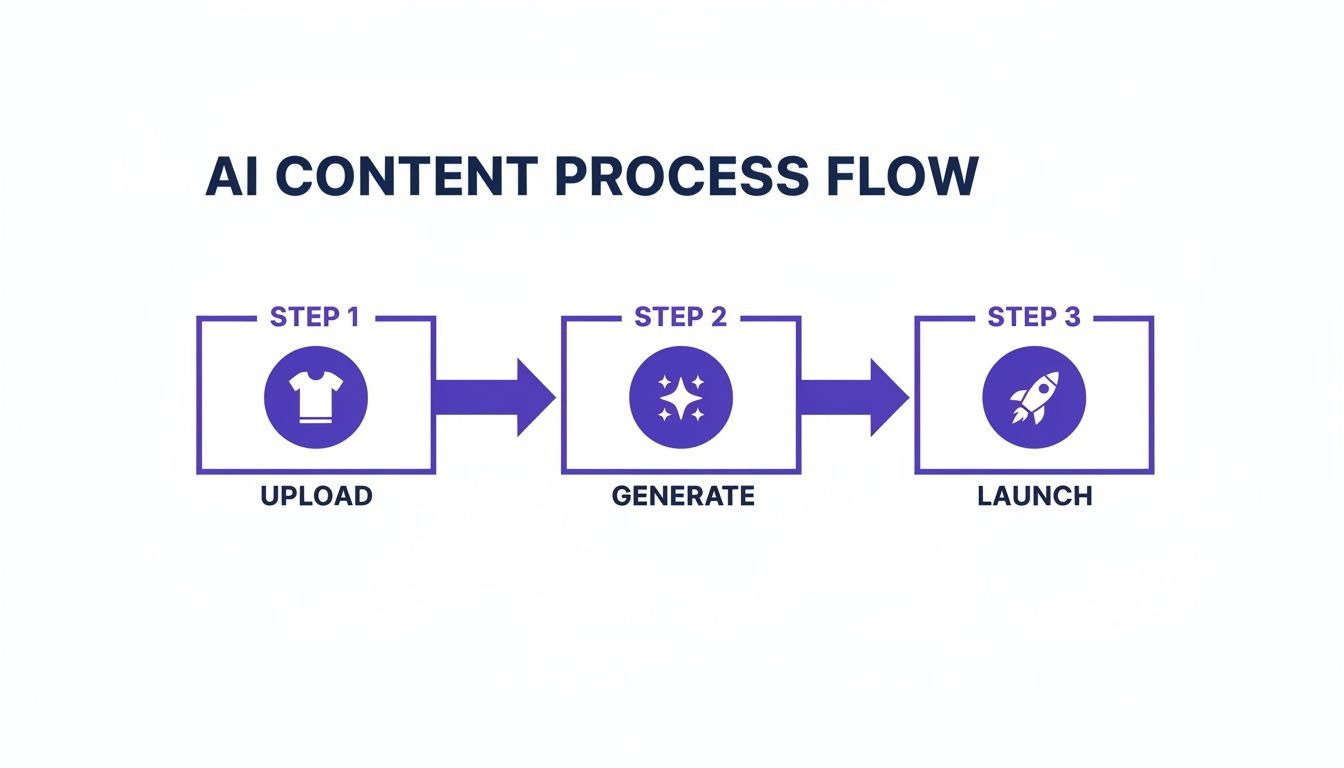
The core AI content workflow is simple: upload a basic product photo, generate a range of on-model and lifestyle scenes, and launch that new content. This model dramatically cuts down the time and headaches of traditional photoshoots.
Setting Up and Executing the Test
First, select 5–10 products. Choose a mix that represents your catalog — perhaps a structured blazer, a flowy dress, and a basic tee. This variety shows how the app handles different fabrics and silhouettes.
Next, prepare your input images. A clean, well-lit photo of the garment laid flat against a neutral background is all a tool like Picjam needs.
With your photos uploaded, start generating. Your goal is a full set of on-model and lifestyle shots for each product. Experiment with different AI models, tweak backgrounds, and test various poses to get a feel for the creative range.
Compare AI outputs side-by-side with your current photography. Be critical. Are the texture and drape realistic? Does the aesthetic feel like your brand? Are important product details sharp and clear?
Finally, run a small A/B test. Swap the new AI-generated images onto a few product pages or use them in a targeted social media ad. Then, let the data talk. Watch metrics like click-through rate, add-to-cart rate, and conversions to get concrete proof of the app's impact.
How to Measure ROI and Build a Winning Business Case
Securing a budget for a new tool isn't about showing off cool features. You need a rock-solid business case proving an AI photoshoot app is a smart financial move. It's about translating slick images into cold, hard ROI.
The argument for AI is about making your entire content pipeline faster, cheaper, and more effective. This breaks down into two kinds of value: hard numbers that hit your P&L, and strategic advantages that are just as critical.
Calculating Your Hard ROI (The Numbers That Matter)
Hard metrics are the tangible, bottom-line numbers that immediately justify an investment. These are the figures your CFO wants to see.
First, get a clear picture of what you're spending now. Our guide on how much photoshoots really cost can give you a benchmark.
Direct Cost Savings: This is your biggest win. We’ve seen apparel brands slash content production costs by 60-70% after adopting AI tools. For a brand like Ganni, which drops multiple collections a year, that could mean saving hundreds of thousands. Data on how AI delivers these efficiency gains backs this up.
Faster Time-to-Market: Speed is money. When you shrink a 4-week production cycle to 4 hours, new products go live sooner. They start making money faster and let you jump on trends while they’re still hot.
Increased Conversion Rates: This is where pilot A/B tests become your secret weapon. If your AI-generated images delivered even a 1-2% lift in conversions, you can project that impact across your catalog. The resulting revenue increase is often significant on its own.
The Strategic Value of Soft Metrics
Soft metrics are about long-term strategic advantage. They are essential for building a brand that's ready for the future.
An AI photoshoot app gives your creative team superpowers. Suddenly, a campaign idea that was "too expensive" becomes feasible. This unlocks a level of creative freedom that wasn't possible before.
Think about a brand like Staud, known for its vibrant aesthetic. An AI tool lets them lock in perfect brand consistency across every image. That consistency builds powerful brand recognition and customer trust.
On top of that, the ability to generate endless variations means they can test new concepts without risk, keeping their marketing fresh. When you put hard numbers next to these strategic benefits, the value is undeniable.
Putting It All Into Action
Getting started with a new photoshoot app doesn't have to be a massive undertaking. A few smart moves will give you the data needed to make the right call and get your team on board.
Get a Baseline of Your Current Spend
Before you even think about new tools, figure out what you’re spending on a single photoshoot. Tally it all up — model fees, studio rental, photographer’s rate, and post-production hours. This number is the benchmark you'll use to measure savings.
Run a Small, Focused Pilot
Don't try to boil the ocean. Pick 3–5 products and run them through a tool like Picjam. Generate a full set of on-model and lifestyle shots. Put them side-by-side with your traditional photography. Compare quality, realism, and brand fit.
Pro Tip: Treat this pilot like a real-world test. Give the same creative brief you’d give a photographer and see how close the AI gets on the first try. The results might surprise you.
Dream Up an "Impossible" Campaign
What's that one creative idea you shelved because it was too expensive? Now’s the time to dust it off. Brainstorm how a photoshoot app could make that "impossible" concept a reality. Could you shoot your winter collection on a Swiss alp without leaving your desk?
This is how you go beyond basic product shots and create compelling visuals for innovative experiential marketing activations without the eye-watering budget. According to recent data, over 15 billion AI-generated images have been created since 2022. It’s a good time to figure out how this shift can work for you.
Frequently Asked Questions
When we talk to fashion brands about AI-powered content, a few key questions always come up. Let's walk through the most common concerns.
Will AI-Generated Models Look Realistic Enough for My Brand?
Yes. The best photoshoot apps today, like Picjam, create hyper-realistic models. These are not the clunky avatars from a few years ago.
Features like ‘Fit to Model’ ensure clothing drapes naturally. With ‘Fixed Product’, your garment’s textures, colors, and details are perfectly preserved. Brands like Ganni or Staud can customize everything from model ethnicity to vibe, ensuring final images match their brand identity.
How Much Does It Cost Compared to a Traditional Photoshoot?
The cost difference is dramatic. A single traditional photoshoot can run $5,000–$10,000. AI photoshoot apps flip this model on its head.
They typically operate on a subscription basis, giving you access to virtually unlimited image generation for a low monthly fee.
On average, brands we work with report saving 60-70% on their content production costs. That’s budget you can push back into marketing or product development.
Can I Maintain My Brand's Unique Aesthetic with an AI App?
Absolutely. This isn't about generic, one-size-fits-all imagery. Leading platforms are designed with brand consistency in mind. You can create and save your own on-brand backgrounds, hand-pick models, and define specific lighting and mood styles.
This lets your team generate a high volume of diverse content that still feels cohesive and true to your brand's visual language. Once created, you can integrate these assets into your broader strategy by exploring effective social media marketing tactics to maximize reach.
Takeaway
- Benchmark Your Costs: Before anything else, calculate the total cost of one traditional photoshoot. This number is the key to understanding your potential savings and building a business case for AI.
- Run a Small, Focused Test: Select 3-5 of your core products and generate a full suite of AI images. A/B test these new visuals on a few product pages or in a social ad campaign to gather real performance data on conversion and engagement.
- Think Bigger Than Savings: The true power of an AI photoshoot app lies in creative agility. Use it to test "impossible" campaign ideas — like shooting a summer collection in a tropical location from your desk — to see how it can elevate your brand's storytelling.
Ready to see how the numbers stack up for your brand? Compare your current photography costs with our free savings calculator and see the potential ROI.

Picjam team
The Picjam team blends AI, product, and creative expertise to eliminate the cost and delay of traditional photography for modern eCommerce brands.