11 Essential Fashion Ecommerce Solutions for Growth in 2026
Explore essential fashion ecommerce solutions to build and scale your brand. Learn how to choose the right platforms, visuals, and tech to boost sales.
By Michael Pirone, Founder of Picjam & Vidico
When Crocs tested AI-generated photos for their spring collection, they discovered a 60% faster campaign rollout. This is the new reality for fashion brands — your tech stack is no longer just a backend system; it’s your primary engine for growth.
So, what are "fashion ecommerce solutions?" It’s the complete tech toolkit that brings a brand’s online store to life. This covers everything from your website platform and product data management to visual content creation and payment systems.
Brands that master this toolkit are not just selling clothes; they are building nimble, data-driven businesses. For instance, platforms like Picjam allow brands to generate studio-quality, on-brand visuals in minutes, turning a major cost center into a strategic advantage.
Let’s break down the essential components every modern fashion brand needs to get right.
How Your Tech Stack Dictates Your Growth Trajectory
The global fashion e-commerce market is on track to hit $905 billion in sales by 2026. While the opportunity is massive, so is the competition.
Your technology needs to work together seamlessly. If one part of your stack is weak, it creates a bottleneck that grinds growth to a halt.
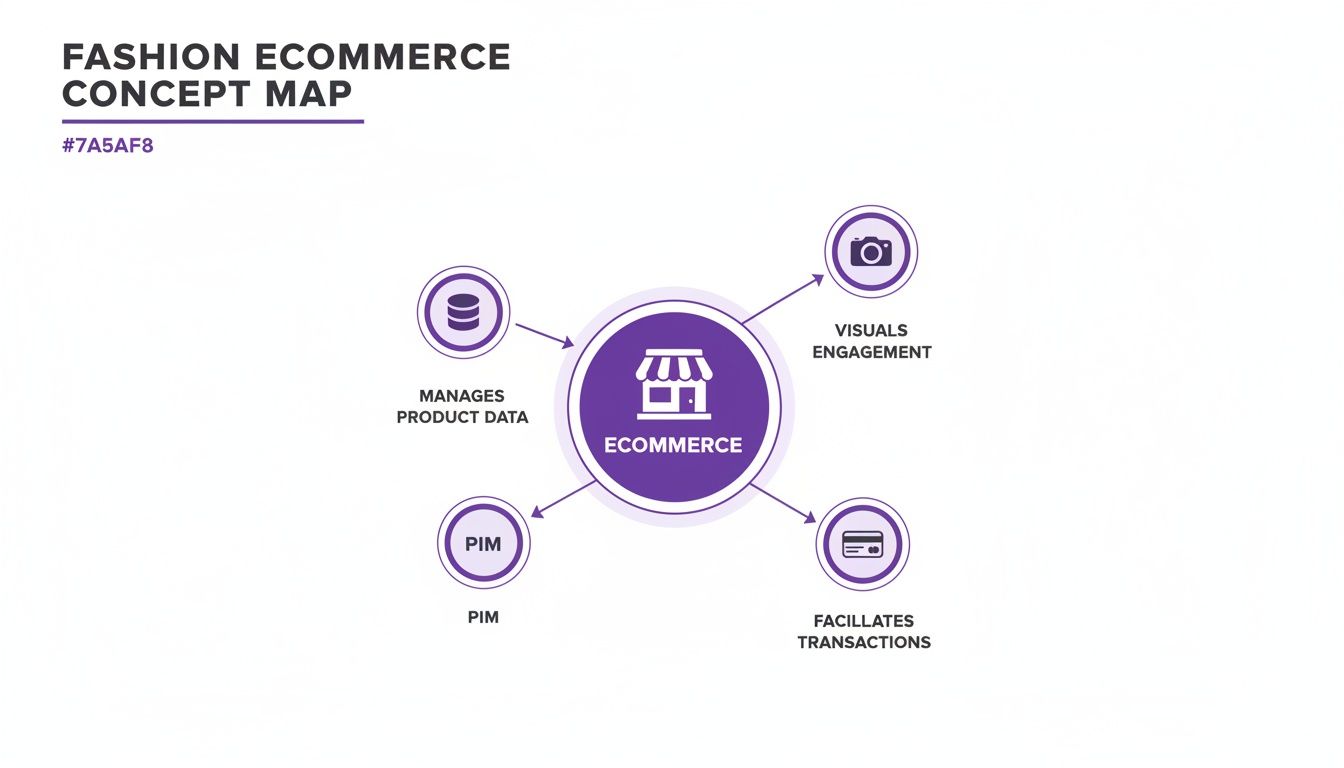
Here’s a breakdown of what each piece does and why it’s critical for fashion.
| Solution Component | Primary Function | Why It's Critical for Fashion |
|---|---|---|
| Storefront & Platform | The customer-facing website and the CMS that powers it. | This is your digital flagship. It needs to be beautiful, fast, and reflect your brand's aesthetic. |
| PIM & Data Management | A central system to manage all product information (SKUs, descriptions, etc.). | Fashion has tons of variants (size, color, material). A PIM keeps this data organized and consistent everywhere. |
| Photography & Visuals | Creating all product images, lifestyle shots, and video content. | Customers can't touch the fabric. High-quality visuals are your only way to convey quality and fit. |
| Payments & Fulfillment | Processing transactions and getting orders to customers. | A smooth checkout and reliable delivery are non-negotiable for building trust and repeat business. |
| Marketplaces & Channels | Integrating with platforms like Amazon, Instagram Shopping, etc. | You have to sell where your customers are. This expands your reach beyond your own site. |
| Marketing & CRO | Tools for email, ads, and optimizing the site for sales. | This is how you attract customers and turn browsers into buyers. |
AI is becoming a critical piece of this puzzle, especially for visual content. This guide will walk you through each system, helping you build a resilient and profitable online fashion business.
How to Choose the Right Ecommerce Platform

Think of your ecommerce platform as your brand’s digital flagship store. This decision will directly impact your brand’s agility, growth potential, and bottom line, making it one of the most critical fashion ecommerce solutions you’ll choose.
The right platform can put you on the fast track, while the wrong one can become a constant source of technical headaches and missed opportunities.
Shopify: The Go-To for DTC Brands
For most direct-to-consumer (DTC) fashion brands, Shopify is the clear starting point. Its reputation is built on being user-friendly, quick to set up, and having a massive app store.
Brands like Allbirds built their empire on Shopify, focusing on product and marketing, not wrestling with server maintenance.
- Ease of Use: Get a polished store live in days, not months.
- App Ecosystem: Thousands of apps for email, loyalty, and analytics.
- Scalability: Shopify Plus offers an enterprise-grade solution for massive traffic spikes.
This combination makes it the go-to for ambitious brands that need to move fast and keep operations lean.
BigCommerce: Built for Complex Catalogs
While Shopify wins on simplicity, BigCommerce shines with powerful, built-in features. It's a favorite among brands with large, complex product catalogs.
If your brand juggles hundreds of SKUs with tons of variants — think different sizes and colors for every item — BigCommerce’s native tools are a huge advantage.
The core difference is philosophy. Shopify offers a lean core with expansion via apps, while BigCommerce provides more comprehensive tools from the start.
Headless Commerce: For Total Creative Freedom
A headless setup separates your front-end customer experience from your back-end ecommerce engine. This gives you absolute creative control, but it requires serious technical resources.
A brand like SKIMS uses a headless architecture to deliver a unique, content-heavy shopping experience that feels incredibly fast and on-brand.
Going headless means investing heavily in a custom-built digital experience. For brands that need to push the boundaries of design, it offers unmatched freedom.
How AI Visuals Can Cut Your Content Costs by 40%
In fashion, visuals are the product experience. When customers can’t touch the fabric, your imagery directly shapes their perception and confidence to buy.
For years, creating these visuals has been a slow, expensive process. A single photoshoot can cost tens of thousands of dollars and take weeks to coordinate.
The Bottleneck of Traditional Photoshoots
The old model of content creation can’t keep up with the demands of a modern digital brand. Marketers need a constant stream of fresh creative for product pages, social media, and ads.
Traditional photoshoots create major bottlenecks:
- High Costs: Studio rentals, photographer fees, and model bookings add up fast.
- Slow Turnaround: It can take weeks or months to get final assets live.
- Creative Constraints: You’re locked into the models, backgrounds, and poses you chose.
This rigidity is a growth killer. It stops brands from reacting to market trends or A/B testing visuals to find out what actually converts.
AI as a Scalable Visual Content Engine
This is where AI-powered platforms like Picjam create a new kind of advantage. AI acts as a force multiplier for your marketing team, automating the tedious parts of image production.
An AI studio transforms simple flat shots into complete, on-brand photoshoots in minutes. It gives marketers the power to generate an endless supply of high-converting visuals at a fraction of the cost.
According to Vogue Business, 73% of fashion executives expect to increase their investment in AI over the next three years. They aren't just chasing hype; they are chasing efficiency and savings.
The impact is immediate and measurable.
Create Diverse Representation: Generate on-brand shoots with a diverse range of AI models that reflect your global customer base.
Generate Endless Backgrounds: Instantly place your products in any environment, from minimalist studio settings to specific lifestyle scenes.
Produce High-Converting Imagery at Scale: Fuel your product pages, social feeds, and ad campaigns with a wealth of visual assets for rapid A/B testing.
This technology allows your team to test more, sell more, and build a stronger brand identity across every customer touchpoint.
How to Streamline Your Backend Operations

A beautiful storefront can only take you so far. The real engine of a scalable fashion brand is the machinery working silently in the background.
Without solid backend fashion ecommerce solutions, you risk disappointing customers with shipping delays and inventory errors. An integrated backend is about building a business that can handle success.
PIM: Your Single Source of Truth for Product Data
At the heart of your backend is a Product Information Management (PIM) system. It's a central library for every piece of product data — your one source of truth.
Fashion products are complex. A single t-shirt might have 5 sizes and 10 colors, creating 50 unique SKUs. A PIM ensures this information is consistent everywhere you sell.
This consistency is vital. When a shopper sees the correct size chart and an accurate description, they feel confident hitting "buy," which helps cut down on returns.
Secure Payments to Build Customer Trust
The payment process must be seamless and secure. Payment gateways are the bridge between your store and your customer's bank.
Choosing a trusted provider like Stripe or PayPal provides instant social proof that a transaction is safe. A clunky or untrustworthy checkout is a guaranteed way to lose a sale.
Fulfillment: The Final, Lasting Impression
The post-purchase experience — fulfillment and logistics — is where you make or break customer loyalty. It's the final touchpoint you have with your customer.
Many growing brands partner with a third-party logistics (3PL) provider. These companies handle warehousing and shipping, freeing you up to focus on product and marketing.
If you're managing logistics in-house, inventory management software is non-negotiable. It syncs stock levels across all sales channels in real-time, preventing overselling.
How to Use MarTech to Acquire and Retain Customers

Once your store is running, the real work begins: growing the business. This is where marketing technology, or MarTech, steps in.
These tools drive traffic, build relationships, and turn first-time buyers into loyal fans. An effective MarTech stack is a non-negotiable part of any modern fashion ecommerce solutions framework.
Email and SMS: Your Direct Line to Customers
Email and SMS platforms are the bedrock of retention. Tools like Klaviyo let you build highly targeted, automated conversations.
- Abandoned Cart Recovery: A simple automated sequence can claw back a huge chunk of lost sales.
- New Collection Drops: Build hype and give your best customers early access.
- Personalized Recommendations: Use purchase history to suggest items they’ll love.
These touchpoints keep your brand top-of-mind and build a relationship that lasts.
CRM: Rewarding Your Best Customers
Customer Relationship Management (CRM) systems and loyalty programs help you understand and reward your best customers. A CRM tracks every interaction a person has with your brand.
This data is pure gold. It helps your marketers pinpoint your most valuable customer segments.
Creating a loyalty program gives customers a tangible reason to choose your brand over a competitor, significantly increasing lifetime value.
CRO: Optimizing Every Click for More Sales
Conversion Rate Optimization (CRO) is the science of improving your website to get more visitors to buy. It’s about using data, not just your gut, to make decisions.
CRO tools like heatmaps show you where people are clicking and where they get stuck. A/B testing platforms let you test two versions of a page to see which one performs better.
This brings your visual content strategy full circle. Using an AI studio like Picjam, brands can generate dozens of visual variations for ads and product pages in minutes.
You can test a single jacket on five different AI models to find the exact combination that drives the most clicks and sales — all without an expensive reshoot.
Takeaway
Building the right tech stack isn't about finding a single, perfect tool. It’s about weaving together an integrated, flexible system where every component makes the others stronger.
Treat Visuals as Your Most Important Sales Driver. Your ability to create compelling images and video quickly and affordably will directly dictate how fast your brand can grow. It’s that simple.
Use AI to Gain a Competitive Edge. Smart brands are moving on from slow, expensive photoshoots. AI tools like Picjam give you the power to generate endless creative, test what converts, and produce studio-grade content at a fraction of the cost.
Build for Where You're Going, Not Just Where You Are. Choose platforms and partners that can grow with you. Every choice should support your five-year vision. A future-proof stack combines a solid operational backend with a fast, flexible, AI-powered visual content engine.
The first step to building a more efficient future is getting honest about your present. How much are you really spending on photoshoots when you factor in all the time, people, and hidden costs?
See how much you could save with our savings calculator and quantify your potential ROI right now.
Frequently Asked Questions
Jumping into the world of fashion ecommerce solutions can feel like a maze. Here are some straight answers to the most common questions I hear from brand owners.
What is the most important ecommerce solution for a new fashion brand?
When you're starting out, two things matter most: a user-friendly ecommerce platform like Shopify and a way to create great visual content without breaking the bank. Your storefront and your visuals have to be in perfect sync.
This is why tools like Picjam are a game-changer for new brands. They let you produce stunning, studio-quality visuals without the crippling cost of traditional photoshoots, leveling the playing field from day one.
How much should I budget for my fashion ecommerce tech stack?
There’s no single magic number. Your budget will depend on your brand's size and goals.
- Startups: A few hundred dollars a month for a Shopify plan and essential apps.
- Established Brands: Tens of thousands of dollars per month for a custom setup.
The key is ROI. Investing in an AI photography solution can slash your single biggest marketing expense: content creation. With a McKinsey report noting that over 80% of shoppers plan to keep their fashion spending the same or even reduce it, you have to be smart with your money.
Can I switch ecommerce platforms later on?
Yes, but it’s a major undertaking. Migrating your store is a complex process that involves moving all your customer, product, and order data.
If this isn't handled by experts, you risk data loss, broken links, and a serious hit to your SEO.
My advice is to choose a platform that can support your growth for at least the next 3–5 years. Prioritize scalability from the beginning to avoid a disruptive and expensive migration later.
Ready to audit your visual content workflow? Use the Picjam savings calculator to see how much you can save by switching from traditional photoshoots to an AI-powered studio. Compare your costs here.

Picjam team
The Picjam team blends AI, product, and creative expertise to eliminate the cost and delay of traditional photography for modern eCommerce brands.