Product Photography App: Transform Fashion Visuals with Efficient Studio Shots
Learn how the product photography app can slash shoot costs, speed time-to-market, and elevate your fashion brand visuals.
How to start saving money
Lorem ipsum dolor sit amet, consectetur adipiscing elit lobortis arcu enim urna adipiscing praesent velit viverra sit semper lorem eu cursus vel hendrerit elementum morbi curabitur etiam nibh justo, lorem aliquet donec sed sit mi dignissim at ante massa mattis.
- Neque sodales ut etiam sit amet nisl purus non tellus orci ac auctor
- Adipiscing elit ut aliquam purus sit amet viverra suspendisse potent i
- Mauris commodo quis imperdiet massa tincidunt nunc pulvinar
- Adipiscing elit ut aliquam purus sit amet viverra suspendisse potenti
Why it is important to start saving
Vitae congue eu consequat ac felis placerat vestibulum lectus mauris ultrices cursus sit amet dictum sit amet justo donec enim diam porttitor lacus luctus accumsan tortor posuere praesent tristique magna sit amet purus gravida quis blandit turpis.

How much money should I save?
At risus viverra adipiscing at in tellus integer feugiat nisl pretium fusce id velit ut tortor sagittis orci a scelerisque purus semper eget at lectus urna duis convallis. porta nibh venenatis cras sed felis eget neque laoreet suspendisse interdum consectetur libero id faucibus nisl donec pretium vulputate sapien nec sagittis aliquam nunc lobortis mattis aliquam faucibus purus in.
- Neque sodales ut etiam sit amet nisl purus non tellus orci ac auctor dolor sit amet
- Adipiscing elit ut aliquam purus sit amet viverra suspendisse potenti
- Mauris commodo quis imperdiet massa tincidunt nunc pulvinar
- Adipiscing elit ut aliquam purus sit amet viverra suspendisse potenti
What percentage of my income should go to savings?
Nisi quis eleifend quam adipiscing vitae aliquet bibendum enim facilisis gravida neque. Velit euismod in pellentesque massa placerat volutpat lacus laoreet non curabitur gravida odio aenean sed adipiscing diam donec adipiscing tristique risus. amet est placerat imperdiet sed euismod nisi.
“Nisi quis eleifend quam adipiscing vitae aliquet bibendum enim facilisis gravida neque velit euismod in pellentesque massa placerat”
Do you have any comments? Share them with us on social media
Urna ut fermentum imperdiet lacus, elementum etiam maecenas libero nunc, suspendisse massa, nisl, elit curabitur feugiat in quis ut nibh enim in tristique aliquam sed vitae dui, dis adipiscing pharetra aliquam turpis turpis nibh rhoncus enim, pellentesque leo laoreet neque in sed bibendum fermentum suspendisse tempus non purus adipiscing suscipit fringilla adipiscing convallis dolor nulla fermentum facilisis ullamcorper ut vehicula tortor libero metus donec velit, tristique fermentum, dictum euismod diam scelerisque enim non pharetra tristique lectus habitant pharetra est id
By Michael Pirone, Founder of Picjam & Vidico
When ASOS trialed AI-generated model images, they saw a significant lift in conversion rates by better matching models to specific markets. This is the new reality for a product photography app — it’s not just a filter, but an entire photoshoot studio powered by AI. These platforms take a single garment photo and generate complete, studio-quality visuals in minutes, handling the model, background, and lighting.
For fashion brands, this means creating a limitless supply of diverse, high-converting visuals on demand, without the crippling costs of a traditional shoot.
How Apps Are Setting the New Pace for Fashion E-commerce
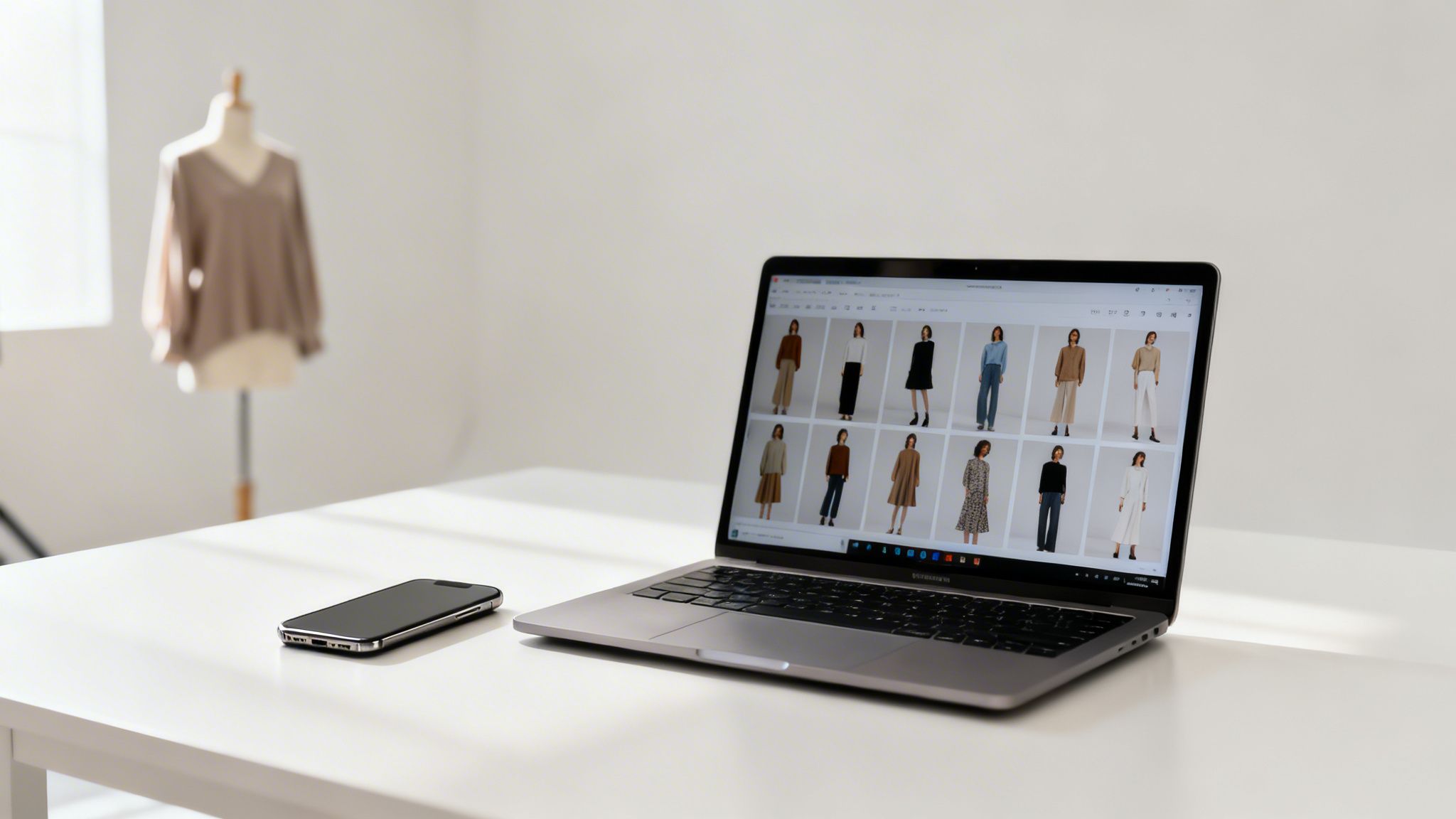
In fashion, speed is everything. For years, content creation was the biggest bottleneck, with photoshoots consuming weeks of time and thousands of dollars.
A modern product photography app shatters this old model. Brands are moving beyond basic editors to AI-powered platforms like Picjam, which can generate a complete photoshoot almost instantly. This is a fundamental shift from slow, manual creation to fast, automated generation.
Accelerate Content Without Sacrificing Quality
This new approach makes high-end visuals accessible to everyone. Instead of juggling complex shoot logistics, brands can produce an entire campaign’s worth of images from a desk.
For fashion brands, these tools wipe out the need for photoshoots that easily cost $500 to $2,000 per product. The advantages are clear:
- Faster Ad Creative Testing: Generate dozens of visual variations in an afternoon to test what connects with your audience without waiting weeks for new photos.
- Greater Model Diversity: Showcase apparel on a wide range of virtual models, reflecting a global customer base and boosting representation.
- Reduced Operational Overhead: Reinvest money once spent on photographers, studios, models, and travel back into growing your business.
As e-commerce demands more dynamic content, this workflow allows any brand to stay agile and competitive.
What Distinguishes a True Product Photography App
It’s easy to confuse a real product photography app with a standard photo editor like Lightroom or Canva. An editor is a tool for manual adjustments — it needs you to be the artist.
An AI-powered platform is the entire art studio, automating workflows that once took days. It doesn’t just refine a photo; it generates a complete, ready-to-publish photoshoot from a single product image.
From Manual Touch-Ups to Automated Photoshoots
Most editing apps are reactive. You snap a photo, then open the app to fix flaws like color balance or blemishes. It’s a linear, one-photo-at-a-time process.
An AI-driven product photography app is proactive. It doesn't just edit; it creates. Understanding this distinction is key to seeing the time and money it saves.
- Simple Editors: Focus on post-production tweaks like saturation and contrast. All creative heavy lifting — styling, finding models, scouting locations — is on you.
- AI Photoshoot Apps: Handle everything at once. They generate the model, create the background, and perfect the lighting from a single shot of your product.
This shift gives smaller brands the creative firepower once reserved for giants with massive marketing budgets.
The Power of Generative AI in Visuals
What truly sets a modern product photography app apart is generative AI. The technology understands context, style, and composition.
It’s the difference between telling a tool to "make this photo brighter" versus "create a campaign for my new sneaker collection, featuring diverse models in an urban setting at golden hour."
This is a massive leap forward. A fashion brand can generate endless on-brand visuals without ever booking a studio or hiring a model. The AI handles the logistics, freeing up your team for marketing strategy.
This allows you to create hundreds of visual assets for A/B testing ad creative or localizing campaigns in a single afternoon. A UK-based brand like ASOS, for instance, could instantly create visuals with models and backdrops that connect with a U.S. audience — all without a new photoshoot.
Key Features Your Fashion Brand Needs

When shopping for a product photography app, it's easy to get distracted by flashy tools. Only a handful of features truly move the needle by cutting costs, sharpening your brand image, and driving sales.
Here is your checklist for what really matters.
AI Model Generation
Traditional model shoots are a logistical and financial headache. AI model generation sidesteps this. You can instantly place your apparel on a range of virtual models right for your audience.
This is about more than savings; it’s about representation. When customers see people who look like them wearing your clothes, they feel a connection.
With an AI-powered app, you can:
- Show true inclusivity: Generate models across different ethnicities, ages, and body types with a few clicks.
- A/B test your audience: Quickly see which model personas resonate best with different customer groups.
- Forget licensing headaches: The images are yours, free and clear, without royalty fees or usage restrictions.
This single feature helps build a more inclusive brand while dramatically cutting your production budget.
On-Brand Background Generation
A photo's background tells a story. A powerful product photography app lets you create custom backdrops that nail your brand identity without scouting a physical location.
Instead of a plain white background, you can conjure scenes that give your products context. A brand selling linen dresses can generate shots in a breezy coastal villa or a chic urban café. You can see how an AI product photo generator makes this simple.
This isn't just about swapping a background; it's about building a world around your product. A great lifestyle shot creates an emotional hook that can boost conversions.
Garment Draping Technology
One of the biggest giveaways of a poor AI-generated image is when clothing looks fake. Advanced garment draping technology is the secret sauce that makes fabric hang, wrinkle, and conform to the model's body realistically.
Without it, clothes can look flat or awkwardly pasted on. Sophisticated draping algorithms analyze your product's shape and material to create a believable fit, preserving texture and detail. This is critical for communicating quality.
Multi-Angle Outputs
Online shoppers rely on images to understand a product. A single hero shot isn't enough. Customers want to see a product from every perspective — front, back, side, and close-ups.
A top-tier product photography app can generate these extra angles automatically from one input image. This is a massive time-saver, eliminating the need to photograph every angle. Giving customers a full view builds trust and is proven to lower return rates.
AI Image Upscaling
Crisp, high-resolution images are non-negotiable for e-commerce. Customers need to zoom in and inspect fabric and stitching. A blurry image screams unprofessional and can kill a sale.
AI image upscaling uses smart algorithms to increase an image’s resolution without sacrificing quality. This guarantees every visual you produce is sharp and clear, whether for a product page, a digital ad, or a high-res Instagram post.
Here's a quick look at how these modern features stack up against a traditional photo editor.
Feature Checklist for a Fashion Product Photography App
| Feature | Traditional Photo Editor | AI Product Photography App |
|---|---|---|
| Model Creation | Manual compositing; requires stock photos | Instantly generates diverse, on-brand models |
| Backgrounds | Manual removal and replacement | Generates unlimited, context-aware scenes |
| Garment Fit | Manual warping/liquify tools; often unrealistic | Automatic, realistic draping and fit technology |
| Multiple Angles | Requires a separate photo for each angle | Generates multi-angle views from one image |
| Image Resolution | Basic resizing; can cause pixelation | AI upscaling for crisp, high-res results |
| SEO Assistance | Not available | Suggests relevant keywords based on image content |
A purpose-built AI app is an engine for creating a visual catalog that's faster, more diverse, and more effective.
How to Integrate a Product Photography App Into Your Workflow

Integrating a modern product photography app can shrink a multi-week photoshoot timeline into a single afternoon.
The key is a simple, repeatable workflow that generates high-quality assets on demand. This approach gives brands a scale once reserved for industry giants.
A Five-Step Blueprint for Instant Visuals
Putting a product photography app to work is about efficiency. This system turns one basic product shot into a full suite of marketing-ready assets.
Here’s a straightforward, five-step process:
Start with One Clean Product Photo. The foundation is a single, well-lit image of your garment. A quick phone shot against a neutral wall is often all you need.
Generate On-Model Variations in a Flash. Upload that image to the app. A tool like Picjam can instantly generate dozens of variations on diverse AI models.
Create Custom Lifestyle and Studio Scenes. Use the app’s background tools to put your product in context. Generate clean studio shots or compelling lifestyle scenes that tell your brand’s story. You can learn how to set up a simple e-commerce shoot studio to complement this process.
Produce Multiple Angles for Your Product Pages. A good app can generate different angles from that one initial image, giving customers a full feel for the product.
Export High-Resolution Images for Every Channel. Once you’re happy, export the final, high-res visuals. The best apps include AI upscaling to ensure your images are sharp and ready for any channel.
Real-World Example: A Startup Launch
Imagine a startup launching a new collection. The old way meant weeks of planning and thousands in costs before the first sale.
With a product photography app, the founder can shoot the collection on mannequins Monday morning. By the afternoon, they have an entire library of on-model photos, lifestyle shots, and studio images ready to go.
This isn't just faster or cheaper — it’s a strategic advantage. The brand can start A/B testing ad creative and building social media hype the same day.
This workflow transforms product photography from a major headache into a nimble, creative asset.
How to Measure the ROI of Your Visual Strategy
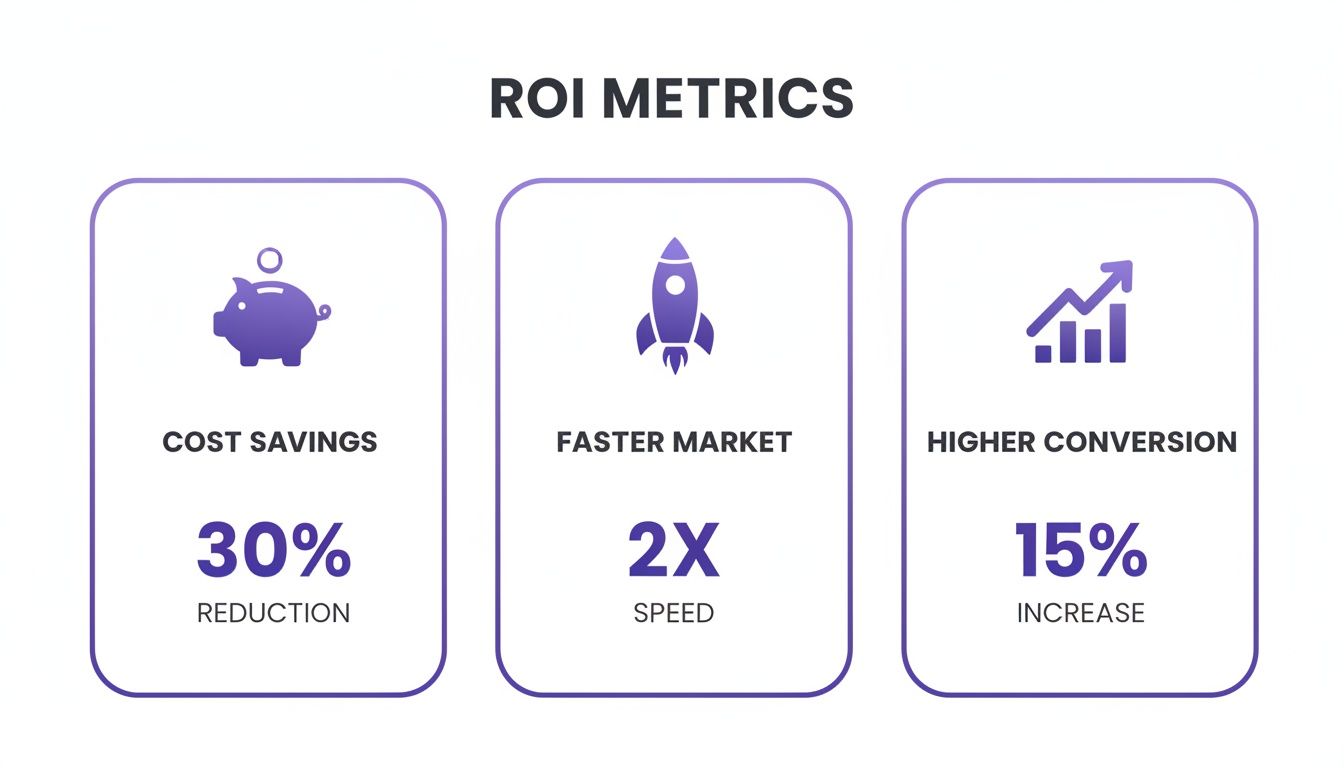
Switching to a product photography app is a business decision. The real proof is in the numbers.
To see what a product photography app is worth, start by defining marketing ROI for your visuals. This framework connects creative work directly to business growth.
Track Direct Cost Savings
This is the easiest metric to calculate. Add up the costs from your last traditional photoshoot: photographer fees, model agency costs, studio rental, and post-production.
Now, compare that to the subscription cost for an app. For many brands, a single traditional shoot costs more than a year of unlimited AI visuals.
Measure Speed to Market
How long does it take for a new product to go live on your store with a full set of images? This cycle can drag on for weeks, acting as a brake on revenue.
A product photography app shrinks that timeline to a single day. If you get products online 14 days faster, that’s 2 extra weeks of sales. Multiply that across all collections, and the revenue boost is serious.
Analyze Conversion Rate Uplift
The real test is whether a photo makes people click "add to cart." A/B testing is the best way to measure this.
Run a test comparing your old product pages with new ones featuring AI-generated images. Show 50% of traffic the old photos and 50% the new ones. Even a small 1% lift can translate into thousands in new revenue. Our guide on creating high-converting AI clothing product photos is a great place to start.
Monitor Ad Performance
A diverse library of visual assets is a superpower for your marketing team. They can generate dozens of creative variations to keep ads fresh and engaging.
Track your Return on Ad Spend (ROAS) for campaigns using AI-generated visuals versus your old photos. You’ll likely see higher click-through rates (CTR) and a lower cost-per-acquisition (CPA) because AI creative can be tailored to specific audiences.
The Takeaway
Adopting a product photography app isn't just a creative tweak — it's a smart business decision that delivers tangible results.
Here’s how to bring AI into your visual workflow.
Your Three-Step Action Plan
Audit Your Current Costs and Headaches. Go back to your last photoshoot and add it all up: photographer fees, model costs, studio rentals, and editing hours. This shows you exactly where to save time and money.
Pinpoint Features That Solve Your Problems. Is your biggest struggle model diversity, consistent backgrounds, or speed to market? Identify your top challenges and look for an app that nails those solutions to get an immediate return.
Run a Small, Low-Stakes Pilot Test. You don’t have to change everything overnight. Pick one upcoming collection and create the visuals with an app like Picjam. Track the cost, time, and team feedback. This gives you data to justify a bigger change.
These tools are what the next wave of agile fashion brands are built on. The first step is figuring out what you stand to gain.
Use our savings calculator to see how Picjam stacks up against your brand's current photography spend: https://beta.picjam.ai/pricing-plans#pricing-calculator
Frequently Asked Questions
Moving from traditional photoshoots to a product photography app is a big shift. Here are the most common questions we hear.
Can an App Truly Replace a Professional Photographer?
The answer isn't about replacement — it's about smarter resource allocation. A product photography app is built to handle the high-volume, repetitive work of creating e-commerce shots for product pages, marketplaces, and social media.
The app automates the grunt work, freeing up professional photographers to shoot the big, brand-defining campaign images that tell your story. The app becomes your in-house studio for everyday essentials, while creative partners tackle the bigger picture.
How Realistic Do the AI Models and Clothing Look?
Realism is a huge deal. The magic behind on-model images that don't look fake comes down to sophisticated draping technology.
The best apps use advanced algorithms to analyze a garment's shape, weight, and fabric from a single 2D photo. This lets the AI determine how the material would naturally hang, fold, and stretch on a person. It preserves crucial details like shadows, highlights, and textile patterns, creating a shot nearly indistinguishable from a real photograph.
What Is the Learning Curve for These Apps?
There shouldn't be much of one. The best platforms are designed for marketers and brand managers, not CGI artists. The whole point is to make content creation faster and easier.
Platforms like Picjam are designed to be picked up in minutes. The workflow is simple: upload a product image, pick a model and a background, and generate your shots. You don’t need special training.
This accessibility means anyone on your team can spin up an entire photoshoot whenever they need to, turning a major production into a simple, everyday task.
Ready to see how much you could save by streamlining your photoshoots? Compare your current costs with Picjam using our savings calculator.
https://beta.picjam.ai/pricing-plans#pricing-calculator

Picjam team
The Picjam team blends AI, product, and creative expertise to eliminate the cost and delay of traditional photography for modern eCommerce brands.