
Mastering Retail Photography in 2026: A Guide for Fashion Brands
Learn how modern retail photography drives sales for fashion brands. Discover workflows, KPIs, and how AI can elevate your visual content strategy.
How to start saving money
Lorem ipsum dolor sit amet, consectetur adipiscing elit lobortis arcu enim urna adipiscing praesent velit viverra sit semper lorem eu cursus vel hendrerit elementum morbi curabitur etiam nibh justo, lorem aliquet donec sed sit mi dignissim at ante massa mattis.
- Neque sodales ut etiam sit amet nisl purus non tellus orci ac auctor
- Adipiscing elit ut aliquam purus sit amet viverra suspendisse potent i
- Mauris commodo quis imperdiet massa tincidunt nunc pulvinar
- Adipiscing elit ut aliquam purus sit amet viverra suspendisse potenti
Why it is important to start saving
Vitae congue eu consequat ac felis placerat vestibulum lectus mauris ultrices cursus sit amet dictum sit amet justo donec enim diam porttitor lacus luctus accumsan tortor posuere praesent tristique magna sit amet purus gravida quis blandit turpis.

How much money should I save?
At risus viverra adipiscing at in tellus integer feugiat nisl pretium fusce id velit ut tortor sagittis orci a scelerisque purus semper eget at lectus urna duis convallis. porta nibh venenatis cras sed felis eget neque laoreet suspendisse interdum consectetur libero id faucibus nisl donec pretium vulputate sapien nec sagittis aliquam nunc lobortis mattis aliquam faucibus purus in.
- Neque sodales ut etiam sit amet nisl purus non tellus orci ac auctor dolor sit amet
- Adipiscing elit ut aliquam purus sit amet viverra suspendisse potenti
- Mauris commodo quis imperdiet massa tincidunt nunc pulvinar
- Adipiscing elit ut aliquam purus sit amet viverra suspendisse potenti
What percentage of my income should go to savings?
Nisi quis eleifend quam adipiscing vitae aliquet bibendum enim facilisis gravida neque. Velit euismod in pellentesque massa placerat volutpat lacus laoreet non curabitur gravida odio aenean sed adipiscing diam donec adipiscing tristique risus. amet est placerat imperdiet sed euismod nisi.
“Nisi quis eleifend quam adipiscing vitae aliquet bibendum enim facilisis gravida neque velit euismod in pellentesque massa placerat”
Do you have any comments? Share them with us on social media
Urna ut fermentum imperdiet lacus, elementum etiam maecenas libero nunc, suspendisse massa, nisl, elit curabitur feugiat in quis ut nibh enim in tristique aliquam sed vitae dui, dis adipiscing pharetra aliquam turpis turpis nibh rhoncus enim, pellentesque leo laoreet neque in sed bibendum fermentum suspendisse tempus non purus adipiscing suscipit fringilla adipiscing convallis dolor nulla fermentum facilisis ullamcorper ut vehicula tortor libero metus donec velit, tristique fermentum, dictum euismod diam scelerisque enim non pharetra tristique lectus habitant pharetra est id
By Michael Pirone, Founder of Picjam & Vidico
When a shopper lands on your product page, they aren't reading your carefully crafted description first. They’re looking at the pictures. In that split second, your retail photography becomes your brand's most important salesperson. It's the digital handshake that builds trust and sparks desire, long before anyone clicks "add to cart."
What Is Modern Retail Photography?

In e-commerce, retail photography has moved beyond simple product shots. It’s a core business strategy — a visual language that tells your brand’s story, signals product quality, and convinces a customer to buy. Great imagery isn't just a nice-to-have; it's the engine driving online sales.
The sheer volume of content needed is staggering. Projections show that over 2.1 trillion photos will be taken in 2026, with a huge portion driven by e-commerce demands. To stand out, your images must do more than just exist; they have to perform.
How Leading Brands Use Photography as a Performance Lever
The smartest brands have stopped viewing photography as a creative expense. Instead, they treat product photography as a performance lever — a strategic asset directly tied to business goals. This shift in mindset is critical.
Every photo on your site has a job:
- Build Trust: Crisp, high-quality images prove your product is the real deal, assuring customers of its value.
- Communicate Quality: Thoughtful lighting and styling signal a premium brand experience from the first glance.
- Reduce Returns: When you accurately show fit, texture, and color, you set clear expectations and help customers buy with confidence.
The Problem With Traditional Photoshoots
The classic photoshoot model is slow, expensive, and a massive bottleneck for fast-moving apparel brands.
Coordinating models, studios, photographers, and stylists for one collection can take weeks and cost tens of thousands of dollars. That process can't keep pace with social media trends and rapid product drops.
This is exactly why platforms like Picjam were built. Instead of a slow, costly workflow, AI-powered tools let you generate an entire campaign of studio-quality, on-model visuals in minutes — for a fraction of the cost.
Traditional vs. AI-Powered Photography Workflow
To see how different the approaches are, let's break down the typical stages of a photoshoot. The table below compares the time, cost, and creative limitations of a conventional shoot versus an AI-driven one.
| Stage | Traditional Photography | AI-Powered Photography |
|---|---|---|
| Pre-Production | 2–4 weeks: Casting models, booking studios, sourcing stylists, shipping samples. | <1 hour: Upload a single photo of your garment. |
| Photoshoot | 1–3 days: Full-day shoot with crew, models, and equipment. | 5–10 minutes: AI generates hundreds of on-model images instantly. |
| Post-Production | 1–2 weeks: Culling, retouching, and color correcting selected images. | Immediate: Images are generated ready-to-use with consistent lighting and color. |
| Total Time | 3–7 weeks | < 1 hour |
| Cost | $10,000–$50,000+ per collection. | A small fraction of the cost, often a monthly subscription. |
| Creative Control | Limited to the shots taken on the day. Reshoots are expensive. | Unlimited variations. Change models, settings, and styles with a few clicks. |
The difference is stark. By transforming a single photo into hundreds of diverse, on-model variations, you're not just creating content faster. You're making it smarter and more scalable.
From Hand-Drawn Ads to AI-Powered Campaigns
The history of retail photography is a story about the endless chase for a customer’s attention. Before cameras, brands relied on hand-drawn sketches to sell wares in catalogs. Photography turned advertising from informational to aspirational.
That shift was a slow burn. When Condé Nast bought Vogue around 1909, it kicked off a new era of visual commerce by pioneering high-quality photographic ads. Edward Steichen's work in 1911 is often cited as one of the first times an artist truly merged their craft with retail photography. He proved an image could sell a dream, not just a dress.
The Explosion of Photographic Advertising
Momentum built fast. By 1920, photos were already in 15% of all advertisements. That number skyrocketed to 80% by 1930, thanks to new portable cameras from companies like Eastman Kodak. You can dig into a more detailed history of commercial photography to see how these milestones paved the way for modern advertising.
Through it all, the goal has stayed the same: use powerful visuals to drive sales. Every technological jump — from black and white to color film, from print to digital — has served that objective.
The Next Leap: Artificial Intelligence
Today, we're at another pivotal moment. Artificial intelligence is the next logical step, not to replace human creativity, but to unlock it by tearing down old barriers.
For decades, creating high-quality, aspirational fashion campaigns was a luxury only legacy brands with bottomless budgets could afford. AI flips that script, giving emerging brands the same visual firepower.
Platforms like Picjam are on the front lines of this shift. With AI, a small DTC brand can now generate a full suite of on-demand, studio-quality images in minutes.
How AI Gives Modern Brands an Edge
Instead of sinking weeks and tens of thousands of dollars into a traditional photoshoot, brands can now upload a single photo of a garment and get back hundreds of unique, on-model photos. This new workflow lets them:
- Test creative ideas instantly without the financial risk of a failed shoot.
- Launch localized campaigns with diverse models who genuinely reflect a global customer base.
- Jump on trends in real time, churning out fresh content for social media and ads as fast as culture moves.
This isn’t some far-off future for retail photography; it’s what's happening right now. AI gives a new generation of fashion brands the power to connect with customers through visuals, continuing the journey that started over a century ago.
Building an Efficient Retail Photography Workflow
That perfect product shot didn't happen by accident. Behind every great image is a deliberate, well-oiled process. A repeatable retail photography workflow is the secret to creating consistently high-quality visuals that drive sales.
A solid workflow gets rid of guesswork. It breaks down into three key stages: pre-production (the plan), production (the shoot), and post-production (the polish). New tools are completely changing how brands manage them, shrinking timelines from weeks to hours.

As you can see, AI represents a huge leap in efficiency for creative teams.
Pre-Production: Planning Your Visuals
This is where the magic begins. A successful pre-production phase lays the foundation and prevents costly reshoots.
- Creating a Mood Board: This is your visual North Star. Collect images that capture the exact look and feel you're aiming for.
- Developing a Shot List: This is your non-negotiable checklist. It details every angle, composition, and variation required for each product.
- Styling and Sample Prep: Every garment needs to be steamed, lint-rolled, and prepped. Plan each outfit down to the accessories.
In a traditional setup, this stage involves weeks of booking models and studios. With an AI platform like Picjam, pre-production gets back to basics. You focus on the creative — the mood board and a single photo of your prepped garment.
Production: Bringing the Vision to Life
Production is go-time. In a traditional studio, this is a high-pressure day with a photographer, model, and stylist working to execute the shot list.
Key priorities during a classic shoot:
- Lighting Consistency: The lighting setup must be locked in to ensure a cohesive look across the collection.
- Model Posing: The model needs clear direction to show off the garment’s fit, drape, and details.
- Technical Execution: The photographer manages camera settings to capture sharp, well-exposed, and color-accurate images.
The biggest risk is that what you shoot is all you get. If you miss an angle, you’re stuck with it or facing a costly reshoot.
Post-Production: Refining and Optimizing
Once the shoot wraps, the work moves to editing. This is where raw files become polished, e-commerce-ready assets. For a closer look, check our guide on the end-to-end product photography workflow.
A consistent editing style is as much a part of your brand identity as your logo. It creates a professional shopping experience that builds customer trust.
The standard post-production steps:
- Culling: Sifting through hundreds of photos to pick the best ones.
- Retouching: Cleaning up imperfections like dust, wrinkles, or stray threads.
- Color Correction: Fine-tuning colors to match the physical product, which is crucial for reducing returns.
- Formatting and Resizing: Cropping and exporting images for your e-commerce platform and marketing channels.
This stage is a huge bottleneck. AI-powered generation practically eliminates it, producing images that are already retouched and color-corrected, turning a week-long marathon into an instant delivery.
Technical Standards for High-Converting Images
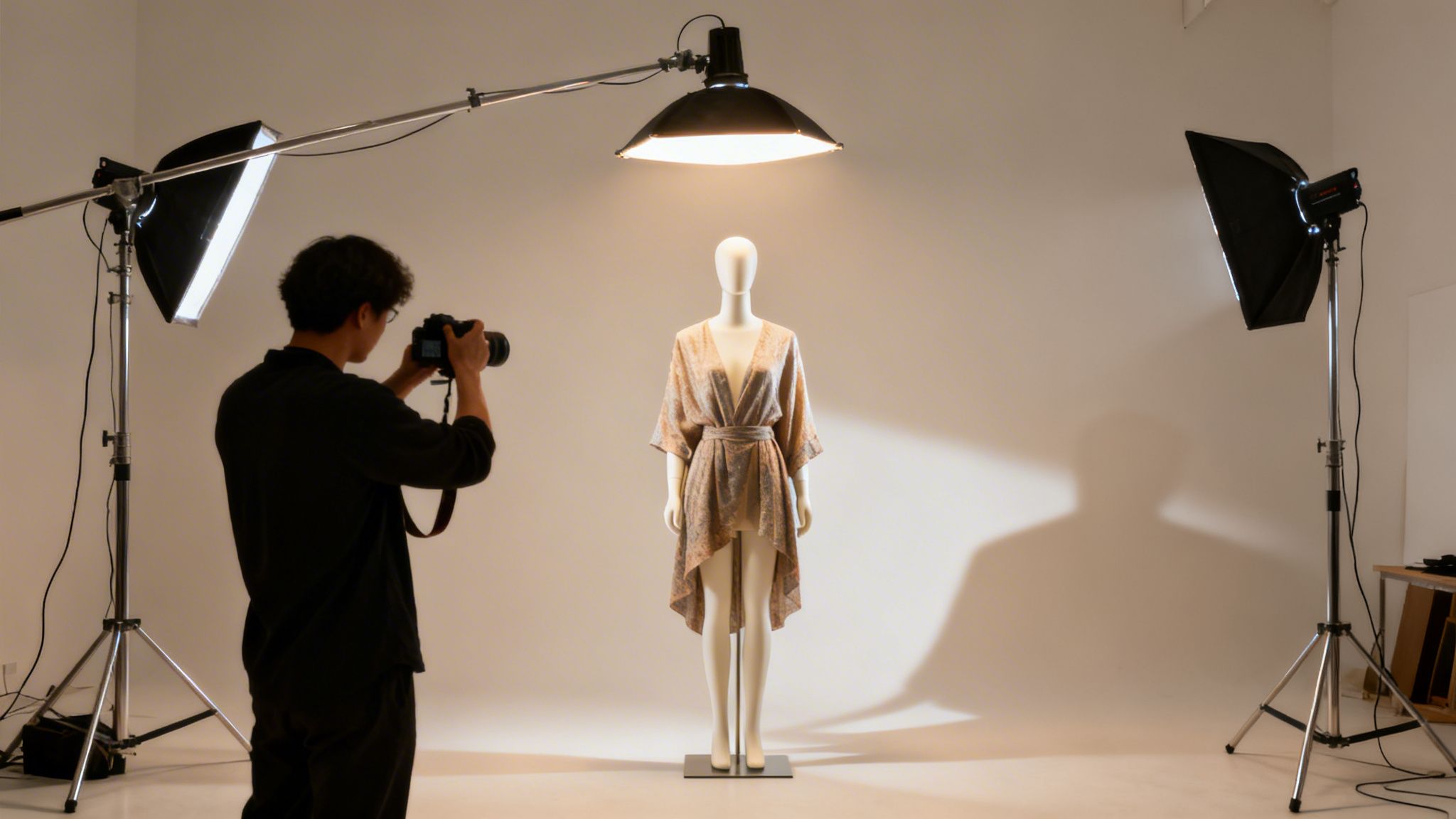
In retail photography, technical details build trust and drive sales. When a customer zooms in, they expect to see fabric texture, not a blurry mess. Pixelation or weird lighting screams "amateur," making a shopper think twice.
Your product images are your digital storefront. Getting the technical standards right means your shop always looks polished and professional.
Mastering Lighting to Sculpt and Define
Lighting is everything. It’s about using light to shape the garment, define its texture, and give it life. The classic three-point lighting setup is an industry standard for a reason — it works.
Imagine you're lighting a blazer on a mannequin.
- Key Light: Your main, brightest light source, positioned off to one side. It carves out the main shape of the blazer.
- Fill Light: On the opposite side, this softer light "fills in" dark shadows, revealing details without making the image look flat.
- Backlight: Placed behind the product, this light separates it from the background with a crisp outline that makes the blazer pop.
This combination gives the product depth and makes it feel tangible. Tools like Picjam now automate this, applying lighting principles to deliver studio-quality results without a physical studio.
Composition and the Rule of Thirds
How you frame the shot is just as important as how you light it. The Rule of Thirds is a simple but effective tool. Imagine your screen is divided into a 3x3 grid.
Instead of dead-centering the product, try placing it along one of the lines or at an intersection. This creates a more balanced, dynamic image. When applied consistently, your whole store feels cleaner and more high-end.
Consistently applied technical standards — from lighting to resolution — are the foundation of a trustworthy brand experience. It silently tells your customer, "We care about the details."
Resolution and File Size: The Balancing Act
For modern e-commerce, high-resolution images are non-negotiable. Customers expect to zoom in. As a rule of thumb, images should be at least 2048 x 2048 pixels for a crisp zoom experience.
But high-res images can slow your website. The trick is optimization — compressing file size without a noticeable drop in quality. We get into the nitty-gritty in our guide on product image size for Shopify.
Getting these technical standards right removes friction. Every sharp, well-lit image erases doubt and brings your customer one step closer to checkout.
How to Measure the ROI of Your Visual Content
Great images are an investment, not an expense. If you can’t measure the business impact of your retail photography, you’re flying blind. The goal is to move past "this looks nice" and make objective, data-driven decisions.
The history of product photography is a story about ROI. It started in the late 19th century with still-life shots driving catalog sales. Today, it's a massive $11.5 billion market, according to 2022 IBISWorld data. McKinsey reports that the right images can lift conversions by up to 40%. You can dig deeper into the evolution of the photography market to see its full commercial impact.
Key Metrics to Track
To understand how your images perform, track these key performance indicators (KPIs).
- Conversion Rate: The percentage of visitors who make a purchase. The ultimate test of your images.
- Add-to-Cart (ATC) Rate: The percentage of visitors who add a product to their cart. This signals purchase intent.
- Product Return Rate: A lower return rate is a huge win. It's a sign that your photography sets accurate expectations.
Connecting these KPIs to your visual content lets you stop guessing and start making smarter, more profitable decisions.
A/B Testing Your Visuals for Higher Conversions
The best way to figure out what your audience loves is to let their actions tell you. A/B testing is simple: show two different versions of an image to two groups and measure which one performs better.
For example, you could test:
- A studio background vs. a rich lifestyle setting.
- A smiling model vs. one with a more neutral, high-fashion expression.
- An on-model shot vs. another on-model shot with a different pose.
The goal of A/B testing isn't to find one "perfect" image. It's to build a continuous feedback loop that helps you learn what your customers respond to.
For a long time, this kind of rapid testing was out of reach for most brands due to cost. AI-powered platforms like Picjam have changed the game.
Brands can now generate dozens of on-model and creative variations for ads and product pages at a fraction of the cost. This unlocks a level of data-driven creative optimization that was once reserved for the biggest players in fashion.
How AI Is Reshaping Fashion Imagery
Artificial intelligence isn't replacing creative directors. It’s becoming a powerful partner for any fashion brand needing to create visual content at the speed of culture. It delivers speed, scale, and personalization that were out of reach a few years ago.
The conversation in 2026 is no longer about if AI belongs in the creative workflow, but how it gives savvy brands a competitive edge.
Consider Zara. With AI, they can instantly generate campaign images for different markets, using models that feel local to customers in Tokyo, São Paulo, or Dubai. Or a new DTC brand can spin up a holiday campaign in an afternoon without booking a studio.
This is the new reality of retail photography. For a deeper look, you can explore the fast-moving world of AI product photography.
Why Speed and Scale Are the New Competitive Edge
The most dramatic shift AI brings is pure throughput. A traditional photoshoot locks brands into weeks of planning for a finite set of images. An AI workflow collapses that timeline from weeks into minutes.
AI allows brands to test new collections, explore endless creative directions, and connect with a global audience more effectively and sustainably — all while achieving significant cost savings.
This isn't just about getting the same assets faster. It’s about unlocking new capabilities. Brands can now jump on micro-trends, generate fresh ad creative daily, and populate product pages with a rich variety of images.
The Power of Smart Personalization and Testing
AI enables personalization at scale. A brand can take a single product and instantly create dozens of visual stories around it to see what connects with different customers.
- Model Diversity: Instantly generate shots with models representing a huge range of ethnicities, ages, and body types.
- Background Variations: Test a single jacket against a clean studio backdrop, a bustling city street, and a quiet landscape to see which context drives the most clicks.
- Creative Exploration: Experiment with bold styling, different moods, and dramatic lighting without the cost of a full-scale production.
With platforms like Picjam, this kind of creative testing is part of the daily workflow. It hands marketers the data to stop guessing and start making smarter decisions. Of course, fundamentals still matter. Our guide on how to take great product photos covers the core principles.
Takeaway
Treat photography as a performance asset, not a cost. Track metrics like conversion rate, add-to-cart rate, and returns to measure the direct ROI of your visuals. Brands like Zara do this to optimize every campaign for maximum impact.
Define and automate your workflow. Establish a repeatable process for pre-production, shooting, and post-production to ensure brand consistency. Use AI tools to automate repetitive tasks and shrink timelines from weeks to hours.
Use AI to test and personalize at scale. Don’t just produce content faster — produce it smarter. Leverage AI to create endless variations of on-model, background, and styling options. A/B test them to learn what resonates with your audience and double down on what works.
Ready to see how much you could save on your next campaign? Compare your current photography costs with the Picjam savings calculator.

Picjam team
The Picjam team blends AI, product, and creative expertise to eliminate the cost and delay of traditional photography for modern eCommerce brands.

